
LPWire: Elephant Family Grows Again at Disney's Animal Kingdom
(c)Disney
Elephant Family Grows Again at
Disney's Animal Kingdom
It's a Girl! Third Baby African Elephant Calf Born At Disney's Animal
Kingdom Park
The Walt Disney World Resort's
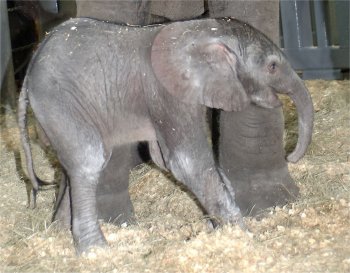
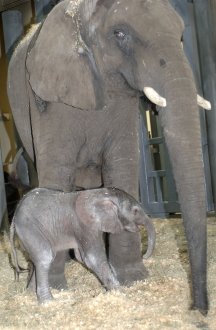
animal care team welcomed a 233-pound bundle of joy to Disney's Animal Kingdom
earlier this week. The female African elephant calf arrived early Monday
morning, and joins her 21-year-old mother Donna after 21 months (gestation) in
the womb. The calf has not yet been named. Both the calf and her mother are
doing well according to veterinarians and elephant managers, who are cautiously
optimistic about the calf's likelihood for survival. The first-time mother
experienced a very short labor, lasting approximately 16 minutes. With
assistance from the animal care team, the newborn became comfortable using her
"newly-discovered" legs and began nursing successfully from Mom soon after her
birth. She is already feisty and very active.
"African elephants are endangered and difficult to breed, and having a
successful birth is a significant event both for the species and for our
talented and experienced team of elephant experts who have been working on this
breeding program for more than five years," said Dr. Beth Stevens, vice
president of Disney's Animal Kingdom Theme Park and President of the American
Zoo and Aquarium Association (AZA). Donna, who is on permanent loan from the
Albuquerque Zoo, became pregnant through natural breeding on March 17, 2004,
when she mated with Jackson, a bull here on breeding loan from the Pittsburgh
Zoo. This arrangement is part of the AZA Elephant Species Survival Plan (SSP), a
consortium of zoos and wildlife parks working cooperatively to conserve
elephants.
"The next critical milestone is for the calf to continue the bonding process
with her mother who will teach her important lessons and protect her as she is
introduced to the herd," said John Lehnhardt, animal operations director for
Disney's Animal Kingdom Theme Park.
Going forward, the focus of the elephant managers and veterinarians at Disney's
Animal Kingdom will be on the health and welfare of the calf and Donna.
In the near future, Guests will be able to see the calf's progress on camera
monitors at Rafiki's Planet Watch at Disney's Animal Kingdom. It will be several
weeks before the calf and her mother will join other elephants on the savanna.
Lehnhardt noted that breeding African elephants is a challenging process, so it
is especially exciting that this is the third African elephant to be born at
Disney's Animal Kingdom Theme Park. A male calf, Tufani, was born in May 2003
and has gained nearly 1,500 pounds in his first two and a half years, and Kianga,
a female born in July 2004, has gained more than 500 pounds in her first year.
Lehnhardt said because many of the elephants giving birth in zoos and wildlife
parks are first-time mothers -- just as several of the elephant cows at Disney's
Animal Kingdom are -- it is not unusual for the animals (both in the wild and in
wildlife parks) to lose their first calf either through a still birth or
following the birth. He is optimistic that observation and interaction with
Tufani have helped the other elephants gain additional maternal knowledge, thus
improving the success rate for the Animal Kingdom breeding program.
(c)Disney
Importance of Breeding Programs
African elephants are classified as endangered species by IUCN, the World
Conservation Union, and their future in zoos and wildlife parks is complicated
as the aging pachyderm population in North American zoos passes its reproductive
prime.
Disney's Animal Kingdom has a breeding program that is part of a cooperative
effort coordinated by the AZA that is focused on sustaining the elephant
population in North America.
AZA's Elephant Species Survival Plan (SSP) has called for a five-fold increase
in African elephant reproduction efforts -- using both natural and artificial
breeding methods -- in order to create a self-sustaining elephant population
among North American zoos and wildlife centers.
Preparing for a newborn
In the same way that people prepare their homes for a newborn baby, the staff at
Disney's Animal Kingdom took steps to "baby proof" the elephant habitat to
ensure that there were no hazards for a young elephant calf. The team has taken
a critical look at the habitat and made many changes, including planting more
trees and shrubbery for shading purposes, closing gaps between boulders, and the
installation of a shallow pool behind the scenes where the calf will be able to
explore the water and learn to swim in a safe environment.
High-Tech Pregnancy
Donna received extensive pre-natal care during her pregnancy. In addition to
regular ultrasounds, veterinarians and elephant managers monitored her hormonal
levels on a daily basis to help them determine when she would give birth. She
has been receiving around-the-clock attention from the animal care team over the
past few weeks as the birth became imminent.
Disney's Animal Kingdom Theme Park is accredited by the American Zoo and
Aquarium Association (AZA). With its more than 200 accredited members, AZA is a
leader in global wildlife conservation and your link to helping animals in their
native habitats. For more information, visit http://www.aza.org .
--Posted December 20, 2005
Source: Walt Disney World Resort