
New Pin Releases and June 24th Workshop Coverage
Page 6 of 7
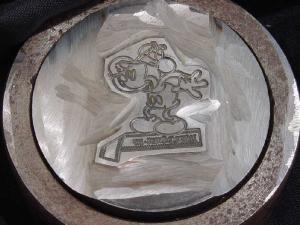
Part of the LE Filmstrip series
"Most of the pins that I see in the park today, I would venture to say that less than 10% are actual true cloisonné. And the reason for that is, if you look at cloisonné... there are only about 130 colors... cloisonné is basically ground glass, that's ground into a very, very fine powder and mixed with a glue substance into a sticky paste and a spatula is used to fill in the pin. The problem with cloisonné... first of all it takes a higher temperature to fire it, so you don't get the clarity. Plus, if you look at some of your pins and there's a grainy-ness to it - the colors aren't really bright, it's because cloisonné is very limited in color." You can also see the grainy-ness in the pins and the overall gray cast to the colors is a way to determine if the pin is a true cloisonné.
The color range is just one of the advantages to hard enamel pins, sometimes called soft-cloisonné, price is also a factor as true cloisonné is much more expensive to produce. "We can have any color that Disney specifies or that the artist specifies, literally by numbers. If any of you are in the graphics field, there's a book called a Pantone chart and there are literally thousands of colors. Bottom line is each color has a corresponding number. So if Mickey's flesh tone is PMS162 that's exactly the color that we use... Mickey's pants, I believe are 185." After every color is set in the pin a worker will go over a tray of pins with a blowtorch to "set" the colors. So if a pin has 10 colors it is "set" with the flame 10 times. A hard enamel pin is very durable, "And may outlast even you and I." he joked.
"The margin for error is about zero. These people are true artisans. It takes about 6 months before anyone is put on line." Mario noted. The labor required for some pins is intense. "Some of the pins on the park have 20 colors, if you have the Rafiki pin, that's 21 colors." After the colors are applied and the colors are set the pin will be buffed on a wheel and smoothed. "There are 8 different stages of quality control", Mario notes, and still a pin may sneak past the factory. "When you're talking about the hundreds of thousands if not millions of pins that are manufactured in the factory in any given year the percentage of errors is very, very small."
The final step from the buffer to quality control is to the plating. "All pins start off with a brass color. It's not until the final stage where they're actually putting it into an electroplate. Depending on which basket they put it in determines the color... gold, there's silver, there's black and every once in a while you'll see copper. It doesn't effect the color or the enamel at all, just the finish of the metal." Mario noted, "Generally speaking a factory that does plating will not only do plating for pins also does plating for other jewelry or auto parts." So you may see a batch of pins being plated with a batch of car gas caps or costume bracelets.
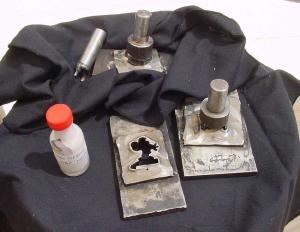
Tools of the pin making trade
In the photo etched process a sheet of brass is photo etched then developed in an acid bath which fixes the positive image to the metal, washing away just enough of the metal to create a well for the colors to be applied. Unlike traditional photographic processes, this can all be done in the light, no dark room is required. Hundreds of pins can be manufactured on a single sheet of brass and then processed into pins. "The colors are not very deep, but the process is pretty cool." The pins are not fired as with enamel but are run through a planer to shave off a layer of paint to smooth the surface. Another technique used is silk-screening, in which detail is added to a pin with a screen process, exactly as a t-shirt or a lithograph is screened. "Some of the details in the pins is really, really minute."