
T.J. Detweiler Goes Big: Celebrating 25 Years of “Recess: School’s Out”


When Recess: School’s Out hit theaters on February 16th, 2001, it felt like the ultimate reward for fans of the ABC One Saturday Morning staple. Based on the hit series Recess, the film took the playground politics of Third Street School and raised the stakes to near James Bond proportions, with a tractor beam, a lunar perigee, and a plot to eliminate summer vacation forever. Twenty-five years later, the movie remains a fascinating time capsule of late-1990s Disney TV animation — ambitious, slightly unhinged, and deeply sincere about the importance of kids being kids.
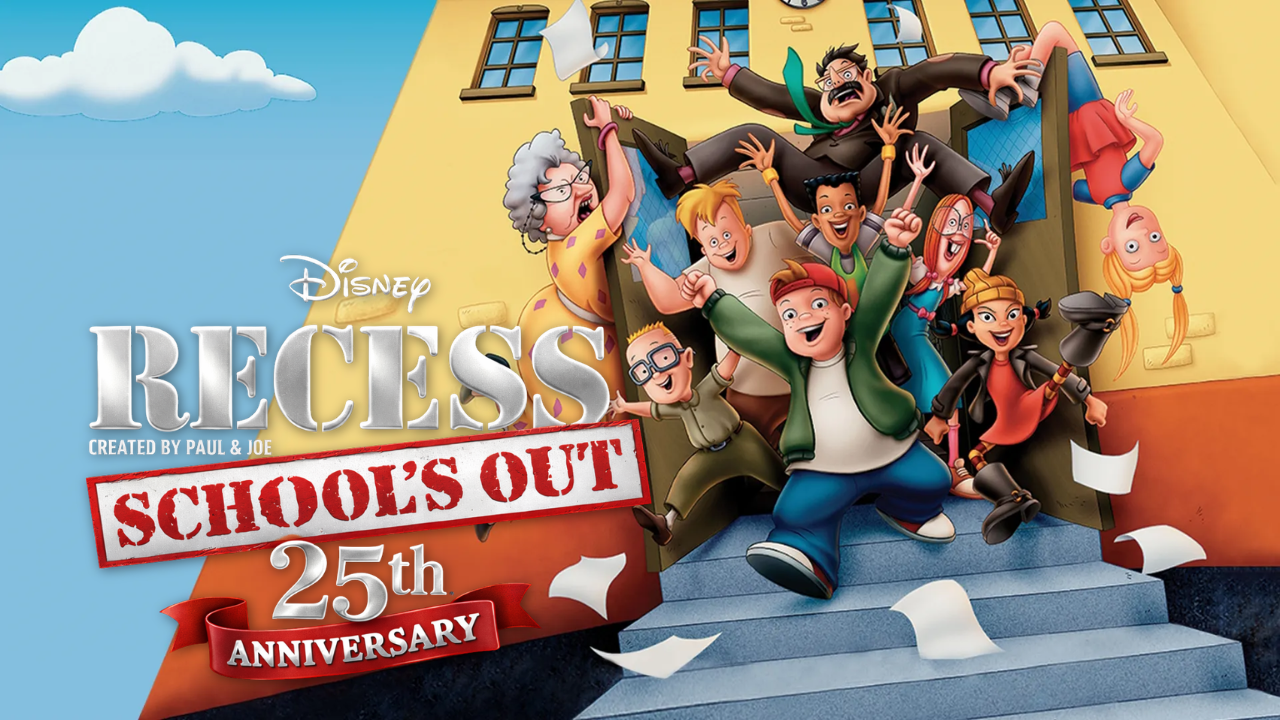
Premiering on ABC’s One Saturday Morning block on September 13th, 1997, Recess quickly became one of Disney’s most beloved animated series. Across 65 episodes and four seasons, it transformed elementary school hierarchies into a fully realized social ecosystem, with T.J. Detweiler (Andrew Lawrence) leading a tight-knit gang that included Vince, Mikey, Gretchen, Spinelli, and Gus.
By 2001, Walt Disney Pictures saw theatrical potential in the brand. Produced by Walt Disney Television Animation and distributed by Buena Vista Pictures Distribution, Recess: School’s Out arrived in theaters towards the end of the show’s original run — a rarity for a TV-to-film adaptation at the time. The film grossed $44.5 million worldwide against a reported $23 million budget. Critical response was mixed, but audiences showed up. For fans, it wasn’t just an extended episode — it was validation that their favorite playground crew deserved the big screen.
The premise is gloriously over-the-top: after a group of mysterious men steal a top-secret device from a military base, they set up shop inside Third Street School. T.J., devastated that his friends are heading to separate summer camps, begins noticing strange activity at the school — including a tractor beam aimed at the moon. The mastermind behind the plot? Dr. Phillium Benedict (voiced with delicious menace by James Woods), a former friend of Principal Prickly (Dabney Coleman), who was once fired for attempting to abolish recess to improve test scores. Now a disgraced former Secretary of Education, Benedict seeks revenge by creating a permanent ice age — forcing children indoors year-round and eradicating summer vacation forever.

It’s a concept that feels even more pointed today. Beneath the cartoon sci-fi spectacle lies a surprisingly sharp satire about overemphasis on standardized testing, bureaucratic overreach, and the undervaluing of unstructured play.
One of the film’s greatest strengths is how it deepens characters who were often comedic foils on the show. Principal Prickly, long portrayed as a stiff rule-follower, becomes a tragic figure — a man who once fought to protect recess and lost his best friend in the process. His arc culminates in a touching moment when he thanks T.J. for reminding him why he became a teacher in the first place.
The voice cast is stacked with talent. Ashley Johnson returns as Gretchen (and one of the Ashleys), while Pamela Adlon brings edge to Spinelli. The film also features Melissa Joan Hart as T.J.’s sister Becky and the late Robert Goulet providing Mikey’s operatic singing voice — Goulet’s final theatrical film role before his death in 2007. Even the villains are memorable, from Clancy Brown’s imposing security chief “Kojak” to Peter MacNicol’s meek Professor Fenwick.
The film also marked a small but notable moment in Disney music history. In the U.S., the end credits featured “Dancing in the Street” performed by then-new Buena Vista Records artist Myra, who would later score a breakout hit with “Miracles Happen” for The Princess Diaries later that same year. In the UK, the song was replaced with a version by Atomic Kitten — a reminder of how global marketing strategies were already shaping Disney releases in the early 2000s.
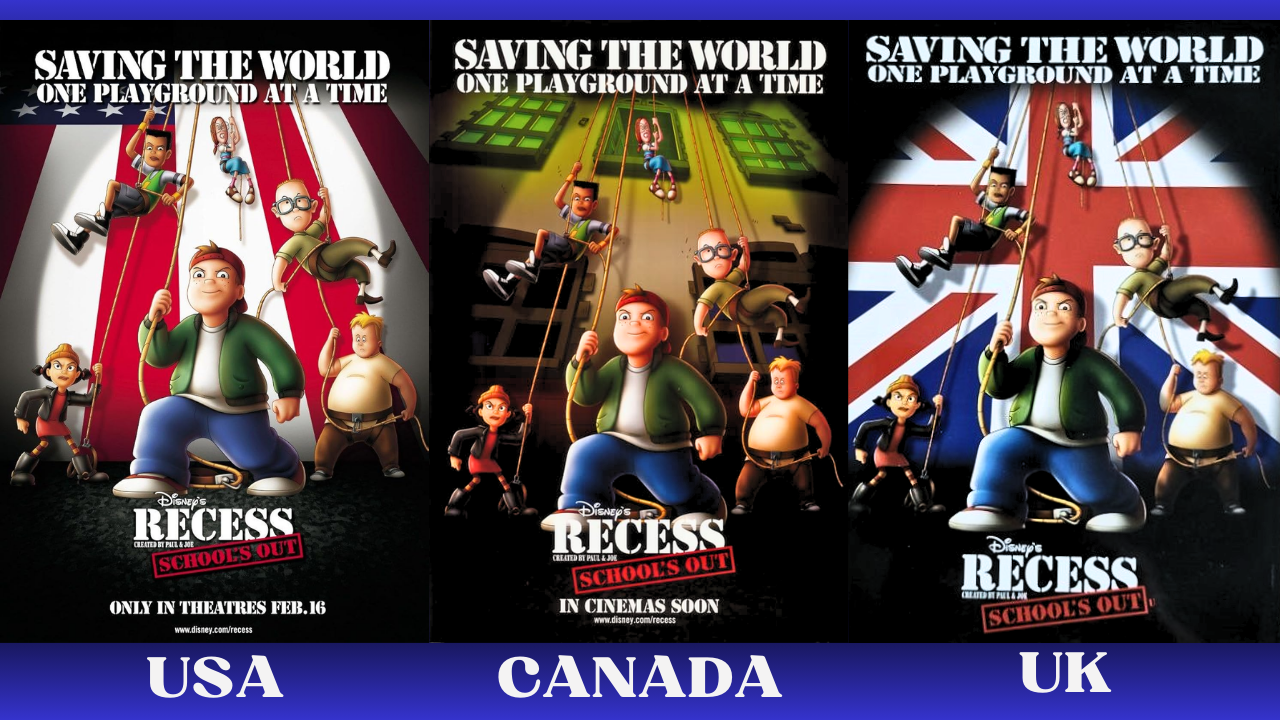
Poster art for the film featured the kids descending from ropes in front of the American flag. For international releases, the flag was changed to Third Street School with green, glowing windows. The exception to this rule was the UK, where the American Flag was replaced by the Union Jack, even though the film was set in the USA.
Recess: School’s Out arrived during a transitional moment for Disney television animation. The original series concluded later that year on November 5th, 2001. While the franchise continued with direct-to-video films like Recess Christmas: Miracle on Third Street, All Growed Down, and Taking the Fifth Grade, the theatrical feature stands apart. It gave the playground the epic scale it always deserved.
More importantly, it preserved something essential about childhood. The film argues — loudly and literally — that recess and summer vacation aren’t luxuries. They’re vital. They’re the spaces where friendships form, imagination thrives, and leadership skills are forged in kickball games and dirt patches. In a media landscape increasingly driven by franchise escalation, it’s refreshing to look back at a movie that escalated simply to defend the joy of not having homework.
Twenty-five years later, Recess: School’s Out feels almost prophetic. Conversations around academic pressure, screen time, and the importance of play are louder than ever. The movie’s core message — that kids need space to be kids — hasn’t aged a day. And neither, in many ways, has T.J. Detweiler’s rallying cry.
When the final scene ends with the gang deciding to spend their summer together — and Principal Prickly reminding T.J. he’ll still face consequences in September — it perfectly captures the balance between rebellion and responsibility that defined the series. It may not have reinvented animation. It may not have earned universal acclaim. But 25 years later, Recess: School’s Out remains a joyful, slightly chaotic, big-hearted tribute to the sacred institution of summer vacation. And for that alone, it deserves an A+.
Recess: School’s Out is streaming on Disney+.