
An Interview with Steve Anderson - Director, Meet the Robinsons
Page 2 of 5
RW
Who was your head of story?
SA
Don Hall. He’s been a story artist at Disney for a long time. I started with him on “Tarzan�? back in ’95 and he’s been a real close friend and colleague. He was fantastic at also setting that mood and setting the tone for the team. So I really think that’s what the whole process is about. Even beyond the story room, in all areas of production it needs to be a safe room and everybody needs to feel like they’re there to create and collaborate and make the movie great. It doesn’t matter whose idea is the best one, it just needs to get up there on the screen.
RW
You know it’s a very difficult zeitgeist to maintain. This industry in general, and animation in particular, aspire to that but very seldom really manage to achieve it. In fact, I can think of several high-profile people in animation who have left Disney and gone elsewhere looking for that and were lured with the promise of it, but ultimately didn’t find it. I sincerely worry that others who follow even now won’t find it, either. There’s plenty of good intention on the part of some other studios to create that ideal safe environment, but the reality is frequently, unfortunately, quite the opposite.
You’ve been really lucky, and I have to say that one of the things I’m really pleased by – and I say this in spite of my doing so much editorial writing about the animation industry and Disney in particular, uhm …. I’m loathe to read and hear speculation and insider opinions about what’s happening on a project that’s still in production. I do hear it all the time, and I talk to folks like you and to colleagues and close friends at the Studio, and I frequently know the gory details, but over the years I’ve been reticent to write about it because by and large the leaks about the changes in story, or shifts in a character or plot line just lead to everybody judging it much too soon – way before the facts are in. And by facts I mean the completed film. Speculation and insider tale-telling two, three years out – or even just a year or less out, I think does more harm than good. So I guess what I started to say was that one of the things that I’m very happy to know about John Lasseter and Ed Catumul is that they keep a tighter lid on things. But you’ve been really lucky. There wasn’t too much of that speculation and inside leaks on this film, and it seems to me that you had a uniquely safe production period.
SA
Yeah, it is weird how little people do know about the movie. I know, being in the industry a long time I tend to find out about everything that’s going on from colleagues that work at the studios, through the grapevine and all that. I have talked to a lot of friends at other studios about our movie and they really don’t know all that much about what’s going on. I mean they know it exists, obviously, but it’s interesting how there isn’t a lot of “Oh, I heard that this is happening on your movie�? or “I know you have a character like this�? or “you have a moment like this.�? Part of that may be because the Studio really, I think, rallied around this movie and embraced it and felt protective of it. I think it’s been the kind of move that we haven’t had for a while because every body really took it into their hearts and, even if they’re not working on it, they see it as being “theirs.�? I think there’s a lot of ownership for this movie. It obviously hasn’t always been that way. There have been plenty of other movies where people feel like it’s their job, they come in, they do their work, they go home, and they don’t really feel invested for a variety of reasons.
RW
Part of it might also be that you were in a very interesting slot. You were like the last kid still living at home when Mom and Dad divorced. Nobody was grousing because they were or weren’t working on it, they were just glad that was at least one, healthy, home-grown survivor during a critical transitional period for the studio. So in many ways you benefited from that transition.
SA
Mmm hmmm. Plus how the film was created was a bit different, too, in that we actually storyboarded all the way through the whole move before we screened any of it. The first time the studio saw the move was the whole movie. None of us had ever experienced that, never sat down and been introduced to a project entirely on story reels from start to finish.
RW
You know you say that none of you had ever experienced that, and it’s kind of sad because not all that long ago it was the norm, not the exception. Think about the fact that Bill Peet went from Smith’s book, to a treatment, to a script, to a full set of storyboards (entirely his own) on “101 Dalmatians�? before anything got tinkered with. In so many ways it makes the most sense.
SA
Oh yeah, I mean first of all I felt really excited that the studio was willing to do something like that, and secondly really honored that our team was the first team to be able to do that, and the fact that as a film maker to be able to make your complete statement that early…I can remember turning to one of the story artists and saying on the day of that screening ‘if they don’t want to make this movie, if we don’t live to see another day on this film, I’ll still feel satisfied because in a way we did get to make it, we did get to tell our story all the way through. Yeah, it could be a lot better, it could be stronger, it could be funnier, the characters could be clearer, but we got to make our complete statement from A to Z and I think that’s really important!
RW
Yeah, it’s critical!
SA
Even just to be able to get your statement out, even if you’re not able to see it through to fruition. But that experience of being able to say “here’s the story I want to tell, do you want to tell it?�? that’s so important.
RW
Yeah, yeah. It just makes so much friggin’ sense. Then it’s much safer to go back in and do the hard work and make big changes where big changes need to be made. For one thing, any of those conversations are much more intelligent and fully informed conversations, versus the frequent sort of pooled ignorance that get tangential with some random scene or sequence without a complete understanding of the story – not just the beat within a story. Any suggestion for refinement or suggestion to turn left or right is coming from a much better understanding rather than the random “oooh oooh ooh, what if you did this?�? suddenly in the middle of your second sentence on page three, which sends so many pictures in the wrong direction…so many pictures both animated and live action.
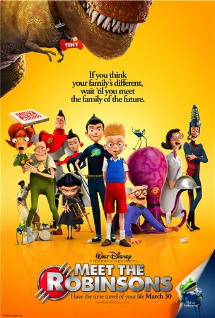
I know that you said elsewhere that you’d like to see a sequel produced. In the lexicon of Disney there have only been two theatrical sequels – Mike Gabriel’s “The Rescuers Down Under�? and of course “Toy Story 2�? – all the others have been direct to video and had little to no involvement of the original creators. Have you and John Lasseter and Ed Catmull discussed the franchise of “Meet the Robinsons�? and your possible involvement, so that the integrity of the continued story of these characters is insured?
SA
No, actually we haven’t. I certainly intend to…depending on how it goes this weekend. It’s definitely something I’m interested in talking to John about because I think there’s a lot of potential for this. The great thing about this kind of time travel movie is that we can really chart the course of some of our characters lives throughout this movie and imply a lot of back story. There’s so much that we can do to fill in the gaps and fill in character moments – the exposition that we were never able to get the movie about who these characters are – all the Robinsons, who these people are, where they came from. But also to continue the story, continue Lewis’s story as he evolves and he grows up and really address that. The next chapter would be adolescence and here’s a kid who…you know, what is Lewis like, how does he carry the inventing thing into being a teenager, what happens to him, what goes on in his mind. I think that there’s a lot that we can do to continue to broaden the universe of the move. So, I’m really anxious to talk to John about that.