
Disney Legend Tony Baxter Reveals the Untold Origins of Indiana Jones Adventure


Disney Legend Tony Baxter took audiences inside the creation of one of Disneyland's most beloved attractions during a special presentation at the ILM Theater in San Francisco on Saturday, April 4th. Hosted by the Walt Disney Family Museum, "Behind the Creation of Indiana Jones Adventure" offered a rare look at three decades of development history, complete with archival footage, early animatics, and stories that have never been publicly shared — all from the Imagineer who made it happen.
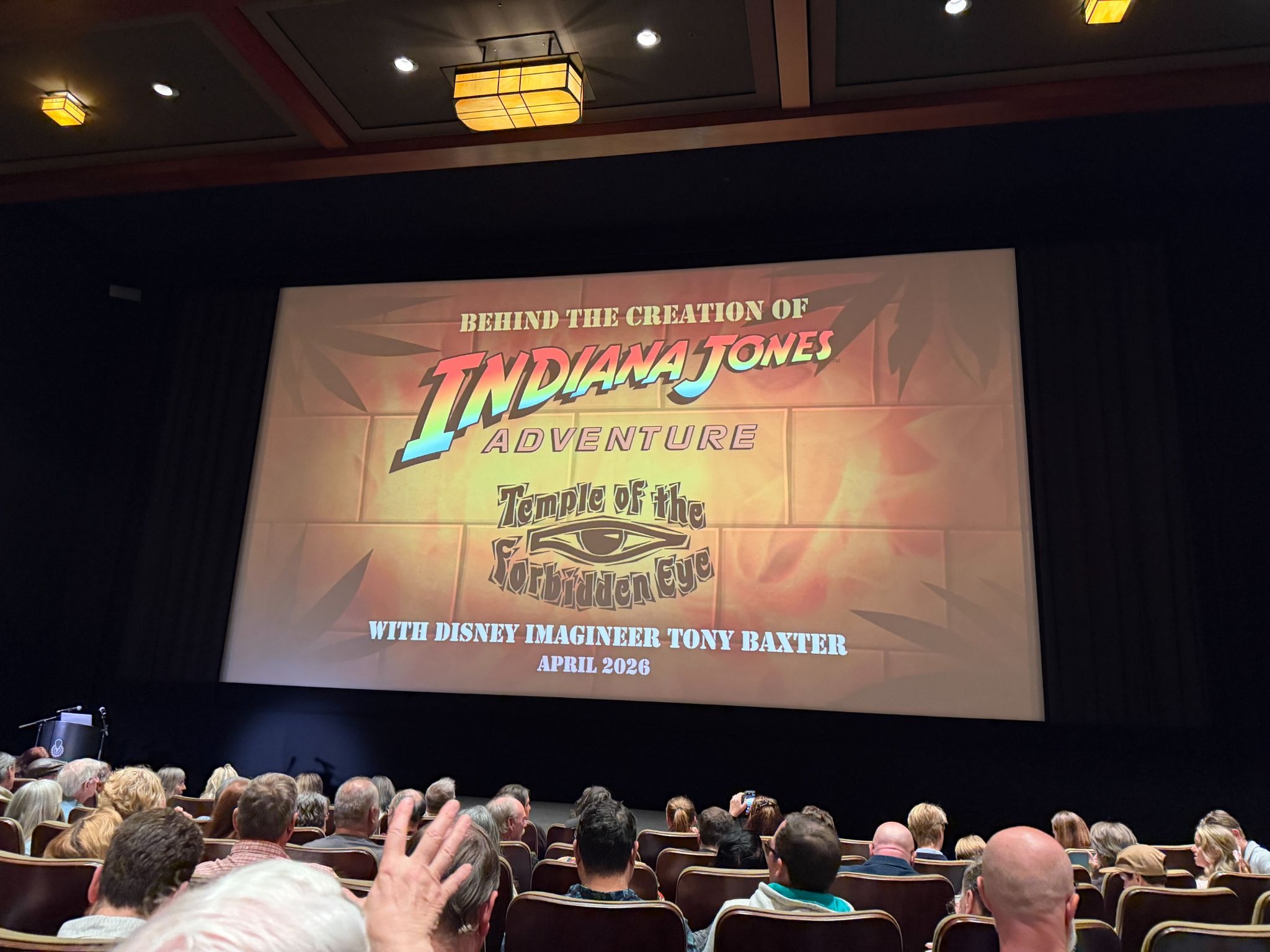
Baxter, who served as Senior Vice President of Creative Development at Walt Disney Imagineering before transitioning to a creative advisor role in 2013, was the driving creative force behind Indiana Jones Adventure: Temple of the Forbidden Eye, which opened at Disneyland on March 4th, 1995.
Baxter's connection to Indiana Jones predates any official Disney involvement. When Raiders of the Lost Ark opened in 1981, Baxter and Skip Lange — who would later serve as a director on the attraction — slipped out of work one afternoon to catch a screening at a theater in Pasadena. Walking out of that theater, their first thought was what kind of ride Disney could build if it ever owned the Indiana Jones property.
That question sat with Baxter for years. In the mid-1980s, with Disney's homegrown IP feeling less culturally vital than the worlds George Lucas and Steven Spielberg were creating, Baxter made a case to Disney management that the parks needed the kind of emotional bond those franchises offered. The response was essentially: take it to Ron Miller.
Miller, who was running the studio at the time, was receptive. He arranged a meeting at Silverado Vineyards, inviting George Lucas to join. Baxter found himself standing in a backyard buffet line with Ron Miller ahead of him and George Lucas behind him — a surreal moment for a kid from Santa Ana who had grown up dreaming about these films. Lucas told the group he understood how expensive these projects were, had even thought about theme park attractions himself, and saw no reason why Disney and Lucasfilm — both number-one product companies, as he put it — shouldn't work together. Flying home that night, Baxter felt his life was about to change.
What came next was not the Disneyland attraction fans know today. When Disney-MGM Studios opened in Florida in 1989, the park needed a stunt show to anchor its movie-making premise, and Baxter's Indiana Jones concept was redirected there — becoming the Indiana Jones Epic Stunt Spectacular. Its success created a new problem: management came back to Baxter and asked for a Disneyland equivalent. He pushed back, noting that Disneyland isn't about the filmmaking process. The land called for something different.
His solution was clever: the final film in the trilogy, Indiana Jones and the Last Crusade, opened with a young Indiana Jones sequence set in Utah ranch country — terrain that aligned naturally with Disneyland's Frontierland. Baxter developed a live show concept centered on a young Indy, written with an emotional button at the end where the boy would stand next to the older Indy and receive the famous hat. The script, by Baxter's account, gave people chills.
The concept died in estimating. Running a live show day after day proved far more expensive than running a ride. Management sent Baxter back to the original ride concept. About two years after the live show was shelved, The Young Indiana Jones Chronicles came to television, and Baxter couldn’t help but notice the similarities between his Disneyland stunt show concept and the series.
Once the Disneyland ride was back on track, the scope was enormous. Early concepts integrated the attraction with the Jungle Cruise, the Disneyland Railroad, and a separate mine-car experience — a sprawling redesign of Adventureland that ultimately had to be scaled back to fit the available land and budget. Legendary Disney artist Herb Ryman was brought in to develop the look of the queue and temple environment, producing concept paintings that Baxter described as simply letting Ryman's imagination run free.
The queue itself became one of the project's signature achievements. Baxter wanted guests to have a reason to wait — not just stand in line — so the team built a mythology around the attraction: a temple offering the gifts of eternal youth, boundless wealth, or knowledge of the future, with a catch.
The ride vehicle itself was a genuine engineering milestone. Dubbed the Enhanced Motion Vehicle, it was developed by George McGinnis and was designed to physically react to the story — lurching away from snakes, tilting unnervingly on corners in the opposite direction of the turn to simulate instability. A half-scale test track was built in a warehouse near Magic Mountain in Valencia, California, with a full-size car traveling through a compressed version of the ride layout. Engineers ran the car through twice per session, resetting lighting and motion cues between passes to simulate the full experience in half the space. The car's computer system was so bulky it required its own trailer — with a cardboard shell designed to approximate the final vehicle's appearance.
With the ride taking shape, one question loomed: would Harrison Ford allow his likeness to be used? Baxter's team pursued artist Drew Struzan — whose iconic poster work had defined the Indiana Jones film series — to create the attraction's promotional art. They were under the assumption that, given his amazing artwork of the actor, Struzan must be well-connected with Ford. In reality, they’d never met. Struzan would use poses of himself as a reference, replacing his own face with a headshot. But the team figured it was still worth having Struzan make the introduction.
The phone call to Ford was made from the Imagineering offices, with Struzan visibly nervous. Ford answered and, recognizing Struzan's name, was immediately effusive — telling the artist how much pressure he'd always felt trying to live up to Struzan's imagery of him. The conversation turned quickly to the attraction, and when Struzan confirmed that he would be involved, Ford agreed on the spot.
Baxter walked the audience through several of the attraction's practical effects.. The rats that appear to leap into the vehicles were trained from birth to run a specific path to reach their food, filmed and projected onto a mist screen. With the vehicles unable to go in reverse, the iconic boulder scene was inspired by the sensation of a car wash — the same perceptual trick that makes a stationary car feel like it's rolling. Legendary Imagineering effects designer Yale Gracie, Baxter noted, operated on the principle that the best effects often come from simple everyday observations, like a lamp reflecting in a window or the optical illusion of a departing train.
The snake pit sequence was the result of a negotiation with George Lucas himself. Baxter had pushed for a single giant snake as the scene's centerpiece, arguing that in a ride environment — where scale perception is fixed and guests can't zoom in — a realistically sized snake reads as a worm. Lucas maintained that the Indiana Jones films never exaggerated reality, and held firm. They compromised: a large snake would be added alongside approximately a thousand smaller ones, with the public's reaction determining which stayed.
Indiana Jones Adventure opened on March 4th, 1995, with a queue that stretched through all of Adventureland and into Frontierland. Thirty-one years later, Baxter reflected on the attraction's enduring cultural footprint — the fan clubs, the documentary films, the merchandise sellouts at D23 — and traced the lineage of Indy attractions that followed.
Tokyo DisneySea opened its own version, Temple of the Crystal Skull, in 2001. A fourth Indiana Jones film, released years later, drew from that attraction's iconography with mixed results, Baxter observed diplomatically. The mine-car ride concept Baxter had also developed for the Disneyland project didn't disappear entirely. It was transplanted to Disneyland Paris, where Indiana Jones et le Temple du Péril opened in July 1993 — the first coaster at the resort with a vertical loop.
Looking ahead, Baxter touched on the new Indiana Jones attraction in development at Disney's Animal Kingdom, with construction already underway. The concept, as he described it, will be distinct from all existing versions — centered on Indy discovering a remarkably preserved Mayan temple, with rumors of a mythical creature woven into the experience. As for whether there will be snakes? Baxter said he could guarantee it.
Visit waltdisney.org for more information about the Walt Disney Family Museum and future events like this one.