
Ollie Johnston: A Celebration of Life - 8/19/2008 at the El Capitan Theatre
Page 3 of 10
Author Charles Solomon was next asked for his earliest memories of Ollie Johnston. It was also at the time that Frank and Ollie were working on Disney Animation: The Illusion of Life. Solomon met the pair in a room filled with delicate pastel floral renderings from Fantasia. He described them as such ordinary human beings, but ones who could make him want to get involved.
�They were so articulate,� added Maltin, �Not only passionate, but they could talk about it.� He went on to say he was always struck by their youthfulness. �Even as their bodies grew old,� he said, �They were youthful in spirit and mind.�
Solomon also noted Ollie�s gentleness, and his lack of guile in interviews. There were chuckles in the crowd when Solomon noted that he never knew Ollie to speak ill of more than three or four people. He did recall that Ollie was critical of the cupids in Fantasia, saying, �They had all the individuality of Donald Duck�s nephews!�
The next question was directed to Andreas Deja: As a lifelong student of classic Disney animation, what made Ollie�s work unique?
Deja quickly noted that each of the Nine Old Men had his own approach. Ollie�s work had an almost casual feel. He produced more drawings than most of the others, because his work wasn�t labored over. He didn�t go over and over each pose, and was therefore able to move a lot of footage.
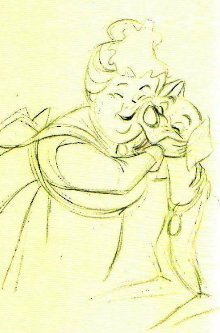
Ollie�s delicate line work, seen here in 101
Dalmatians
Click here for a much larger version of this picture
As examples of Ollie�s delicate drawings filled the screen, Solomon noted that this talent was reflected in Ollie�s characters. They had an ease and naturalness. Deja added that Ollie also had amazing range, that he was able to animate everything from villains to young girls.
Maltin mentioned Ollie�s ability as a �performer,� how he would mime characters as diverse as Trusty from Lady and the Tramp to the Stepsisters in Cinderella. �Balloo, too,� added Roy.
Andy Gaskill recalled a day he approached Ollie with a question about his drawings in a scene between Bernard and Bianca in The Rescuers. After outlining his dilemma, Ollie simply asked, �What does he want?� Gaskill marveled at what an elementary question it was. Maltin noted that it was good advice for a live action actor, as well. Deja recalled a phrase of Ollie�s that always stuck in his mind, which he described as his philosophical approach: �Don�t animate drawings, animate feelings.�
Malitin then turned to Roy Disney and expressed amazement at the through line that ran from Roy�s dad and uncle, Roy and Walt Disney, that pushed the animators in the 1930s, to what the studio was doing in the 21st century. Roy readily agreed, noting that Frank and Ollie�s book was such an important part of this, totally crystallizing what animation is. He described The Illusion of life as a touchstone, more than any other, for Disney animation. �I think these two guys articulated it better than any other,� he said. Roy chuckled as he claimed that for years he�d been quoting Frank and Ollie subconsciously. They had left, he concluded, �an amazing legacy.�
Bringing this panel to a close, Maltin asked Andreas Deja about a pair of clips he had brought to share. Although Ollie was noted for his cute and warm scenes, these two presented a rarely seen side of his abilities. The clips, said Deja, were full of cleverness and wit. As Solomon noted that Ollie was very proud of his work in Reason and Emotion, a scene from the World War II era film filled the screen. It depicted the internal quarrel between a young woman�s Reason and Emotion, personified as two contrasting women. Reason, a prim young lady, sat firmly in the driver�s seat, despite Emotion�s sassy insistence on moving up from the back seat.
The second clip was a surprising one, from a training film made about the same time. Andreas told of meeting an animator in the Soviet Union who claimed that seeing this scene from an American military film led to his interest in the field. This time it was a pencil test, intended to show the sort of daydream that might distract a young soldier on duty. The brief clip showed a charming young lady, slipping into a garment and accidentally offering a tantalizing glimpse of something one didn�t expect to see in a Disney film. In a recording, Ollie�s voice was heard explaining that Walt�s reaction to the scene was to exclaim, �That girl�s horsey!� Ollie explained that that was Walt�s way of saying sexy.