
A Spoonful of Love & Laughter: Celebrating Richard Sherman Aboard the DVC Member Cruise


There are countless ways to tell the story of Disney Legend Richard M. Sherman. You can talk about the two Academy Awards he and his brother Robert earned for Mary Poppins, the seemingly endless collection of songs they created for Disney films and attractions, or the melodies that continue to be heard by millions of people around the world. But during a special presentation aboard the Disney Vacation Club Member Cruise, Richard’s granddaughter Mandy Rose Wolf and his longtime friend Tim O’Day chose a much more personal way to remember him.
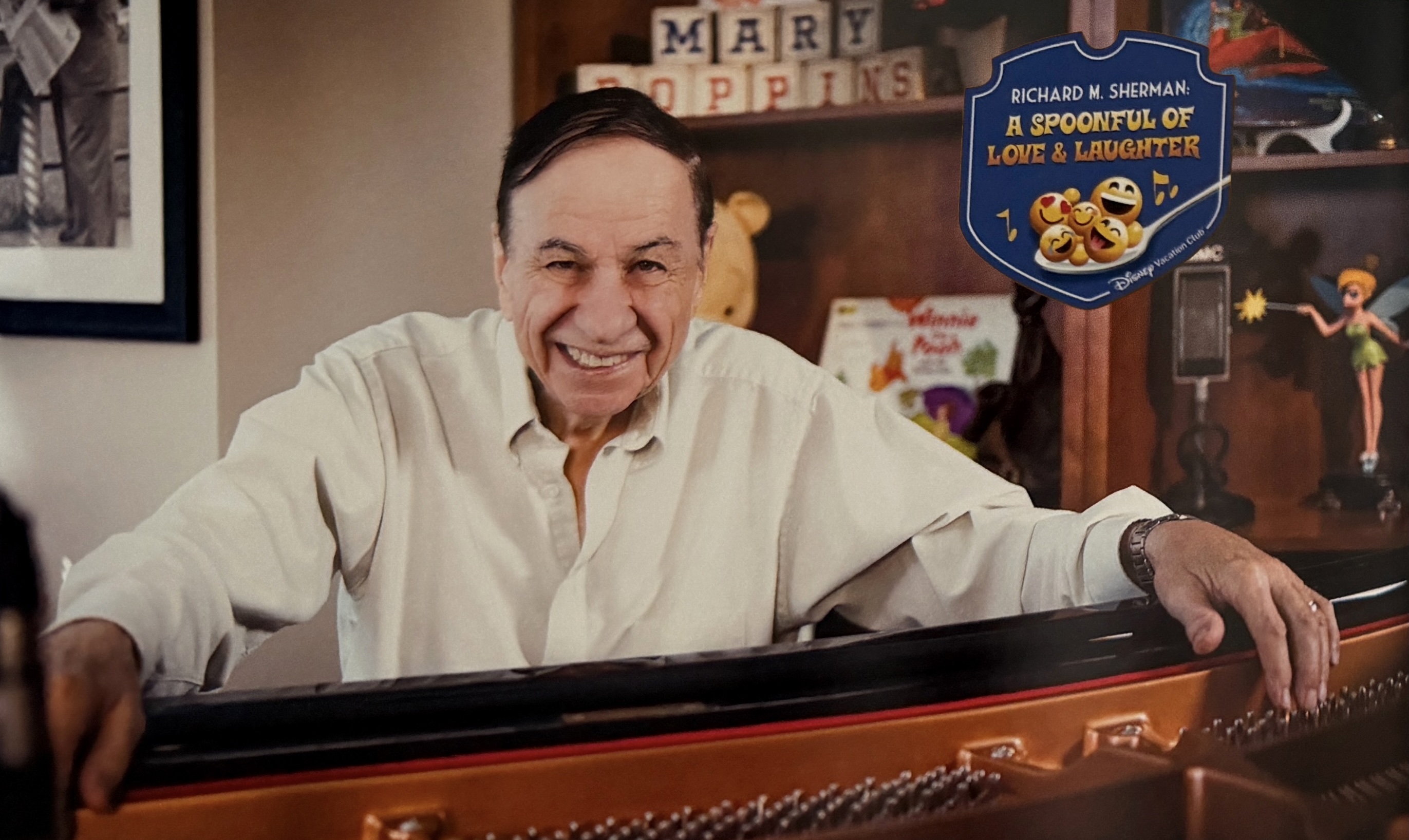
Titled “Richard M. Sherman: A Spoonful of Love & Laughter,” the presentation promised funny and heartwarming stories about the remarkable life and enduring legacy of the Disney Legend, and that description proved remarkably accurate. Disney author and historian O’Day brought decades of memories from working, performing and traveling with Sherman, while Wolf offered something even more intimate: the perspective of a granddaughter who grew up knowing one of Disney’s most celebrated songwriters simply as her grandfather.
Together, their stories painted a wonderfully human portrait of Sherman. He was a musical perfectionist who could instantly hear a flat note, but he was also a grandfather who secretly let Mandy play with a valuable Mickey Mouse doll when Grandma wasn’t looking. He could perform an enormous catalog of songs from memory but was terrified enough by a tarantula to suggest moving out of his house. He loved pianos, M&M’s and cookies, adored his wife Elizabeth, and seemingly never missed an opportunity to turn an ordinary moment into a song, a joke or a story.
O’Day began by asking for a show of hands from anyone who had never heard a Sherman Brothers song. Unsurprisingly, no hands went up, and a video montage racing through the brothers’ catalog demonstrated just how deeply their music has become woven into Disney history. Yet before exploring the Richard Sherman known to millions of Disney fans, Wolf and O’Day went back another generation. To understand where Richard’s remarkable relationship with music came from, they began with his father, Al Sherman, and a family history in which melodies seemingly had a habit of passing from one generation to the next.
Al Sherman was himself a successful songwriter, and Wolf described her great-grandfather as someone with a remarkable ability to recognize an opportunity. According to a favorite family story, Al was once summoned to the home of George and Ira Gershwin’s parents, who wanted him to convince their sons not to work together as a songwriting team. Al listened to some of the material the brothers were developing and reached precisely the opposite conclusion. “They better stay together,” Wolf recalled him deciding, which may qualify as one of the better pieces of advice in songwriting history.
Those musical instincts continued through subsequent generations of the Sherman family. Wolf told a story about Richard arriving home after a day spent working on “Portobello Road” for Bedknobs and Broomsticks, excited to play the newly written song for his wife, Elizabeth.
Before he could properly unveil it, Richard and Elizabeth heard the same melody coming from upstairs. There was no possibility that someone had heard the song elsewhere because Richard had only written it that day, so they rushed upstairs and discovered Wolf’s mother, Victoria, then just three years old, playing the melody on her little piano after apparently absorbing it by ear.
Decades later, Wolf experienced her own unexpected musical discovery. At eight years old, she underwent surgery to remove extremely enlarged tonsils and adenoids that had been restricting her airflow, but what was expected to be a relatively routine procedure became frighteningly serious. She needed three blood transfusions and endured a difficult recovery that lasted for months. Once she had recovered, Wolf felt like singing and pulled up a karaoke version of “The Star-Spangled Banner.” She began belting it out in her room, prompting her parents to rush through the door because they initially thought they were hearing a recording. For the first time, everyone heard the voice that had finally been given room to come through. Just as an earlier generation had discovered Victoria’s musical ear at a tiny piano, another Sherman descendant had discovered a musical gift of her own.
To Wolf and her brother, Richard Sherman was never primarily a celebrity. He was simply the joyful man who entertained them at the piano and tried to negotiate for a little something sweet after virtually every meal. That perception changed somewhat when Wolf entered her teenage years and decided she wanted to make music her career. She accompanied Richard to a recording session and sat beside him while a vocalist worked through one of his songs, giving her an opportunity to watch her grandfather operate in a professional environment. During the second take, Richard abruptly interrupted the singer with a single word: “Flat!”
Wolf was stunned because this was not the grandfather she was accustomed to seeing at home. “It was kind of like another person stepped out of his skin,” she remembered, as the genial man asking for cookies and M&M’s transformed into an exacting composer who knew precisely what he wanted and was unwilling to accept something that did not match what he heard in his head. “Even though Grandpa’s critiques were thorough and abundant, he was absolutely right,” Wolf said. By the final take, she remembered the performance as “gorgeous and flawless,” giving her a new appreciation for the tremendous amount of work behind music that could sound effortless.
O’Day knew that professional side of Sherman particularly well, having begun working with Richard and Robert in the 1990s. He spent years accompanying Richard at concerts and Disney appearances and remembered a musician whose polished performances concealed an extraordinary amount of preparation. “Richard never passed a piano he didn’t like,” O’Day joked. He also almost never forgot a lyric, with O’Day able to remember essentially one exception across all their years together.
During a massive D23 concert in 2013, Richard shared the bill with fellow Disney Legend Alan Menken. Sherman, then in his mid-80s, performed his portion of the program largely from memory, while O’Day jokingly remembered Menken arriving with a sizable stack of sheet music.
During “Winnie the Pooh,” Richard suddenly went blank on a lyric. From the shadows offstage, O’Day supplied “willy nilly,” allowing Sherman to pick the song back up while visibly trying not to laugh at what had just happened. The moment quickly became an inside joke between the friends. For weeks afterward, Sherman would occasionally call O’Day and announce himself with some variation of “Willy nilly here,” turning what O’Day remembered as virtually the only lyrical mistake he ever witnessed into another treasured memory.
O’Day described Richard and Robert as having distinctly different personalities, with Richard’s seemingly boundless enthusiasm earning him comparisons to Tigger. That energy followed him throughout his life, and wherever there was a piano, Sherman seemed destined to find it. One particularly memorable encounter occurred during a gathering in Walt Disney’s office. Surrounded by friends and Disney colleagues, Richard naturally gravitated toward Walt’s piano and began playing some of his most famous compositions, including “Feed the Birds.” As Richard finished one of the songs, something strange happened: the piano appeared to continue playing by itself. While everyone else reacted with surprise, Sherman immediately quipped, “Walt, if you’re going to keep playing, I’ll stop.”
A stuck pedal was eventually offered as the practical explanation, although O’Day admitted that the moment retained an appropriately Disney sense of mystery. More importantly, it demonstrated Richard’s ability to instantly turn something unexpected into a perfectly timed joke.
If Richard loved pianos, he loved Elizabeth even more. The two were married for 67 years, and Wolf grew up repeatedly asking her grandparents to retell the story of how they met. Richard first spotted his future wife at one of the famous gatherings hosted by his best friend, Magic Castle co-founder Milt Larsen. She was there with another man, so Richard kept his distance, although he remembered her face. A few days later, a friend asked Richard to describe his ideal woman. He imagined someone petite, sharp, beautiful and funny, then suddenly realized he had already seen exactly that woman at Larsen’s party.
Months later, another party offered him a second chance. The same woman appeared, once again with another man, but this time Richard summoned the courage to introduce himself. The two immediately connected, although Richard was apparently reluctant to admit that he was a struggling songwriter. Searching for something that sounded more impressive and secure, he claimed to be an insurance salesman. Eventually Richard led Elizabeth to the piano and began playing some of the music he had been working on. He finally confessed that he was actually a songwriter, prompting Elizabeth to respond, “You think I hadn’t worked that out by now?”
The following day, Elizabeth excitedly told her coworkers that she had met a songwriter and musician. Their advice was less enthusiastic, as they warned her to dump him because he was unlikely to amount to anything. Nine months later, Richard and Elizabeth were married, beginning a partnership that would last 67 years.
Their decades together included adventures around the world, while many of O’Day’s favorite memories with the couple came from Walt Disney World. During one visit, Elizabeth was searching for a particular type of parasol similar to one she had seen at Disneyland, sending the group on a resort-wide quest that carried them through multiple locations. Eventually, the search somehow brought them into a costuming area at the Disney-MGM Studios, where they discovered Mary and Bert’s “Jolly Holiday” costumes from Mary Poppins. Richard suggested that he and Elizabeth wear them to a masquerade party which was being held as part of the old school Disneyana conventions of yesteryear. Elizabeth happily embraced the idea despite one fairly significant complication. Richard’s costume fit without much trouble, but the petite Elizabeth required considerably more improvisation. O’Day joked that she was ultimately wearing “more safety pins than fabric,” but the result worked, and the couple happily embraced another opportunity to transform an ordinary Disney visit into a performance.
Another evening became even more surreal when O’Day found himself sitting in rocking chairs on the BoardWalk with Richard, Elizabeth and Hayley Mills. As dusk settled over Walt Disney World, Richard observed that the setting reminded him of Summer Magic, for which he and Robert had written the songs. Naturally, Richard began singing “On the Front Porch.” Elizabeth joined him, followed by Mills, leaving O’Day wondering what exactly someone is supposed to do when Richard Sherman, Elizabeth Sherman and Hayley Mills unexpectedly launch into a private musical number beside him.
O’Day eventually started humming along, thinking, “Okay, I’m in a movie now with these three people.” There were no smartphone cameras recording the moment and no audience assembled to watch, making the impromptu performance an even better illustration of what Wolf said her grandparents were like when the public was nowhere around. “They were always theatrical behind closed doors with just family,” Wolf said. For Richard and Elizabeth, apparently, life did not have to wait for an audience before becoming a musical.
Some of Wolf’s favorite childhood memories came from sleepovers at her grandparents’ home, a place she remembered as something of a musical museum filled with records, enormous movie posters and fascinating pieces of Disney history. To a child, nearly everything in the house looked like a toy waiting to be played with. Almost everything was fair game except for one particularly valuable vintage Mickey Mouse doll protected inside an aging display case. Elizabeth made the rules very clear that Wolf could play with anything else, which naturally ensured that Mickey became the object she wanted most. Richard noticed his granddaughter’s fascination and quietly became her accomplice. Whenever Elizabeth went downstairs to prepare dinner, he would remove Mickey from his case and let Wolf have some forbidden time with him before her grandmother returned.
Years later, as Richard became older, Wolf found her own way to bend the household rules on his behalf. Sweets became her preferred form of persuasion, particularly when the family was trying to convince Richard to get up and exercise. Whenever Elizabeth left the room, Wolf would tell him, “Hey, Grandpa, I have a cookie in my pocket. You can only have it if you come with me.” It worked almost every time, leaving Elizabeth astonished that her granddaughter could get Richard moving when seemingly nobody else could.
According to Wolf, Elizabeth never discovered the secret. The cookie-assisted exercise plan was one more private conspiracy between a grandfather and granddaughter who happened to share the same chronic sweet tooth.
Sweets were not the only trait Richard passed down to his granddaughter, as Wolf also inherited his fear of spiders. She recalled a tarantula wandering into the Sherman home after a sliding glass door was left open and provoking such an extraordinary reaction from Richard that Elizabeth came running because she thought something catastrophic had happened. Instead, she found her terrified husband staring at a spider. Elizabeth calmly used a broom to guide the tarantula outside, and once Richard regained his composure, he offered his preferred solution to the problem: “We’re moving.”
O’Day noted the delightful irony that the man terrified by spiders would later write songs for Charlotte’s Web. Unfortunately for Richard, arachnids were not the only creatures capable of inspiring thoughts of immediate relocation.
During a vacation in Mexico, Richard got out of bed during the night and began hearing mysterious crunching noises under his feet. Initially wondering whether someone had been eating potato chips, he turned on the lights and discovered cockroaches seemingly covering the floor, walls and ceiling. The Shermans slept with the lights on for the remainder of the night. By morning, Richard had reached another characteristically decisive conclusion and informed Elizabeth, “We’re moving hotels.”
Then there were frogs. During a Hawaiian vacation, Richard and Elizabeth encountered a road filled with bullfrogs and reluctantly drove through them to reach their accommodations, only for Richard to arrive at the cabin and declare, “We’re switching islands.”
O’Day began detecting a pattern in these stories and joked that “there’s a lot of switching going on in the world.” Considering Richard’s responses to tarantulas, cockroaches and bullfrogs, perhaps one secret of his legendary optimism was simply his willingness to relocate whenever circumstances became unpleasant.
One of Wolf’s most meaningful connections to her grandfather’s legacy came when she was 13 and her theater company announced it would be staging Mary Poppins. Wolf knew exactly what the opportunity meant, and she also understood that her last name would create expectations none of the other young performers had to confront. After auditioning, she was cast as one of the performers playing Mary across the production’s multiple casts. Her excitement soon became complicated when she overheard other performers suggesting she had received the role only because Richard Sherman was her grandfather.
Rather than retreat from the challenge, Wolf became determined to earn the role on her own merits. “I realized I would have to work harder than everyone else to prove that I belonged on that stage just as much as them,” she said, turning the burden attached to her family name into motivation.
Opening night brought another obstacle when Wolf suffered the worst stage fright she has experienced before or since. Waiting in the wings, she could see her parents, grandparents and family friends sitting together in the audience, and more than anything, she wanted Richard to be proud of what she was about to do with music that meant so much to him. Then her cue came. Wolf stepped onto the stage and discovered that the moment she delivered her first line, the fear disappeared and, as she remembered it, “it felt like I was home.”
After the performance, Richard joined the cast on stage and reflected on how many decades had passed since he and Robert had first tried to determine what music belonged in the story of this magical nanny. For Wolf, hearing the man who helped create Mary Poppins praise what she and her fellow performers had done became one of the defining moments of her life.
“No matter what I accomplish in this lifetime, not much will come close to that special day that my little 13-year-old self made Grandpa as proud as can be,” Wolf said. It was a rare intersection between the two Richard Shermans she knew: the legendary songwriter whose music had become part of popular culture and the grandfather whose approval mattered more to her than anyone else’s.
Mary Poppins represented the pinnacle of the Sherman Brothers’ film career, earning them Academy Awards for Best Original Song and Best Original Score. Of all the music they created for the film, however, none became more intimately connected with Walt Disney himself than “Feed the Birds.”
O’Day witnessed an extraordinary addition to that story on December 5, 2001, when Disneyland marked Walt Disney’s 100th birthday. Richard was one of the special participants in the celebration and performed at a white piano in the park’s hub, where the background music had been silenced so guests could hear him clearly. O’Day remembered it as a beautiful, crisp winter day, and there were virtually no birds around the hub as Sherman began his performance. Richard played several pieces before arriving at “Feed the Birds.”
In the middle of the song, a pigeon suddenly swooped toward the piano, landed near Sherman, appeared to look toward him and then flew away. The crowd collectively gasped at the extraordinary timing, but Richard was so focused on playing that he noticed none of it.
When the performance ended, Richard asked O’Day what had caused the sudden audience reaction. “Oh, Walt came by and said hi,” O’Day told him before explaining what the pigeon had done.
Sherman refused to believe him. O’Day began recruiting members of the crew and other witnesses to confirm that the bird had indeed flown down beside him, but Richard remained convinced that everyone was pulling his leg.
Only after being shown video of the performance did Sherman finally concede that the pigeon had really appeared. Of course, Richard was also a born storyteller, and O’Day joked that in subsequent retellings the modest pigeon gradually grew into a larger bird, then something approaching a condor and eventually practically a pterodactyl.
The original story needed little embellishment, particularly given the emotional significance “Feed the Birds” held in the relationship between Sherman and Walt Disney. “I’d like to think that it was Walt saying hi,” Wolf said.
As Wolf grew older, she discovered that her grandfather’s music could surprise her in ways that went beyond sentimentality. While studying at Berklee College of Music, she took two notoriously demanding courses in tonal harmony and counterpoint with the same professor, an accomplished classical composer and violinist.
During one lesson, the professor used songs from Mary Poppins Returns to demonstrate different approaches to harmony. Seeing Mary Poppins on the board made Wolf curious about what her professor thought of the original Sherman Brothers score, so she approached her after class and asked. “Eh, they’re all right. Not my cup of tea,” Wolf remembered her professor responding. The professor had no idea that the student asking the question was Richard Sherman’s granddaughter, and Wolf had no intention of telling her.
Wolf immediately called her mother and jokingly asked how she was supposed to learn to write music from a composer who didn’t like the Sherman Brothers. Still, she respected the professor’s honesty, stayed in the class and gradually developed a deeper understanding of the mechanics behind the music she had heard throughout her life.
When the class moved into counterpoint, Wolf had a revelation. As she learned how separate melodies can function independently while also combining harmonically, she realized that one of her grandfather’s most famous compositions provided an almost perfect illustration of what her professor was teaching. The song was “it’s a small world.”
After class, Wolf approached her professor again and asked whether she had ever considered the song as an example of counterpoint. The professor thought about it for a moment, went to the piano and began playing “it’s a small world” from memory. Then she heard what Wolf had heard. “Oh, my God. Oh, my God. It’s perfect. How have I never thought of this?” Wolf remembered her saying.
The professor became so fascinated by the discovery that she returned for the next lecture with an entire page of handwritten notes breaking down the structure of “it’s a small world.” She used the song to demonstrate how its two distinct melodies could exist independently and then fit together to create something greater when performed simultaneously.
Wolf never revealed why the discovery meant so much to her. Her professor finished the semester without knowing that the student who had encouraged her to reconsider “It’s a Small World” was the granddaughter of one of the men who wrote it. “She managed to teach me a lot about the mechanics of composition, but I like to think that I managed to teach her something special too,” Wolf said. For a granddaughter who had grown up surrounded by Sherman Brothers music, the experience offered a new way to understand what Richard and Robert had accomplished.
The story also provided an illuminating answer to anyone tempted to mistake simplicity for a lack of sophistication in the Sherman Brothers’ work. “It’s a Small World” was designed to be instantly understandable and singable across cultures and languages, yet beneath that accessibility was enough compositional craftsmanship to surprise a professor teaching advanced music students decades after the song was written.
O’Day then highlighted another musical gift Wolf possesses: perfect pitch, an ability he noted she shares with a relatively small group of notable singers. He joked that while someone could essentially tune a piano to Wolf, “Me personally, you can tune a lawnmower.” Rather than simply tell the audience about Wolf’s musical abilities, O’Day turned the remainder of the presentation over to her so she could demonstrate them through the music that had brought everyone together. Wolf began with “The Parent Trap,” the Sherman Brothers song from the 1961 Disney film that held additional meaning for her after she later had the opportunity to meet and sing with Hayley Mills.
For the final song, Wolf reached deeper into the Sherman catalog with “Ten Feet Off the Ground” from The One and Only, Genuine, Original Family Band. O’Day recalled the 1968 Disney musical and noted that the song was later recorded by Louis Armstrong, giving another example of how Sherman Brothers music could travel far beyond the project for which it was originally created.
The choice made for an especially appropriate conclusion to a presentation devoted to a family whose lives have been intertwined with music for generations. As Wolf sang about rhythm, harmony and melody lifting people above the ground, the performance demonstrated that the Sherman musical story did not conclude when Richard Sherman played his final notes.
Richard Sherman’s Disney legacy can easily be measured in accomplishments. Alongside Robert, he won two Academy Awards for Mary Poppins, wrote songs for beloved films and attractions, and created melodies that have been heard by generations around the world. Yet “A Spoonful of Love & Laughter” made a compelling case that the man behind those achievements was every bit as memorable as the music.
O’Day remembered the consummate professional who could perform an enormous catalog from memory, immediately hear a flat note and transform an unexpected mistake into an inside joke that lasted for years. Wolf remembered the grandfather who secretly removed Mickey from his display case for her, could be persuaded to exercise with a cookie and was prepared to move houses, hotels or even islands when confronted with the wrong creature.
Those stories were funny because Richard Sherman was funny, but they were also unmistakably stories of love. O’Day’s memories reflected the affection of a friend who understood just how fortunate he had been to share so many unlikely adventures with Sherman, while Wolf’s revealed the special relationship between a granddaughter and a grandfather who happened to be responsible for some of the most famous songs in Disney history.
For Wolf, that legacy also carries forward through music. She first knew the songs as a granddaughter sitting beside a piano, then grew old enough to understand their craftsmanship as a musician herself and eventually discovered her own place within a musical tradition that began generations before she was born.