
The Ageless Joy of Dick Van Dyke: A Celebration of a Disney Legend on the DVC Member Cruise


Despite all of Disney Legend Dick Van Dyke’s accomplishments, perhaps the most remarkable thing about Van Dyke is that, despite his varied career, his infectious joy is at the center of everything he does. That spirit was celebrated aboard the Disney Vacation Club Member Cruise during “The Ageless Joy of Disney Legend Dick Van Dyke,” featuring Disney Legend Karen Dotrice, filmmaker Ned Nalle, and Disney author and historian Tim O’Day. The presentation incorporated extensive footage from the recent American Masters documentary Starring Dick Van Dyke, produced by Nalle and directed by his producing partner John Scheinfeld, along with personal stories about the entertainer whose career has now touched generations.
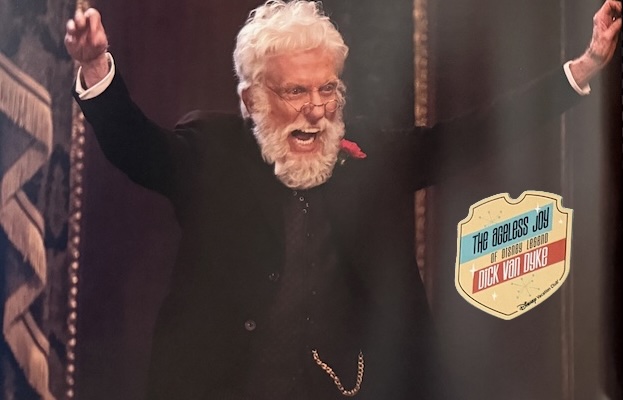
The documentary was born from an extraordinarily simple question. The married Nalle and Dotrice were attending a dinner honoring Van Dyke for his 98th birthday when they approached him and asked why nobody had ever made a feature documentary about his life and career. Van Dyke’s response was equally simple: “Nobody’s asked.” Nalle and Dotrice immediately replied, “We’re asking.”
They subsequently met with Van Dyke, explained the story they hoped to tell, and received his blessing. That eventually led to Starring Dick Van Dyke, a film structured not simply around his accomplishments but around something Nalle believes is essential to understanding Van Dyke’s extraordinary longevity: his willingness to continually reinvent himself.
Before exploring Van Dyke’s career, O’Day, Nalle and Dotrice shared their own stories about meeting him for the first time. Each encounter was memorable for a completely different reason, and together they immediately established the playful tone that would carry through the presentation.
O’Day’s encounter came at Disneyland in the early 1980s, where Van Dyke was filming a television special connected with EPCOT. Van Dyke was dressed as a painter in white overalls splattered with paint and was heading toward the backstage cast member commissary known as the Inn Between. Coming in the opposite direction were Disneyland’s Mary Poppins penguins. There was just one problem, the animated penguins alongside Bert in Mary Poppins are rather small, while their Disneyland counterparts were considerably closer to six feet tall.
Van Dyke stopped and stared at them, and the penguins stopped and stared back. Naturally, Van Dyke began doing a little soft-shoe routine and the penguins responded in kind. O’Day remembered Van Dyke laughing at the absurdity of it all before continuing toward the commissary.
Nalle’s first meeting was considerably shorter. Around Christmas 1995, he found himself at a Toys “R” Us in Santa Monica fighting another shopper for the last Beanie Baby, only to look up and realize that his opponent was Dick Van Dyke. “And he won,” Nalle said, drawing a laugh from the audience. He then joked that he was still somewhat surprised Van Dyke later allowed him to make the documentary.
Dotrice’s first encounter with her future Mary Poppins co-star was considerably more embarrassing. She was undergoing costume fittings for the film, including having a plaster cast made of her backside so effects could be created for sequences such as Jane and Michael Banks sliding up the banister. She was bent over during this undignified procedure when Van Dyke walked into the room. It was not exactly the introduction a young actress might have imagined having with the star of her new movie, but decades later it made for a story that had the Member Cruise audience roaring.
When Nalle and Scheinfeld began considering how to tell Van Dyke’s story, they faced a fundamental problem. With a life and career this long, they needed to determine what the story actually was beyond simply cataloging one hit after another.
Their answer was reinvention. Van Dyke began in radio in the Midwest, moved through comedy sketches and television appearances, struggled through projects that failed and was even paired with Walter Cronkite on a CBS morning program. Not every experiment worked, but Van Dyke repeatedly found a way to move toward the next opportunity. “He kept changing what he was and what he approached,” Nalle explained. That willingness to change became the central thesis of the documentary and, in Nalle’s view, one of the reasons Van Dyke has remained relevant through so many eras of entertainment.
One of the first great examples came on Broadway. In 1959, Van Dyke appeared in The Girls Against the Boys, which lasted just 16 performances. With a growing family to support, the failure left him worried about what would come next. Then he auditioned for legendary director and choreographer Gower Champion, who also happened to be the husband of Disney Legend Marge Champion. Van Dyke admitted that he could not really dance, and Champion essentially responded that he could teach him. That opportunity became Bye Bye Birdie.
During its out-of-town tryout in Philadelphia, producers reportedly considered replacing Van Dyke, believing he was not making enough of an impression. Champion stood behind him, and the creative team also transformed “Put on a Happy Face,” originally intended for co-star Chita Rivera, into a showcase for Van Dyke. Suddenly, the performer who was worried about supporting his family was a Broadway star. Yet even then, Van Dyke did not settle. Broadway was not the dependable income he wanted for his family, so he began looking toward television, a decision that led him to Carl Reiner.
Reiner had developed a sitcom called Head of the Family and originally played its central character himself. The concept did not quite work with Reiner in the role, but when Van Dyke was cast as television writer Rob Petrie, everything clicked.
The Dick Van Dyke Show premiered in 1961 and ran through 1966, pairing Van Dyke with Mary Tyler Moore and creating one of television’s most enduring married couples. O’Day noted that the series arrived during an era of optimism in American culture and presented something that was still somewhat unusual on television, a married couple who genuinely appeared to enjoy being married.
Rob and Laura Petrie were not merely sitcom spouses sharing a house. Their affection for each other was palpable, and that warmth helped make the series feel more contemporary and emotionally authentic than many of the shows that had come before it.
Van Dyke also brought something to Rob that could never have been completely captured on a page, his extraordinary physical comedy. One routine shown during the presentation involved a drunken husband who becomes instantly sober whenever confronted by his wife, and the joke depended as much on Van Dyke’s body as the dialogue. He could transform his posture, expression and movement almost instantaneously. Dotrice said that physical quality remains one of the defining characteristics of his performances, describing him as fluid, limber, light and remarkably reflexive.
That physicality would become even more important when Walt Disney came calling. Before getting there, however, the presentation paused to explore how Van Dyke and the series used comedy to tackle issues that went far beyond ordinary sitcom material.
Van Dyke was an outspoken supporter of civil rights, and that philosophy found its way into The Dick Van Dyke Show. One of the boldest examples was the third-season premiere, “That’s My Boy??”
In the episode, Rob becomes convinced that the hospital accidentally switched his newborn son with another baby. His evidence is based on similarities between the names Petrie and Peters and various other apparent coincidences, leading him to contact the other family and invite them over.
The writers then reveal that Mr. and Mrs. Peters are Black. The joke depended entirely upon audience assumptions, because the Petries' television world had previously been overwhelmingly white, and the episode deliberately used that fact to confront viewers with their own expectations.
The network was nervous enough about the ending that CBS reportedly refused to pay for the episode if it offended the studio audience. Reiner and producer Sheldon Leonard agreed to take the risk themselves, believing the payoff was worth it.
When the Peters family appeared at the door, there was initially silence. Then came an enormous laugh, one that reassured the producers that the audience understood exactly what the episode was doing.
Importantly, the Peters are never portrayed as the target of the joke. Rob is, and the characters quickly recognize his mistake, laugh about it and move forward with the suggestion that these two families might actually become friends.
For Nalle, it was an example of Van Dyke’s values extending beyond the screen. The presentation also included footage of Van Dyke participating in the 1964 Religious Witness for Human Dignity event at the Los Angeles Memorial Coliseum, where Dr. Martin Luther King Jr. delivered the keynote address. Van Dyke delivered remarks on racial equality written for him by The Twilight Zone creator Rod Serling. “The dignity of human beings is not negotiable,” Van Dyke told the crowd, a line that underscored why Nalle felt this portion of the documentary was so important.
The same applies to Van Dyke’s longtime support for people experiencing homelessness and addiction through organizations including Los Angeles’ Midnight Mission. Nalle also recalled a story involving the son of The Dick Van Dyke Show actor and director Jerry Paris, who credited Van Dyke with helping him through his struggles with alcohol. “He said, ‘It is because of Dick that I am a sober man today,’” Nalle recalled. Van Dyke has been similarly candid about his own past struggles with alcohol, turning those experiences into another opportunity to help others.
Even while The Dick Van Dyke Show was becoming a television institution, another reinvention was underway. Van Dyke had already appeared in the movie adaptation of Bye Bye Birdie, but he had publicly expressed a desire to make films he could comfortably watch with his children. That philosophy caught the attention of Walt Disney. The result was Mary Poppins, a movie that would become one of the defining works of Van Dyke’s career.
Van Dyke had grown up loving Disney movies and dreamed of appearing in one. When Walt called and showed him the artwork while introducing him to the Sherman Brothers’ music, Van Dyke immediately knew he wanted to be involved.
For Dotrice, who played Jane Banks, the pairing made perfect sense. “A lot of Dick’s qualities remind me of Walt,” she said, adding that she could easily understand why Walt wanted him in the film. She described Walt as a “magic man” and imagined that if he had not been occupied running an enormous studio, he might have enjoyed being every bit as playful as Van Dyke. There was, in her view, something similar in the way both men approached creativity with curiosity and an almost childlike sense of possibility.
Bert also provided an ideal showcase for Van Dyke’s versatility. He begins the movie as a one-man band, reappears as a sidewalk artist and later becomes a chimney sweep, but beneath those occupations is something more significant. Bert understands Mary Poppins, and he also seems to understand life. As Van Dyke observed in the documentary, Bert has already discovered the secret of happiness.
For Dotrice, memories of making Mary Poppins are inseparable from Van Dyke’s ability to bring joy to the set. She was a young girl from the English countryside suddenly transported to Hollywood and surrounded by some of the most talented performers and filmmakers in the world. It could easily have been intimidating, but Van Dyke made sure it wasn't. Julie Andrews needed to maintain some of Mary Poppins’ authority around the children, Dotrice explained, while Van Dyke could simply be silly and keep the young actors relaxed.
He would perform pratfalls between takes and find ways to make Dotrice and Matthew Garber laugh during long filming days. Dotrice particularly remembered filming “Supercalifragilisticexpialidocious,” where the children repeatedly held large candy apples.
During one take, Van Dyke wandered over and took an enormous bite out of hers simply to make her laugh. He also worked with the prop department to vary the flavors of the treats the children had to handle over and over again, introducing little surprises to break the monotony. “The man is filled with joy,” Dotrice said. She added that to this day, Van Dyke remains a bundle of laughs who never seems to disappoint when people are hoping to see that familiar sense of fun.
No conversation of Van Dyke's Mary Poppins performance would be complete without confronting perhaps the most notorious Cockney accent in movie history. Van Dyke himself has never been shy about discussing it, and the documentary gives him a chance to address the subject directly. In archival footage included in the film, Van Dyke acknowledged that mastering the accent was one of his greatest challenges on Mary Poppins. Dotrice was more forgiving than generations of British critics have been. “I didn’t think it was that bad,” she said, noting that there isn't a single universal Cockney accent in the first place. More importantly, she argued, Van Dyke was so charming, funny and physically compelling that audiences simply went along with him.
The presentation then turned to one of the clearest demonstrations of Van Dyke’s extraordinary physical abilities: “Step in Time.” The rooftop production number remains astonishing six decades later, with Van Dyke and the chimney sweeps throwing themselves across rooftops, down chimneys and through increasingly elaborate choreography.
Interview subjects in the documentary struggled to even categorize what Van Dyke was doing as simply dancing. His entire body became part of the performance, and Julie Andrews herself reflected on how extraordinary the sequence remains. Dotrice came up with a rather more contemporary comparison. She asked the audience to think about the inflatable tube figures that wildly bend and wave in the air outside car dealerships. “That’s what he’s like,” Dotrice said. Thanks to Karen Dotrice, it may now be impossible to drive past one without thinking of Bert dancing across the rooftops of London.
Van Dyke could easily have spent the rest of his career recreating Rob Petrie or Bert. Instead, he kept changing, moving from Chitty Chitty Bang Bang and The New Dick Van Dyke Show to Van Dyke and Company and eventually roles that challenged the widespread assumption that one of America's greatest comedians could only be funny.
The Morning After provided a particularly dramatic departure, with Van Dyke portraying a man struggling with alcoholism. He later appeared as the villainous District Attorney Fletcher in Warren Beatty’s Dick Tracy, while his CBS drama Diagnosis: Murder ultimately ran for more episodes than The Dick Van Dyke Show.
Nalle pointed out that the dramatic ability had been visible much earlier. One of the most affecting moments in Mary Poppins comes when Bert speaks with George Banks after the disastrous chimney sweep invasion of the Banks home. Rather than making another joke, Bert quietly forces George to consider what his children actually need from him. It is one of the movie’s emotional turning points, and Van Dyke delivers it with a tenderness that feels miles away from the explosive physical comedy of “Step in Time.” Van Dyke already possessed comedy, drama, singing, dancing and pathos in 1964. The following six decades simply gave him more opportunities to demonstrate them.
More than half a century after Mary Poppins, Dotrice and Van Dyke found themselves together again for Mary Poppins Returns. Dotrice's involvement began at the Walt Disney Studios during the unveiling of Walt Disney's restored office.
Because she had actually been inside the office during Walt's lifetime, she was among those who could provide firsthand memories as the historic space was recreated. During the event, then-Walt Disney Studios president Sean Bailey approached her and asked if she wanted to appear in the new film. “We’re doing a thing called Mary Poppins Returns,” Dotrice remembered him saying. “Would you like to be in it?” She joked that she tried to play hard to get for approximately two seconds before accepting.
Returning to Cherry Tree Lane was emotional, surreal and, in Dotrice’s wonderfully irreverent description, something like seeing the familiar street “on acid.” Director Rob Marshall had created an enormous new version of the London world she remembered from childhood.
The glamour disappeared slightly between takes. During cold English filming days, stars including Lin-Manuel Miranda, Emily Mortimer and Dotrice found themselves crowded around a small portable heater attempting to stay warm.
Then Van Dyke arrived, and the mood changed. Cast and crew members found themselves simply staring at him because his presence provided a living connection to the original movie. At more than 90 years old, he remained remarkably energetic. Most famously, Van Dyke danced on top of a desk without needing elaborate trickery, proving that he still had more than a few steps left in him.
For Dotrice, returning to Mary Poppins was intensely emotional. She admitted that she cried frequently during the experience, something she joked was not particularly popular with the makeup department.
Van Dyke's longevity naturally became another subject of the documentary. One clue can be found in the title of his 2015 book, Keep Moving, which reflects a philosophy he has continued to follow. Van Dyke has kept exercising well into old age, maintaining a regular gym routine that would be impressive for someone decades younger. Ted Danson provided one of the documentary’s funniest examples, remembering exercising at a Malibu-area gym early one morning when Van Dyke suddenly came dancing past him on his way from one exercise machine to another.
Not walking, but dancing. Danson emphasized that Van Dyke was not performing for anyone or trying to attract attention; that was simply how he moved through the world. Nalle and Dotrice saw another key to Van Dyke's longevity, his younger spirit fueled by curiosity and creativity. He has never seemed particularly interested in becoming a monument to his own past, because there has always been another performance, another project or simply another opportunity to make someone laugh.
Even Van Dyke himself wondered in the documentary whether there eventually comes a point when a performer should worry about wearing out his welcome. At 100, that does not appear to be an imminent concern.
Near the conclusion, O'Day asked the panelists what they hoped people would remember about Van Dyke. Nalle began listing the awards: six Emmys, a Tony, a Grammy and a Kennedy Center Honor, and of course being named a Disney Legend. Then he offered a considerably less measurable achievement. “He won the hearts of billions,” Nalle said, a phrase that captured the emotional impact Van Dyke has had beyond any trophy case.
Dotrice connected Van Dyke’s appeal to something particularly appropriate aboard a Disney ship. The joy that radiates from him is the same quality that draws generations toward Disney, because both Walt Disney and Dick Van Dyke understood the power of keeping a connection to childhood without treating childhood as something trivial.
At 100 years old, Van Dyke still appears delighted by the simple fact that he is here. That philosophy was reflected again in footage from Coldplay’s 2024 music video for “All My Love,” which featured the then-99-year-old Van Dyke and introduced his spirit to yet another generation. Once again, an entertainer who could have comfortably lived entirely on nostalgia was participating in something new. That willingness to continue creating was the perfect final example of the reinvention that had shaped the entire documentary.
The film’s interview subjects attempted to define how Van Dyke might ultimately be remembered. The answers ranged from “consummate performer” to one of the most talented entertainers in the history of the business, while others focused on his kindness, his timelessness or the astonishing range that allowed him to become equally convincing as a clown, dancer, singer, dramatic actor and television detective.
Perhaps the most fitting answer was also one of the simplest. Van Dyke can be remembered “by not being forgotten,” because his work has already become part of the cultural language passed from one generation to the next.
For Disney fans in particular, that legacy feels deeply personal. Bert has danced across London rooftops for more than 60 years, Rob Petrie continues tripping over ottomans in living rooms around the world, and Van Dyke himself is still showing audiences how much fun it can be to keep moving.
The presentation was called “The Ageless Joy of Disney Legend Dick Van Dyke,” and by the end, the title felt less like marketing and more like an explanation. His career has been built on talent and reinvention, but his legacy may ultimately rest on something simpler: an ability to make joy look effortless and to remind the rest of us that growing older does not have to mean growing less curious, less playful or less alive.