
Idina Menzel Revisits Rent, Wicked, Frozen, and Redwood in Candid NYCC Spotlight Panel


On Thursday, October 8th, New York Comic Con hosted “Spotlight on Idina Menzel,” a conversation with the Tony-winning star moderated by Vulture’s Jason P. Frank. In his introduction, Frank pointed out how rare it is for any modern performer to originate a new standard, and argued Menzel had introduced at least half a dozen, calling her one of the most important musical theater actresses of all time. Over the next hour, Menzel walked through her career role by role, with clips from Rent, Wicked, and Frozen punctuating the discussion.
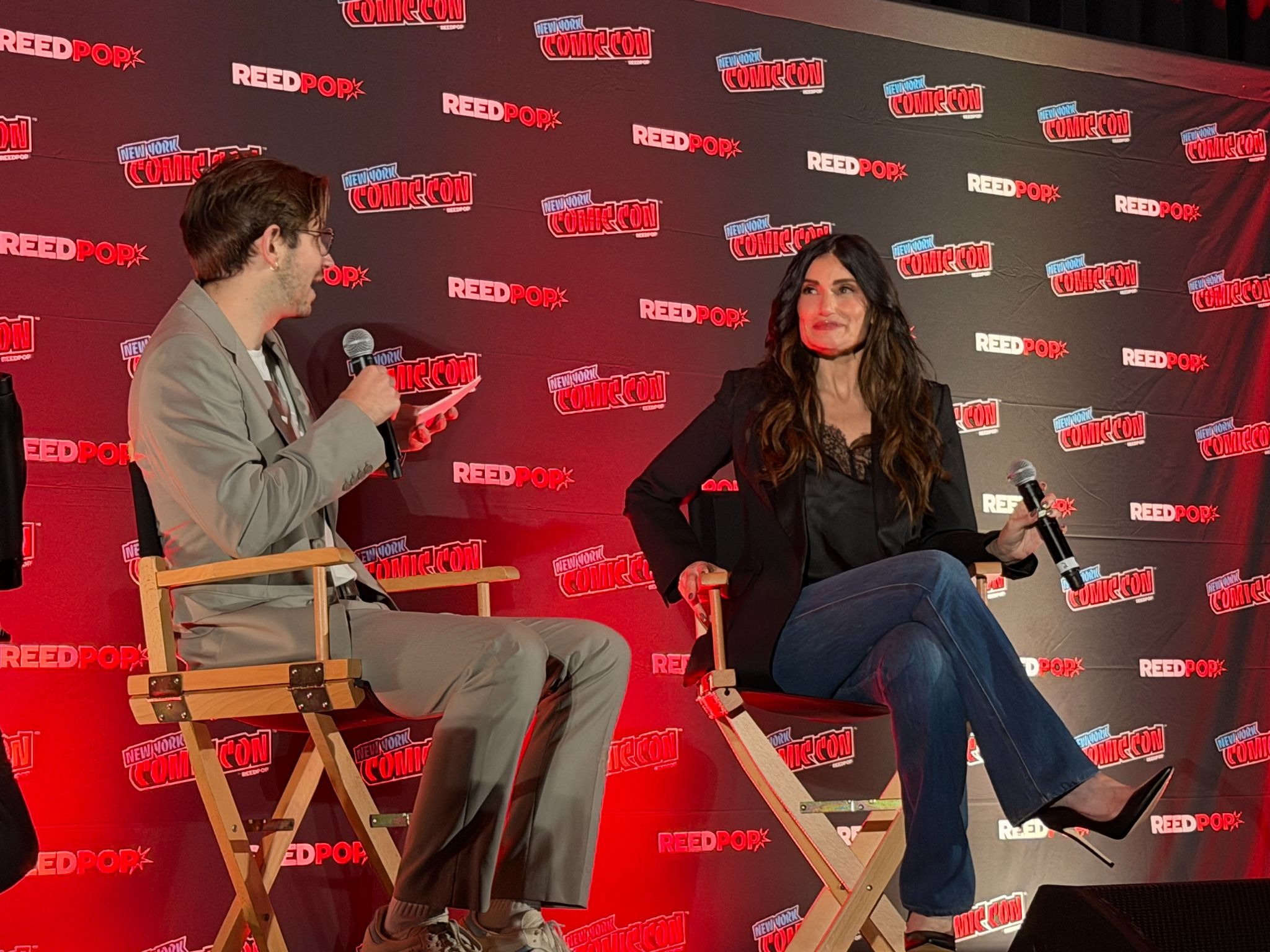
Frank opened by asking about the music that first inspired her. Menzel explained that the years she spent singing at weddings and bar mitzvahs forced her to learn everything, from jazz standards by Ella Fitzgerald and Sarah Vaughan to Madonna’s “Express Yourself,” Aretha Franklin, and Motown. Because nobody at those events was really listening closely, she had freedom to experiment. Her goal was to emulate, not imitate, absorbing what inspires her until it comes out in her own voice. She considered those gigs her real music education.
With Rent approaching its 30th anniversary, Frank asked where Menzel had been in life when the audition came along. She recalled driving her little red Nissan Sentra hatchback around the tri-state area doing wedding gigs, until the slow winter season left her needing work. A boyfriend who worked as an assistant at an agency heard that casting director Bernie Telsey was looking for unknown faces and slipped her headshot into the fax machine.
Menzel admitted, as a warning to aspiring performers, that she was never organized about her audition book. At her callback, she sang Bonnie Raitt’s “Something to Talk About,” forgetting that pop songs often end on a repeating coda meant to fade out on the radio. With no ending prepared, she and the pianist kept looping the final phrase while she shot him desperate looks to wrap it up.
When she received the sides for Maureen’s protest monologue, she couldn’t tell whether it was meant to be serious or comedic. Director Michael Greif suggested she think of it as performance art and pointed her toward artists like Laurie Anderson, telling her to imagine a woman who hadn’t found her own voice yet and took on others' voices. Menzel said the character became a tapestry of eccentric women. She also noted that the suede patchwork skirt Maureen still wears today was originally her own, and that much of the original cast’s wardrobe came straight from the actors’ closets.
The conversation turned serious when Frank asked about being at the center of a phenomenon for the first time. Menzel reflected on the death of composer Jonathan Larson during the show’s development, calling it an extremely sad time for the company. The show itself felt like a gift he left them, and the cast felt he was in the theater with them every night. That sense of purpose kept them humble, to the point that the cast performed eight shows a week for six months without anyone missing a performance, sick or not. Receiving accolades without Larson there to celebrate was bittersweet.
After a clip of “Take Me or Leave Me” from the 2005 film adaptation, Menzel revealed it was the last song Larson wrote for the show. He had replaced a different number from the previous year’s workshop after getting to know her and Fredi Walker, writing to their strengths and vocal styles. She described the magic of originating a role, standing at the piano while an excited composer plays a song written with you in mind. Because Maureen doesn’t appear until late in the first act, Menzel said she went weeks without being called to rehearsal, leaving her castmates wondering who this mystery Maureen was until they finally heard her sing.
Asked about the years between Rent and Wicked, Menzel explained that her dreams had shifted. Singing so many styles had made her want to write her own music and become a rock star in the vein of Alanis Morissette, and the Rent cast would come support her club gigs downtown. Rent finally got record labels to pay attention, and she landed her first deal (with Disney’s Hollywood Records), only to be dropped after the debut album didn’t sell. In hindsight, she said, that was when she should have been pursuing film and television, and she lost some momentum. Still, she considered herself fortunate that her career had been a steady series of next opportunities rather than one straight climb.
Frank asked about Andrew Lippa’s off-Broadway The Wild Party, and Menzel called that company one of her favorite casts of all time. She remembered Jennifer Cody leading spontaneous “naked dance” sessions in the dressing room, and a pact the cast made: if they got a bad review and didn’t transfer to Broadway, they would all take a trip to the Caribbean. When the New York Times review turned out to be a pan, they followed through with a trip to the Dominican Republic. Her run as Amneris in Elton John & Tim Rice’s Aida (from Disney Theatrical) also earned an honorable mention during this era.
Menzel joined Wicked during an early workshop, part of a development process she said took at least four years. Having read Gregory Maguire’s novel, which she noted is very different from the musical, she showed up to her first audition in Doc Martens, a black dress, and green lipstick, expecting a much darker, gothic Elphaba.
At her callback, she had to sing “Defying Gravity,” and she cracked badly on one of the big notes (“It’s MEEEEEE!”). Rather than let it derail her, she stopped, gathered herself, announced she'd try again, and nailed it. Director Joe Mantello later told her that recovery was the moment he saw the strength and ferocity Elphaba needed.
When Frank credited her with bringing Elphaba’s dry sense of humor to the role, Menzel deflected, saying the writers found it during the show’s out-of-town run in San Francisco, where Elphaba had previously been delivering mostly exposition. Once they started writing her with a wry edge alongside G(a)linda’s comedy, the character came alive.
Recalling the show’s initial reviews, Menzel said critics were not kind, and she remembered getting just one line in the Times review. Coming from Rent, she described herself as a natural naysayer who tried to keep success from going to her head. Her favorite gauge of a good night, she shared, was her mother, who listened to audience chatter in the theater restroom during intermission.
Following a clip of “Defying Gravity” from her Barefoot at the Symphony concert special, Menzel insisted she never tires of the song. She takes pride in never missing performances, and she now keeps several arrangements in rotation, from a stripped-down singer-songwriter piano version to a full-band take and a version with an 80-piece orchestra. Her longtime musicians still have to review before each show, she joked, because someone inevitably remembers a different version.
Menzel added the Rent film to Frank’s rundown of her post-Wicked screen work, joking that she was surprised the studio let her play Maureen roughly a decade later. She had still been recovering from an injury sustained in Wicked while learning to tango for the film and worried she wouldn’t heal in time. Enchanted followed, a film she remembered fondly for dancing with James Marsden and Patrick Dempsey.
Glee was more complicated. Menzel joined the show just months after her son Walker was born and was pumping breast milk in her trailer while the show’s young cast surrounded her. She admitted she couldn’t fit into her costumes and that her self-image was pretty low at the time.
Menzel said her path to Frozen began with a failed Tangled audition. Asked to sing something soulful in a recording studio, she performed the Beatles’ “Blackbird” with a guitarist friend. She landed somewhere between the right age and voice for Rapunzel and Mother Gothel, but didn’t get either part; the casting director quietly saved the recording on her phone and brought it back when Frozen was in development.
At the time, Elsa was still written as a straightforward villain without much heart. Menzel explained that once Robert Lopez and Kristen Anderson-Lopez wrote “Let It Go,” the filmmakers saw a character with pain and a big heart, and rewrote her to be far more complicated. Before the sisters had any duet, Menzel and Kristen Bell were asked to sing together at a table read. Bell suggested performing “Wind Beneath My Wings,” which they sang seated on either side of John Lasseter.
After a clip of “Let It Go,” Menzel said no one ever knows when something will become a phenomenon. She remembered leaving the audition crying because she related to the character and wanted the role so badly. She called voice acting the best job in the world, since you can show up in pajamas with no makeup, and described the metal bar the studio gave her to brace against while recording Elsa’s physical exertions, which she jokingly admitted could feel a little provocative.
Frank noted that Frozen’s explosion overlapped with Menzel’s Broadway run in If/Then. Menzel opened up about that period, sharing that she had been going through a separation from her husband while caring for her then-young son, who sometimes stayed in her dressing room. The show’s story of a woman exploring different life choices and finding her identity mirrored her own, and hearing “Let It Go” everywhere became a running irony. Even so, she said the period ultimately filled her heart with joy and forgiveness, and she loved sharing Frozen with her son.
The final topic was Redwood, the original musical Menzel developed for roughly 15 years and co-wrote the music for. She explained that it only got off the ground once director Tina Landau joined, and that its story of a woman finding a path through grief drew on the symbolism of redwood trees: their interconnected root systems that hold one another up, and their heartwood, which is dead inside yet incredibly strong. To her, it was a message about carrying the people we’ve lost as part of our story rather than letting grief break us.
Menzel was candid that the show’s timing had been difficult, opening in a crowded post-pandemic season alongside many other new productions, and as an original property rather than recognizable IP, which she wryly acknowledged given where she was sitting. She also had to time the move to New York around her son starting high school. She admitted she was heartbroken when the show didn’t run longer, and that it took her a while to let it go, a phrase that drew an immediate laugh from the room.
The panel closed with a single audience question from a mother and teacher, who asked what it meant to be the voice of a generation’s hero. Menzel called it the greatest gift of her life. She confessed she still flubs the opening verse of “Let It Go” on stage so often that her band mouths the lyrics to her, then proved her point by working her way through the opening lines on the spot. Every time she sings it, she said, it reveals something new about her, whether that comes from her own life or from the kids in the audience wearing blue dresses. The song, she concluded, never gets old.
Idina Menzel will reprise her role as Elsa in Walt Disney Animation Studios’ upcoming Frozen 3 and Frozen 4.