
Leslie Iwerks Brings "Disney Worldbuilders" to 2026 DVC Member Cruise


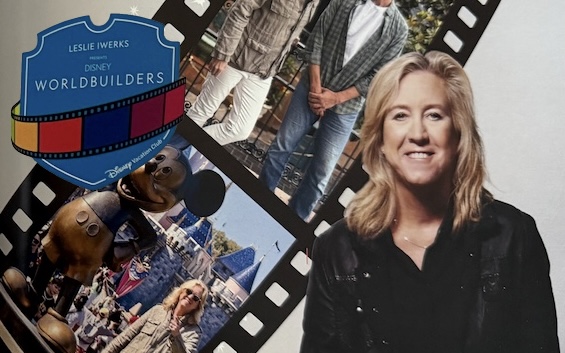
While most Disney fans have already caught Disney Worldbuilders on Disney+, guests aboard the Disney Vacation Club Member Cruise got to attend a special screening at the Walt Disney Theatre, which featured a pre-film conversation between the film’s director Leslie Iwerks and Disney Files Magazine editor Ryan March for a conversation. Their discussion touched on the film, Disneyland Handcrafted, The Imagineering Story and Iwerks' remarkable access to some of today's most influential filmmakers. But before looking at the storytellers defining Disney's present, March invited Iwerks to remember one of the people who helped shape her own life.
As we know, Leslie’s father, Disney Legend Don Iwerks, recently passed away at the age of 97. While Disney fans know him for a career that helped advance filmmaking and theme park technology, Leslie remembers something more fundamental. "My dad was just the nicest, kindest guy," Iwerks said. "He was such a humble man. He was a quiet inventor."
Don Iwerks spent 35 years at Disney, eventually heading the Studio Machine Shop and working on technologies ranging from 360-degree filmmaking to visual-effects systems used on projects including TRON and Star Tours. He worked alongside his father, Ub, continuing a family tradition in which creativity and engineering were often inseparable. For Leslie, however, these innovations were simply the projects her father talked about when she came home from school. He would work at home on his computer, designing a new lens or solving some technical problem, then eagerly attempt to explain it to his daughter. "He would go into great detail about it and tell me how he was designing it," Iwerks remembered. "And I would always glaze over because I didn't get it."
What stayed with her was his enthusiasm for sharing knowledge. Don wasn't merely interested in solving problems. He wanted other people to understand how those problems could be solved. His curiosity extended well beyond Disney. Don was also a private pilot and, Leslie revealed, once flew Walt Disney's airplane from San Francisco to Los Angeles. That fascination with aviation eventually produced one of Leslie's favorite memories from the final years of her father's life.
Even while living in a long-term care facility, Don remained fascinated by technology and followed Leslie's extensive travels through flight-tracking apps and Apple’s Find My feature. Wherever filmmaking took her, her father was effectively traveling alongside her. "He would be tracking me wherever I went around the world," she said. Even when she was driving, Don could sometimes spot a questionable navigational decision. "He would be like, 'Wait, you took the wrong turn. Where are you going?'"
The story drew laughs, but its meaning has changed since Don's passing. Leslie had become accustomed to knowing that somewhere her father was watching her progress across a digital map. "I swear to God, he's with me every day," she said. "I'm thinking, 'Well, where is he? He's not telling me where I am off the coast of Norway or whatever.'"
More importantly, Don was "my very, very best friend." As Leslie traveled the world documenting Disney history, she could tell her father where she had been, whom she had interviewed and what pieces of Disney history she was encountering. Because Don had lived so much of that history himself, he could experience it again through her.
Don also became an invaluable resource as Leslie began chronicling Disney history herself, particularly while making projects such as The Imagineering Story and Disneyland Handcrafted. He had witnessed Disneyland's development firsthand while working with Ub on specialized camera systems and other technologies. Among his projects was A Tour of the West, the Circle-Vision film shown in Tomorrowland during Disneyland's opening year. Ub and his team had only months to develop the 360-degree camera system needed to create it, putting Don close to the technological experimentation surrounding Disneyland from its earliest days.
That history was part of Leslie's childhood long before she considered turning filmmaking into a career. Her father sometimes worked weekends, and young Leslie would accompany him to the Disney Studio lot. While he worked, she explored. She remembers wandering around the backlot, visiting the old Zorro sets and finding Herbie, whom she considered one of her heroes. Don would also bring home 16mm films from the Studio. The family built a screening room at home, where neighborhood children gathered to watch Disney animation while Don explained how the films had been made. Between her father's technical work and the movies themselves, Leslie gradually became fascinated by what happened behind the camera.
That interest eventually led her to USC film school and, somewhat unexpectedly, documentary filmmaking. In retrospect, however, her subjects make perfect sense. Again and again, Iwerks has been drawn toward people willing to venture into unexplored territory.
March pointed out a common thread running through projects such as The Pixar Story, The Imagineering Story and Disneyland Handcrafted. Each deals with creative people taking enormous risks to make something that hasn't existed before. Iwerks believes those people share a defining characteristic. "They were original thinkers," she said.
Walt Disney may have drawn inspiration for Disneyland from Tivoli Gardens and other amusement destinations, but he didn't simply recreate what already existed. Pixar's filmmakers built on the traditions of Disney animation while simultaneously developing computer animation. Imagineers repeatedly used new technologies to create forms of themed entertainment audiences had never experienced.
Iwerks grew up surrounded by that philosophy. Her grandfather's career included Oswald the Lucky Rabbit, the Alice Comedies and, most famously, Mickey Mouse. Those projects repeatedly combined artistic creativity with technical experimentation. The Alice Comedies placed a live-action child into an animated world. Steamboat Willie pushed synchronized sound forward in animation. Ub would continue experimenting with new photographic and animation processes throughout his career.
For Leslie, the compelling part isn't technology for technology's sake. It is what happens when technology, creativity and entrepreneurship collide. "It's that idea between innovation, business and creativity that I think is fascinating," she said. That fascination ultimately provided the foundation for the film the Member Cruise audience was about to see.
The idea began while Iwerks was finishing Disneyland Handcrafted, her remarkable documentary assembled from archival footage of Disneyland's frantic construction before its 1955 opening. As she worked through the material, Iwerks became fascinated by a question the footage couldn't answer. What did it actually feel like for Walt Disney to walk through Disneyland after years of imagining it? One photograph stayed with her. Walt was aboard the Mine Train attraction surrounded by children, looking upward with unmistakable joy. "I just thought, I wish I could go back in time and ask him what that must have felt like," Iwerks recalled.
Then she realized there might be another way to explore the question. She couldn't interview Walt, but she could speak with contemporary filmmakers who had experienced something remarkably similar. Today's Disney directors have watched characters and worlds they helped create move beyond a movie screen and become physical environments visited by millions of people. "They are the legacy creators today," Iwerks said. "They're creating these brands and these characters and these stories that are beloved around the world."
After a conversation with a Disney executive on a Friday, Iwerks gave herself the weekend to develop the concept. By Monday, she had it: bring together the filmmakers responsible for some of Disney's modern stories and let them experience the physical worlds their work inspired. Then came what she assumed would be the difficult part: getting everyone to participate.
Iwerks described the moment she learned the filmmakers had agreed to participate as one of her own "How did I get here?" experiences. Coordinating some of the industry's busiest directors seemed daunting, but the invitation turned out to be irresistible.
The proposition was essentially: would you like to walk around Disneyland, talk about what inspired you, visit the lands your movies inspired and ride the attractions? "Are you kidding?" was essentially the response.
Iwerks recalled exploring Fantasyland with Jared Bush, but one of the most memorable experiences came with Frozen filmmaker Jennifer Lee at Disneyland Paris. Lee had not yet experienced World of Frozen there, giving Iwerks the rare opportunity to capture a creator encountering a theme park interpretation of her own work for the first time. Rather than over-direct the moment, Iwerks and her crew tried to disappear. "We're gonna be flies on the wall," she remembered telling Lee.
Then documentary filmmaking delivered one of those unexpected gifts that no amount of planning can manufacture. Iwerks discovered that Lee's sister would soon be arriving from the airport. She quickly changed the plan and asked whether the sisters might experience the attraction together. The resulting footage took on another dimension once Iwerks interviewed Lee afterward and heard more about the relationship between the sisters and its connection to the emotional foundation of Frozen. "It was the gifts that you get when you just kind of be in the moment when you're making a film," Iwerks said. "Things come to you."
That ability to recognize an unexpected story may be as important to documentary filmmaking as meticulously planning one. The director can create the conditions for something meaningful to happen, but sometimes the best moments arrive on their own.
For March, the film worked partly because it demonstrated that the people responsible for creating beloved Disney stories can be just as emotionally connected to them as the fans who experience them. But he also saw another theme running through Iwerks' work: the value of taking risks and betting on an idea that may initially exist only in one person's imagination. That is precisely what Iwerks hopes audiences take away from the film. "I've always hoped that this would inspire that one aspiring filmmaker out there, or a storyteller, to believe in themselves," she said.
A filmmaker begins with an idea. An animator begins with a drawing. An Imagineer begins with a concept for a place that doesn't exist. Somehow, through a combination of creativity, persistence and collaboration, those ideas can eventually become stories and experiences shared by people around the world. Iwerks has seen the results firsthand while traveling among Disney's international resorts. The language and culture may change, but characters such as Mickey Mouse, Anna and Elsa remain instantly recognizable. "It's amazing that Frozen or Anna, Elsa or Mickey Mouse, for that matter, are so beloved everywhere," she said. "That's powerful."
It also connects Leslie's work back to the family history that opened the conversation. Ub Iwerks spent his career creating things that didn't exist. Don Iwerks quietly devised machines and technologies capable of doing things filmmakers couldn't previously accomplish. Leslie has chosen a different medium, but she continues examining the same fundamental impulse.
For three generations, the Iwerks family story has been intertwined with people looking at an empty page, an engineering problem, an untested technology or an impossible idea and wondering what might happen if they tried something new. "It's one thing to be smart," Leslie said, "but it's another thing to be an original thinker."
Her documentaries preserve the stories of those original thinkers, but Iwerks isn't merely interested in looking backward. If the films do what she hopes, somewhere in an audience may be another filmmaker, animator, Imagineer or storyteller beginning to wonder whether an idea everyone else considers impossible might actually work.
You can catch Disney Worldbuilders at home on Disney+.