
Storybook Magic Revisited: "The Book of Pooh" Turns 25


For many Playhouse Disney kids, The Book of Pooh exists in a warm, honey-colored corner of memory, complete with its charming pop-up-book sets that made the Hundred Acre Wood feel both familiar and dreamlike. But behind its gentle tone and preschool storytelling was one of the most technologically radical productions Disney Channel had ever attempted. And, just like Bear in the Big Blue House before it, the series was the product of a creative gamble by one of children’s television’s most innovative minds: Mitchell Kriegman.
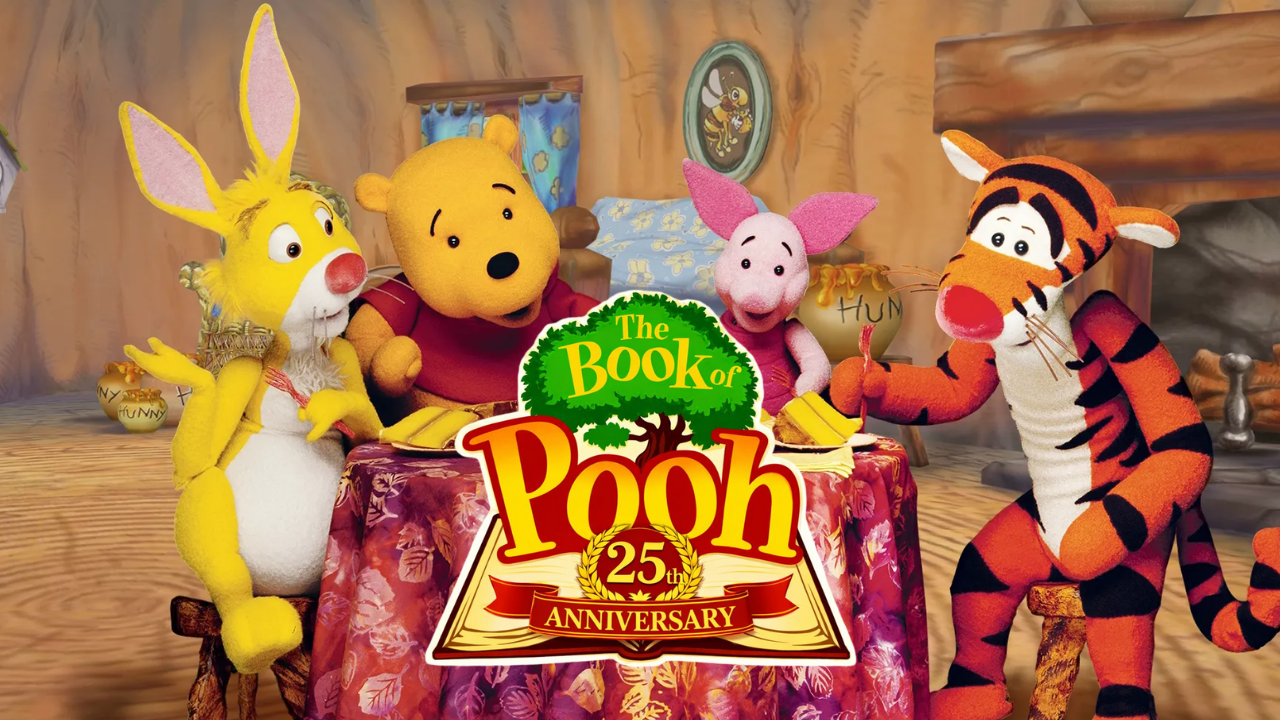
As adults revisit the series in honor of its 25th anniversary, it becomes clear that The Book of Pooh wasn’t just another Pooh show. It was a bold experiment in puppetry, virtual sets, and hybrid storytelling that connected directly to the puppetry renaissance ignited by Bear in the Big Blue House.
When The Book of Pooh premiered on January 22, 2001, audiences saw a cozy new vision of A. A. Milne’s characters. What they didn’t see was the room-sized green void where the series was actually shot, or the puppeteers fully suited in neon green, performing three-person puppets inspired by Japanese Bunraku theater. All of that came from Mitchell Kriegman.
Kriegman — creator of Nickelodeon’s Clarissa Explains It All, longtime Henson collaborator, and the mind behind Bear in the Big Blue House — had been thinking about the future of puppetry in a world of rising CGI. As he put it in a later interview, he wanted a technique that kept puppets warm, tactile, and real, but also pushed them into “the digital age.”
He found his answer in a fusion: Bunraku-style multi-performer puppetry + real-time CGI sets = a new technique he called Shadowmation.
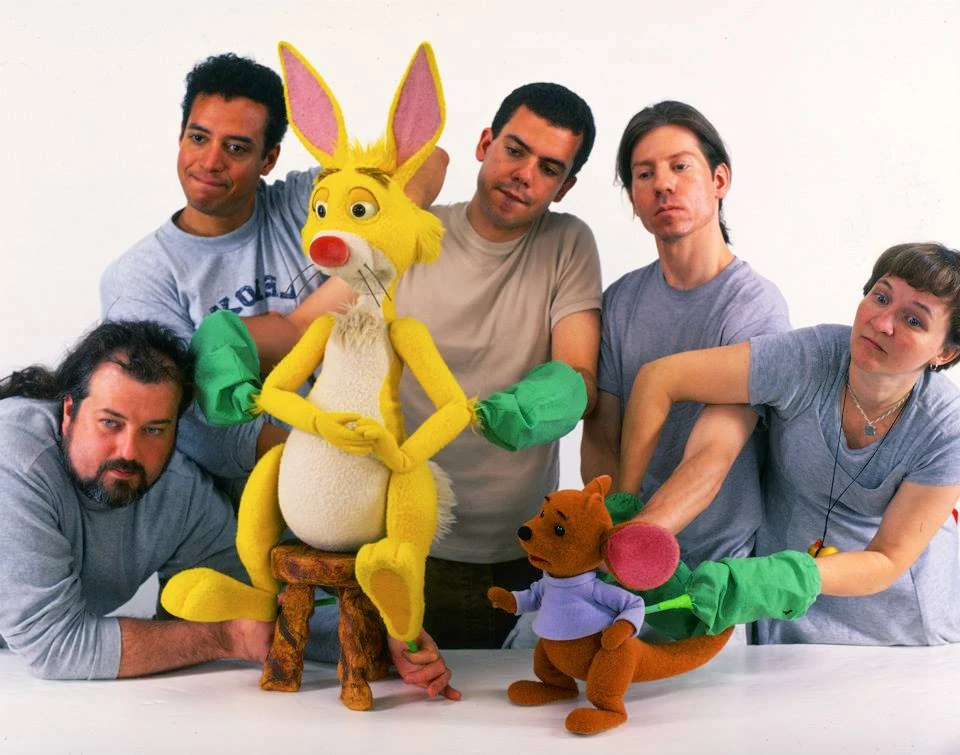
Rather than hiding puppeteers behind floors and walls, the team embraced visibility: performers stood behind the characters in full green suits, lit precisely so computers could key them out. The result, which seems normal now, was revolutionary for children’s TV.
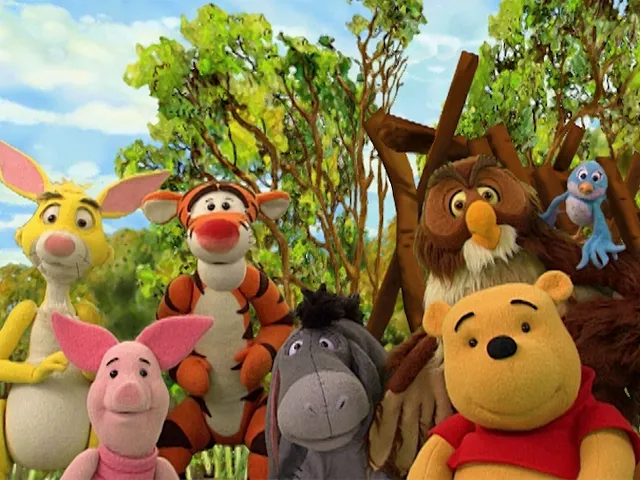
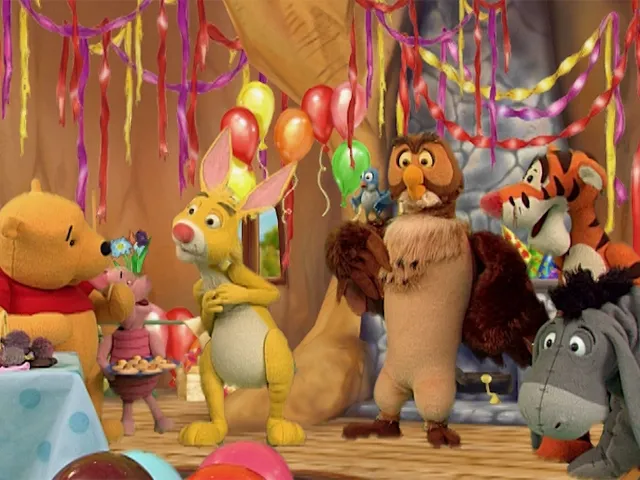
Pooh, Tigger, Eeyore, Piglet, and the rest weren’t digital avatars; they were puppets with weight, texture, seams, and handmade charm. The virtual camera moved through storybook spaces that shifted in real time with each pan and tilt, giving the show its signature pop-up-book feel.
Chris Renaud, who later co-directed Despicable Me, designed the production, giving the show a visual identity that felt simultaneously old-fashioned and completely new.
To the preschool audience, The Book of Pooh and Bear in the Big Blue House existed side by side on Playhouse Disney. But behind the scenes, the connection ran deep. Both shows came from Shadow Projects, were created (or co-created) by Mitchell Kriegman, used puppetry rooted in live theater traditions, integrated music heavily (sometimes as emotional catharsis, sometimes as learning tools), and mixed education with storytelling in ways that felt invisible to adults but resonated deeply with children.
Where Bear focused on social-emotional learning and preschool life skills, The Book of Pooh quietly emphasized literacy. Episodes often revolved around reading, journals, to-do lists, calendars, or the physical act of interacting with a book, an intentional choice by Kriegman, who noted in interviews that children in focus groups sometimes said they were “watching a book.”
Meanwhile, the puppet-building, character performance, and green-screen techniques pioneered on The Book of Pooh informed later seasons of Bear, particularly as Disney and Shadow Projects considered aging the show up for its older viewers.
Even in tone, the shows were siblings: Bear offered warmth and welcome, while The Book of Pooh invited reflection and imagination.
The series required a small army of puppeteers — many of them also Henson alums — to perform characters with multiple operators:
- Peter Linz (later the performer for the 2011 revival of Walter in The Muppets) performed Pooh
- Tyler Bunch handled Tigger’s athletic movements
- Noel MacNeal, the performer of Bear himself, lent his experience to complex characters like Rabbit
- Stephanie D’Abruzzo, Broadway performer and Avenue Q original cast member, brought Kessie to life
- Ron Binion, principal puppeteer for Eeyore, also designed and built the puppet
Eeyore was uniquely difficult. As the only quadruped, his legs had to be manipulated using green rods that couldn’t cross his body, or the chroma key would glitch. Performers described it as one of the most precise and delicate puppetry tasks on the series.
Meanwhile, actors like Jim Cummings (Pooh/Tigger), Andre Stojka (Owl), Kath Soucie (Kanga), and Ken Sansom (Rabbit) carried vocal continuity from decades of Disney’s Winnie the Pooh productions.
The show’s pop-up-book aesthetic came from blending fully virtual environments with select real props — branches, furniture, bed frames, picnic baskets — to give puppets something to physically touch. Everything else existed only in the computer’s memory. Even Christopher Robin’s bedroom was a hybrid: real set pieces merged seamlessly with photographed walls rendered virtually.
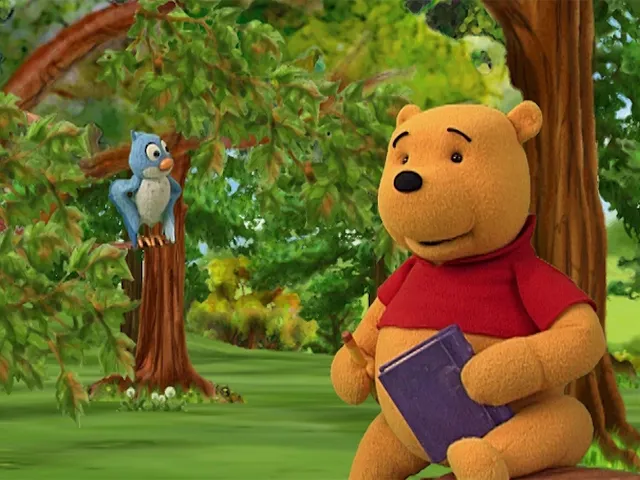
Kriegman’s approach was to embrace all eras of Pooh — Milne’s books, the early Disney shorts, and the 1988–1991 animated series — and distill what he called the “quintessential version of Pooh.” That included bringing back Kessie, the beloved bluebird who previously appeared only twice in The New Adventures of Winnie the Pooh. For Kriegman, it was essential that the Hundred Acre Wood include at least one recurring girl character who wasn’t a mom.
The result was a hybrid continuity that felt comforting to existing fans yet imaginative enough to stand on its own, appealing to the older preschoolers the series deliberately targeted.
By the time the series wrapped in 2003, The Book of Pooh had aired 51 episodes, released a feature-length DVD, and garnered two Emmy Awards. Yet its impact is often underestimated.
Today, it stands at a fascinating intersection of children’s television:
- The last major era of physical puppetry on Disney Channel
- The early experimentation with virtual sets that would later become standard
- A technological sibling to Bear in the Big Blue House
For those who watched it as children — many now in their late 20s and early 30s — The Book of Pooh represents something rare: a show that was gentle without being simple, experimental without being flashy, and fundamentally built on craft.
Kriegman once said that puppets have something CGI characters never will: warmth. And that warmth, combined with the dreamy storybook visuals of Shadowmation, is why the show remains so vividly remembered today.
Twenty-five years later, Pooh still looks like you could reach out and grab him. And for a technique born in a room full of green fabric and computers humming in 2001, that might be the most magical thing of all.
Revisit your childhood memories of The Book of Pooh anytime on Disney+.