
DVC Member Cruise Panel Recap: "Part of Our World: Disney Inspirations in Scandinavia" with Jodi Benson, Tony Baxter, Bob Weis, and Becky Cline


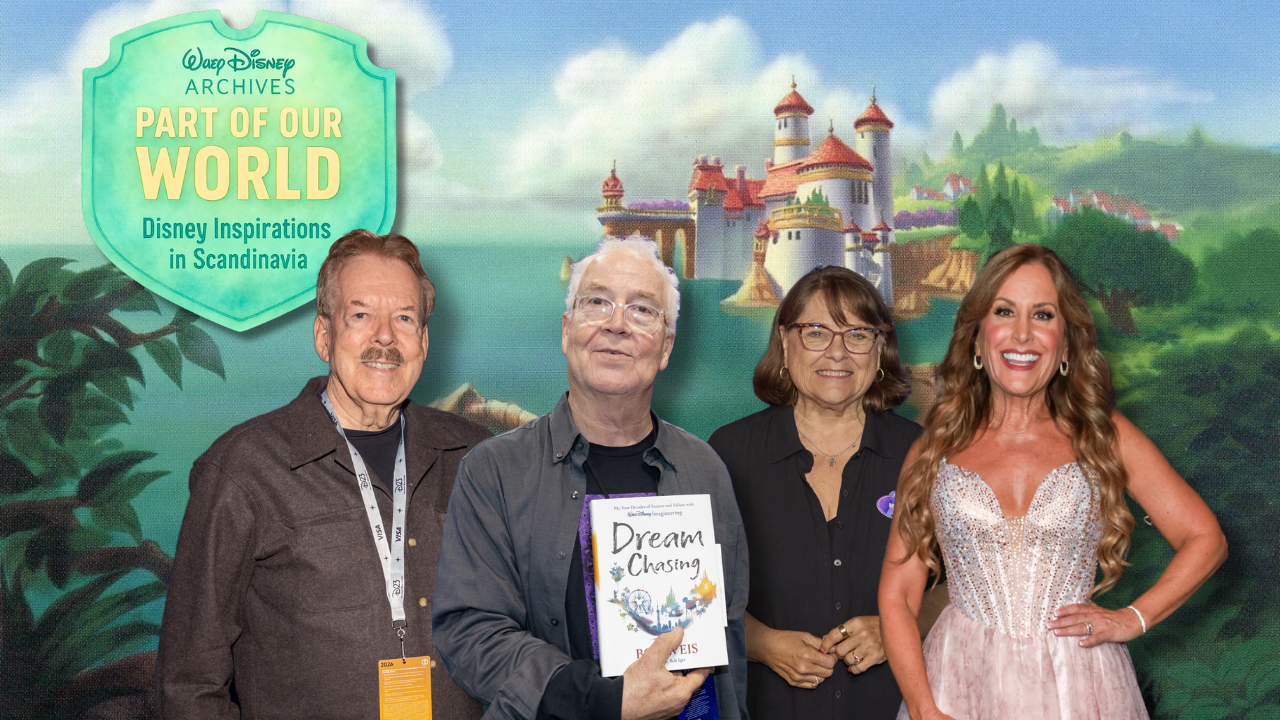
Disney Vacation Club's 2026 Member Cruise is sailing the Disney Dream through Northern Europe this week, and with Copenhagen's Tivoli Gardens on the itinerary for Thursday's port day, the onboard entertainment lineup included a panel built entirely around the region the ship is currently exploring. Part of Our World: Disney Inspirations in Scandinavia gathered a small group of Disney insiders in the D-Lounge to trace just how much of Disney's storytelling history actually begins in this part of the world.
Tony Baxter and Bob Weis on Tivoli, Walt, and the Craft of Imagineering
The host was Disney Legend Jodi Benson, who, as the voice of Ariel in The Little Mermaid (1989), has a more personal stake in this topic than most. Benson's first guests were two of Imagineering's most decorated veterans: Tony Baxter, the Disney Legend and former Imagineer behind Big Thunder Mountain Railroad, Splash Mountain, Star Tours, and Indiana Jones Adventure, who also served as executive producer overseeing the creation of Disneyland Paris; and Bob Weis, a second-generation Imagineer who spent four decades at the company, eventually rising to president of Walt Disney Imagineering, with credits spanning Disney's Hollywood Studios, the reimagining of Disney California Adventure, and parks in Tokyo and Shanghai.
The conversation turned to Copenhagen's Tivoli Gardens, which many DVC members aboard the cruise are set to visit on Thursday. Benson pointed out how Walt Disney's famous description of Disneyland as a place that will never be completed, so long as there's imagination left in the world, echoes a description Tivoli's own founder, Georg Carstensen, is said to have given of his park more than a century earlier, calling it likewise never truly finished. Weis said the parallel wasn't a coincidence; both parks have endured for the same reason, because their founders and everyone who followed them understood that a park has to keep moving forward, constantly refreshing itself and reconnecting with its audience rather than resting on its history. He said Imagineers today still operate by that same instinct, thinking of guests first and always looking for what's next. Baxter agreed, adding that Imagineering's guiding principle has always been to take guests somewhere they couldn't otherwise go, and that the "never completed" idea is really just an acknowledgment that the budget never quite covers every dream on the table at opening day, so the growth continues indefinitely by necessity as much as by philosophy.
Benson then pivoted to nighttime at Tivoli, which DVC cruisers will get to experience for themselves on Thursday, and asked Weis about a connection he'd made to the 1950s TV series Walt Disney's Wonderful World of Color and its "Disneyland After Dark" episode. Weis said he'd become a little obsessed with a clip from that episode showing Walt at sundown in the park, and the group watched a short excerpt together before Weis explained its relevance: that footage, he said, captures exactly what Walt envisioned Disneyland could be from the start; a living, constantly programmed place, one where Weis recalled seeing real jazz legends like Lionel Hampton and Louis Armstrong perform live. He said Tivoli operates on that same principle after dark, where the point isn't just riding attractions but simply strolling, people-watching, and soaking in the atmosphere.
Bringing Tivoli's Lessons to Disneyland Paris, and Back to Tivoli Itself
Jumping back to 1990, Tony Baxter was leading the creation of Disneyland Paris and personally toured then-Disney CEO Michael Eisner and president Frank Wells through Tivoli. Baxter explained that the visit was as much about competitive due diligence as it was about inspiration, ensuring Eisner and Wells understood everything Disneyland Paris would effectively be competing against. He described Tivoli's atmosphere as full of sparkle and light, and said the park essentially transforms three times over a single day: a charming, family-oriented morning with nannies and children and toy-soldier parades; a livelier afternoon shift once local schools let out, complete with arcade games and a legal drinking age lower than guests might expect; and a spectacular nighttime identity built around dining, opera, and other cultural programming. Baxter said he had to talk Eisner and Wells into staying late enough to see Tivoli after dark, since, given that the park is roughly a third the size of Disneyland, nighttime is when it truly earns its reputation as a cultural institution for all of Copenhagen.
Bob Weis shared a Walt Disney quote he uncovered while researching with the Walt Disney Archives for his new book Dream Chasing: My Four Decades of Success and Failure with Walt Disney Imagineering, one that had never previously surfaced in writing or on video. Weis said the Archives turned up documentation of Walt describing his many visits to Tivoli beginning around 1951, during the formative years of Disneyland's development, and Walt's own words crediting Tivoli's cleanliness, friendly spirit, and civic pride as directly inspiring qualities he sought to build into Disneyland himself.
Baxter, for his part, described a more recent chapter: a consulting stint at Tivoli where he lived at the on-site Tivoli Hotel for a couple of weeks, brought in specifically because the park's leadership admired the immersive, narrative approach to guest experience that Baxter had built his career on, something Tivoli's traditionally more generic, carnival-style attractions hadn't fully explored. He shared photos from that visit, including one atop Tivoli's wooden roller coaster. Baxter also recounted meeting Queen Margrethe II of Denmark, who was working with the same Imagineering-adjacent team as costume designer for Tivoli's then-upcoming production of The Snow Queen and specifically asked not to be treated differently from anyone else in the room, despite the obvious.
Somewhat off-topic, Bob Weis teased his forthcoming book built from the personal archive of his mentor, the late Disney Legend Marty Sklar. Weis said that after Sklar's death, he discovered roughly 1,500 boxes of material Sklar had saved and boxed up over his 50-year Disney career, everything from unused Disneyland opening-day tickets and parking passes to signed notes from Walt to Ray Bradbury's original typewritten scripts for what became Spaceship Earth. Weis said the book, drawn from five years of cataloging that collection, will be the first release built from those materials.
Becky Cline and Scandinavia's Fingerprints on Disney Film and TV
Jodi Benson's next guest was Becky Cline, director of the Walt Disney Archives, who succeeded founder Dave Smith. Cline and Benson worked through a run of Disney productions actually filmed on location in Scandinavia. In the early 80's, Lucasfilm’s The Empire Strikes Back filmed the frozen planet Hoth scenes in Finse, Norway, chosen for its glacial tundra as well as a nearby hotel that could house the crew, though Cline noted the shoot itself was brutal, with temperatures near -22 degrees and winds fierce enough to make reloading cameras and recording sound difficult, forcing the crew to frame shots carefully to hide the warm building just out of view. Disney's 1986 film Flight of the Navigator filmed its Florida-set scenes at home but traveled to Oslo, Norway for the spacecraft's interior sets and to nearby glaciers for aerial mountain footage. On the Marvel side, Cline connected Captain America's Hydra plotline (filmed in Norway, tied to the Tesseract's discovery) through to Black Widow, shot partly in Tønsberg and Sandefjord, the latter where Natasha Romanoff's character flees after the events of Captain America: Civil War, noting that star Scarlett Johansson is herself of Scandinavian descent. Cline also flagged Disney+'s 2023 Peter Pan & Wendy as another recent production with Scandinavian ties.
The conversation then turned to Frozen, whose fictional kingdom of Arendelle is nonetheless rooted in real Scandinavian research. Cline explained that location research trips are a long-standing Disney animation tradition dating back to Walt himself, who sent photographers into real forests during production on Bambi so animators could get the backgrounds right, and that the same instinct sent animators to Africa for The Lion King, China for Mulan, and Colombia for Encanto. She said this attention to authentic backgrounds, not just character animation, is part of what makes animated worlds feel believable even when they're entirely imagined. The panel then played a short highlight reel from the Frozen filmmakers' actual research trip in Scandinavia, including footage of a volcano visit.
The Norway Pavilion, a King's Gifts, and Four Scandinavian Disney Legends
From there, Cline and Benson discussed Frozen's theme park legacy, including the new World of Frozen land at Disneyland Paris and Frozen Ever After at Epcot's Norway Pavilion. Cline shared that when the pavilion opened in 1988, the actual King and Queen of Norway sent gifts to honor Walt Disney's memory, which now live in the Archives' collection as a kind of long-term safekeeping arrangement for items too significant to simply hand back. Then-Crown Prince Harald actually traveled to Walt Disney World for the pavilion's dedication, appearing in a photo Cline displayed alongside singers performing Norway’s national anthem. Benson used the moment to note, solemnly, that Norway's King Harald V passed away just days earlier, and that guests should expect to see memorials and tributes to his decades-long reign when the ship reaches Norway, alongside recognition of his son's new reign as king. Cline added that Walt himself had received a Viking helmet and a supposedly thousand-year-old Viking spear as gifts from Scandinavian Disney merchandising executives decades earlier; the spear was inscribed with a plaque dedicating it to Walt as history's great storyteller, in honor of Scandinavia's own great historical figures. The helmet remains at the Walt Disney Family Museum.
Cline and Benson then highlighted four Scandinavian figures who left their mark on Disney history. The first was Bjorn Aronson, hired as an animation assistant shortly after Disneyland opened in 1955, whose obvious artistic talent led Disneyland art director Bruce Bushman to move him into creating the park's now highly collectible silkscreen attraction posters. Next was Disney Legend Gunnar Mansson, who spent more than 25 years as Disney's chief representative across the Nordic countries, overseeing licensing, merchandising, and publishing, and was specifically responsible for launching the Donald Duck comic magazine, which became dramatically more popular in Scandinavia than it ever was in the United States.
Rewinding further, Cline discussed Swedish illustrator Gustaf Tenggren, whom Walt hired in 1936 after returning from a European research trip, laden with fairy-tale storybooks. Tenggren worked on The Old Mill and Snow White and the Seven Dwarfs before staying on for Pinocchio, whose depiction of Geppetto's village closely resembles Rothenburg, Germany, a town Tenggren knew well. Finally, the panel turned to Danish artist Kay Nielsen, who joined Disney in 1939 and contributed to Fantasia's "Night on Bald Mountain" segment, as well as early concept art for a proposed Hans Christian Andersen adaptation of The Little Mermaid, art the panel displayed, including an early, red-haired mermaid design that predates the eventual 1989 film by decades.
A Rare Look Inside the Archives — and Walt's Own Vision for The Little Mermaid
With the stage set, Benson and Cline turned to the day's real emotional centerpiece: two video segments filmed at the Walt Disney Archives ahead of the cruise. The first showed Cline's reading room stocked with rare Little Mermaid ephemera Benson said she'd never seen before, despite decades of collecting related memorabilia herself, including original story sketches loaned to the Archives by Frank Thomas and Ollie Johnston for their book The Disney Villain, a Little Mermaid sound story theater playset, animator reference models, and an original press kit. Benson pointed out that The Little Mermaid was the first movie she ever attended as a Disney employee, having started with the company in September 1989, a coincidence Cline said connected the two of them long before they'd actually met. The pair also paged through a 1992 fan magazine spotlighting Benson as Ariel's "real person" voice.
The second video took viewers into Walt's preserved office and working office at the Walt Disney Studios lot, meticulously restored based on photographs and inventories taken by founding archivist Dave Smith shortly after Walt's death, with the Archives formally taking over the space's preservation in 2015 under a budget approved by Bob Iger. Cline pointed out several Scandinavian items Walt kept on display: a replica of Copenhagen's iconic 1913 Little Mermaid statue by Edvard Eriksen; a statuette of Hans Christian Andersen given to Walt in 1951 by a Danish newspaper illustrators' society; a second Little Mermaid statuette from Royal Copenhagen, gifted to Walt in 1964 by a Tivoli tour guide during a Disneyland-Tivoli exchange program.
The genuine revelation, though, was a set of story meeting notes Cline had located, dated all the way back to 1941, evidence that Walt himself had begun development on a live-action/animation hybrid Hans Christian Andersen film with The Little Mermaid at its heart, just after finishing Snow White. Cline read through Walt's own handwritten comments describing his vision for a musical structure built around a recurring theme: a preparatory sequence leading into the mermaid's rise to the surface, her arrival and time above the waves, a budding romance, a storm, and finally a love theme as she brings the human she loves to shore. The notes also included input from Kay Nielsen, who wanted the songs to carry the spirit of the North, and reflections from a colleague about a haunting, elusive melody that resurfaces throughout the story, much as Benson’s Prince Eric is haunted by Ariel’s melody. Benson, visibly moved, said she'd never known her film's roots ran that deep, or that Walt's fingerprints were on the project so many decades before she ever recorded a line of dialogue.
A Song to Close the Show
To thank Cline for the discovery, Benson closed the presentation the way she said felt most appropriate: with a song. She welcomed Disney concert music director and pianist Benjamin Rauhala to the stage to play piano while she sang "Part of Your World" live, bringing the Scandinavian-inspired presentation full circle with the very song most directly tied to the region's influence on Disney history.
Part of Our World: Disney Inspirations in Scandinavia was presented exclusively for guests aboard Disney Vacation Club's 2026 Member Cruise, sailing the Disney Dream on a seven-night Northern Europe itinerary from Southampton, with a full day in Copenhagen, including Tivoli Gardens, set for Thursday, September 3rd. Stay tuned for more coverage of this voyage’s unique offerings.
(Please note this article contains affiliate links. Your purchase will support LaughingPlace by providing us a small commission, but will not affect your pricing or user experience. Thank you.)