
New "Fight Club" 4K Restoration Got a Premiere Screening and a Look Back at the Battle Over its Marketing Campaign


Both rule number one and rule number two is you're not supposed to talk about Fight Club, but those rules were broken in a fascinating way Wednesday night at the Academy Museum in Los Angeles, alongside the world premiere screening of the new 4K restoration of the beloved film, prior to its upcoming one-night nationwide theatrical screenings and debuting on disc and digital. The screening included an insider's look back at the highly contentious debate over how to market the decidedly subversive and provocative film, which found the filmmakers and cast frequently at odds with the studio releasing the movie, 20th Century Fox (now 20th Century Studios).
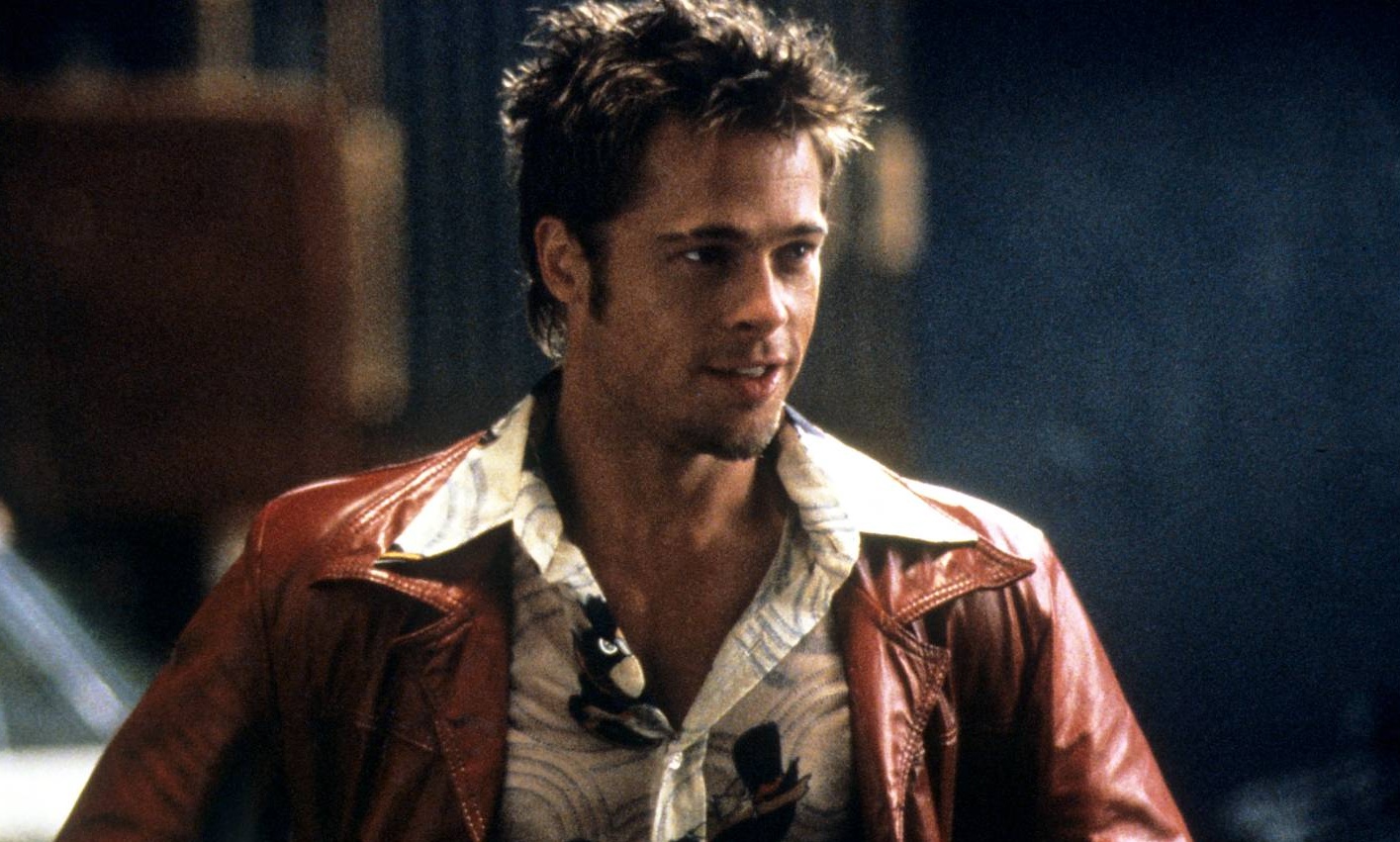
As a longtime fan of Fight Club, it was a thrill to see it on a big screen again, with the new 4K transfer looking terrific and highly detailed but not, thankfully, causing a movie that purposely exists within a world filled with so much grit and grime to look too clean and pristine. The sound presentation was also better than ever, capturing every brutal punch -- and eventually explosions -- along the way as the Narrator (Edward Norton) and Tyler Durden (Brad Pitt) grow their following. The film's examination of consumerism and angry and aimless disaffected men remains as compelling, satirical, and darkly witty as ever, and even though it's been used in so many TV shows and films since, "Where is My Mind?" remains a perfect needle drop at the film's conclusion.
The screening was presented by the Marketing and Public Relations Branch of the Academy, and thus the film's marketing campaign was the focus of the pre-screening guest speaker presentation. Fight Club has an interesting place in cinema -- and marketing -- history, as in its initial 1999 release, it was highly divisive with critics and a box office bomb. However, it went on to became a sensation via the home video market, gaining an ever-growing cult following and a critical re-evaluation as the years went by.
As Academy Governor David Dinerstein noted in his intro at the screening, "When Fight Club was released in 1999 by 20th Century Fox, it posed a unique challenge... The film defied easy categorization. Was it a crime thriller, a dark comedy, a psychological drama? In truth, it was all of those and something else entirely. Marketing a film like Fight Club meant grappling with its tonal complexity, its subversive themes and, of course, its unforgettable twists - elements that made it compelling but also difficult to distill into a traditional marketing campaign."
However, Dinerstein added, "In retrospect, the very elements that made Fight Club difficult to market -- its audacity, its controversy, its refusal to conform -- are precisely what cemented its lasting cultural impact. Fight Club is not just a movie, it has become a cultural event."
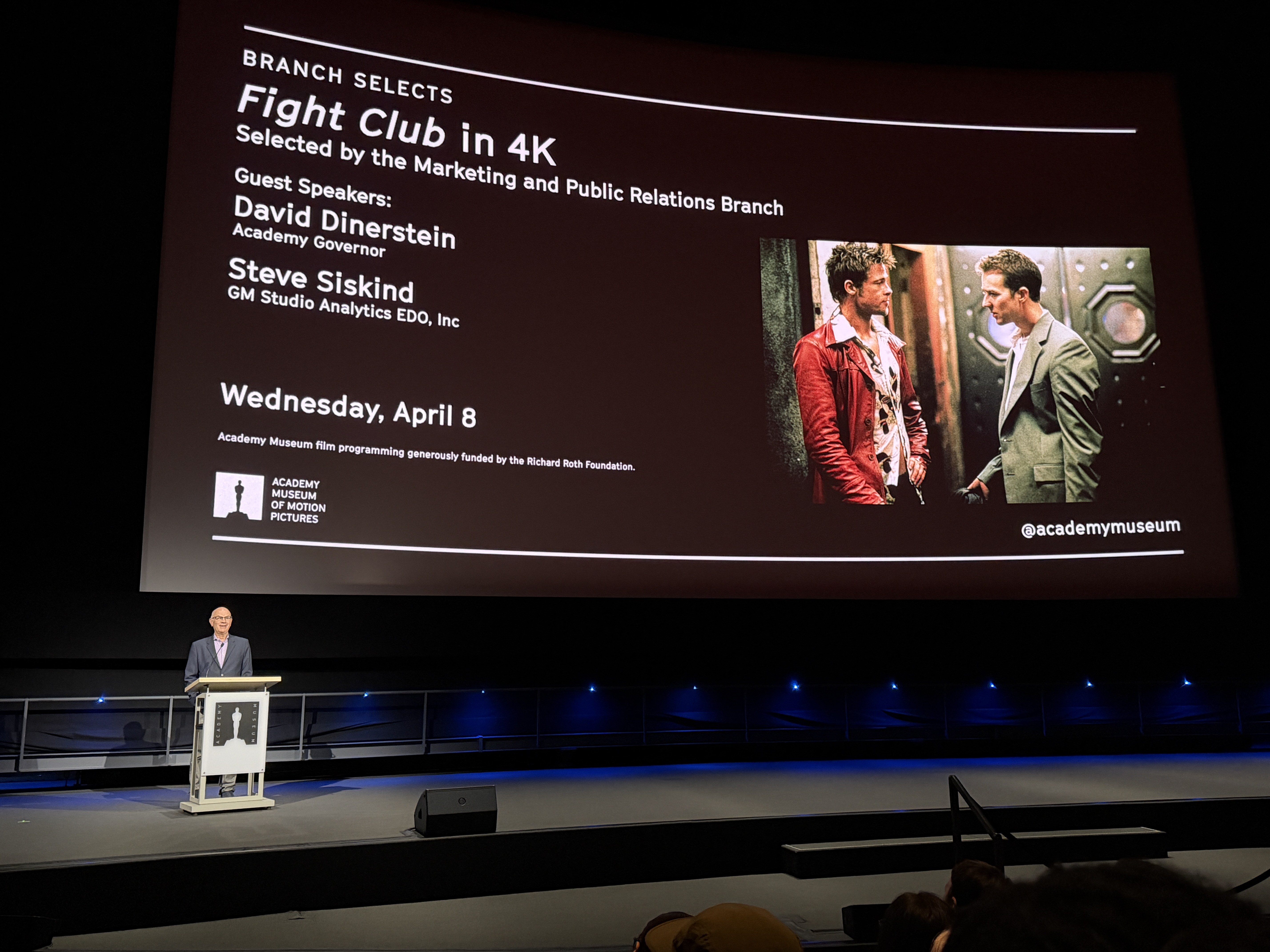
The main speaker of the evening, Steve Siskind, was the head of Media at 20th Century Fox at the time Fight Club came out, which gave him plenty of insight into the struggle over how to market it. As he put it, "It's not an exaggeration to say that Fight Club was one of the most contentious and fascinating marketing campaign processes I've ever witnessed."
Siskind noted that acclaimed director David Fincher had begun his career making commercials for major brands, and had "What could be described as a mutual attraction and repulsion towards the advertising industry. He liked to push boundaries and the discussion about Starbucks product placement in the film, which would end in his mind with blowing up the store, probably best illustrated his unconventional approach to the subject." In the final film, while Starbucks is depicted as one of many examples of modern mass consumerism, the franchise coffee shop that is blown up later on is not a Starbucks, but rather a fictional one created for the movie.
As Siskind described it, "The power of the film was just simply too layered, metaphorical and purposely contradictory to conform to conventional marketing wisdom." This put Fincher, producer Art Linson, and Pitt and Norton in conflict with the studio, because rather than lean into any attempt at traditional, mainstream marketing, "They wanted to confront audiences and shake them out of their comfort zones with a film not about fighting or charismatic stars in familiar roles. They saw a film intended for prestige filmgoers, chock full of intellectual and ultra topical ideas, and in Fincher's vision, a comedy, albeit a pretty dark one. His film's mission was to entertain, but also to gain a deeper understanding of just how crazy and untenable certain movements in society have become. So the face off came down to a traditional campaign versus Fincher's vision."
Siskind praised the Wieden and Kennedy firm -- famous for the Nike "Just Do It" campaigns -- for coming up with some of the film's most creative marketing ideas, including the mock PSAs featuring Pitt and Norton that would suddenly get more subversive near the end. Siskind noted at the time, the studio saw the burgeoning internet in general and any marketing placed there as very niche, so that's where those PSAs were mostly released.
Looking back, Siskind recalled a particularly tense back and forth about the decision to buy ads for Fight Club on WWE (then still called WWF) programming, along with boxing and other sporting events. As Siskind put it, "The filmmakers used this as their main proof point that Fox didn't understand that this was a thinking person's theatrical character movie. Despite all the intellectual and cinephile targeted media we also bought, their rallying cry was that we had done the most obvious and dumbed down thing possible- buying fights for Fight Club."
After Fight Club was a box office bomb, Siskind noted the home media team were encouraged to lean into more unorthodox approaches than the theatrical team had, remarking, "They had a very different experience with the filmmakers. In fact, they both described it as the happiest first meeting they ever had with the director. After the total failure of the theatrical window, home media executives were given the freedom to implement much of the filmmakers vision, as well as their own most unconventional ideas. Case in point was the DVD packaging - a brown cardboard wrapper with a thread around it and the film's title diagonally scrawled across it, in place of the usually flashy, glossy box art." Siskind also humorously recounted how Fincher and others provided a commentary track for the movie on that DVD that openly criticized the theatrical marketing campaign, adding "They even showed home audiences side by side comparisons of the commercials Fox used versus his own rejected ones."
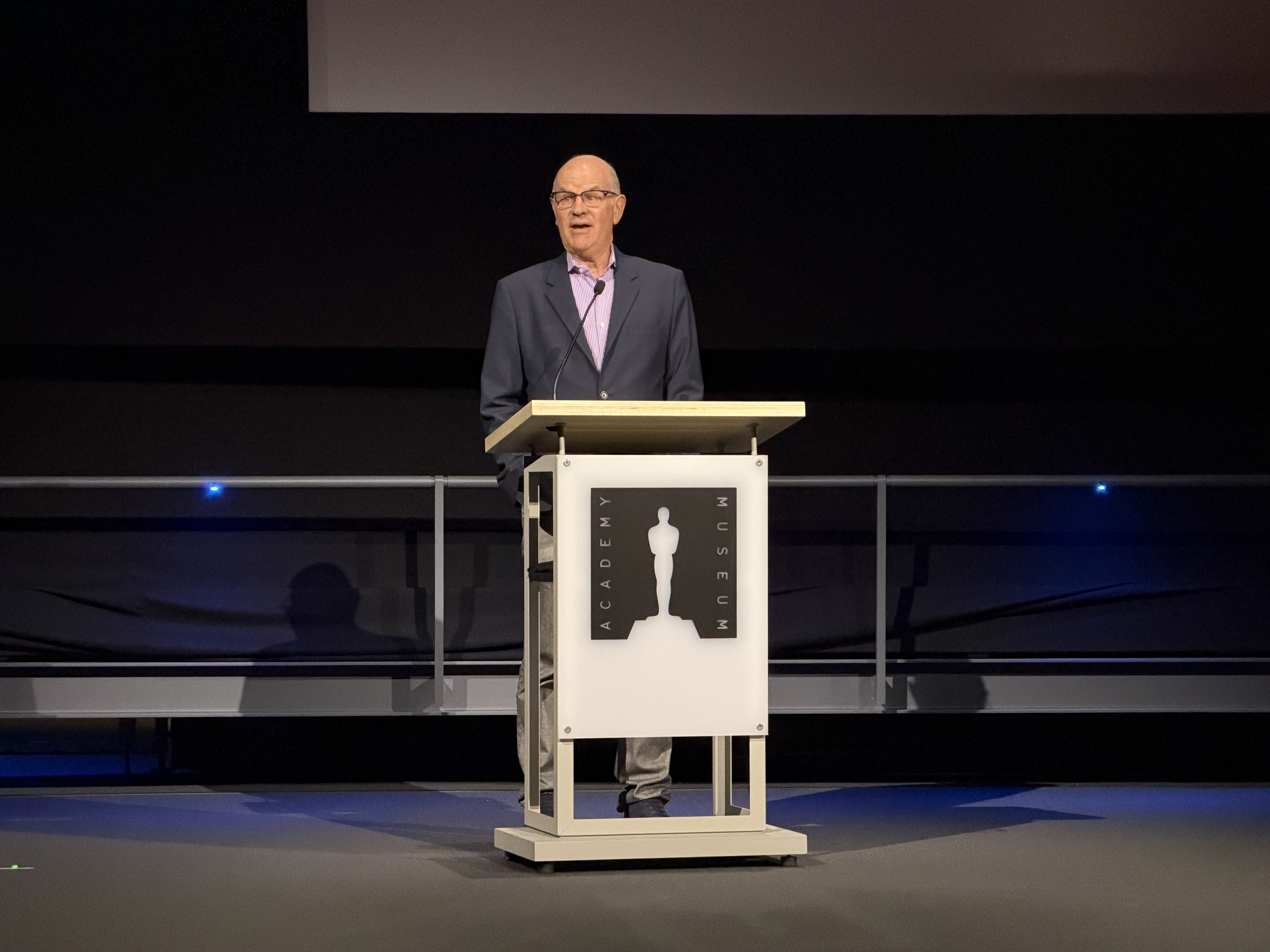
However, ultimately, 20th Century Fox didn't seem to mind the barbs thrown their way "as the years rolled by and tens of millions of dollars flowed back to them." In fact, Siskind stressed that Fight Club was a particularly successful title for the studio on the then-expanding DVD market, eventually selling over 16 million copies. To put it in perspective, he explained that Fight Club would continually be in Fox's Top 20 or even Top 10 best selling movies of the year for years to come, alongside perennial evergreen titles for the studio like The Sound of Music and Aliens.
Years later, when Siskind was at Paramount, he'd ends up working with Fincher again on The Curious Case of Benjamin Button, for what he said was a totally pleasant, non-combative collaboration, during which he joked they "followed the rules of Fight Club" and simply never mentioned their more bitter shared history. And to give the story a true happy ending, Siskind is now the the Studio Analytics GM at EDO, an analytics company founded by none other than... Edward Norton.
Siskind recalled meeting with the CEO of EDO about the job in 2022, who explained "Edward Norton was inspired to start the company after frustrating experiences with film marketing, and the most frustrating experience by far was Fight Club." He chuckled about being told "That film convinced [Norton] there had to be a better way than arguing loudly to choose and measure the effectiveness of creative and media buys, so as to avoid the kind of asinine decisions Fox had made on Fight Club."
Now happily working for Norton's company, Siskind declared, "For the first time, with the distance of a quarter century, I feel somewhat safe breaking the cardinal rule and talking about Fight Club."
Tickets are now on sale for the 4K theatrical re-release of Fight Club on April 22nd, and you can pre-order the 4K UHD disc and Digital versions now, prior to its May 12th release in those formats.