
Sundance Review: Andrew Stanton’s “In the Blink of an Eye” Finds Humanity Across Millennia


Andrew Stanton has always gravitated toward stories that wrestle with time, purpose, and the quiet rhythms of human connection. With In the Blink of an Eye — adapted from Colby Day’s 2016 Black List script — the WALL-E filmmaker turns those instincts toward live action, crafting a triptych that stretches from 45,000 BCE to a distant colonized future. It’s an ambitious, gently moving sci-fi meditation about how little changes even as everything does.
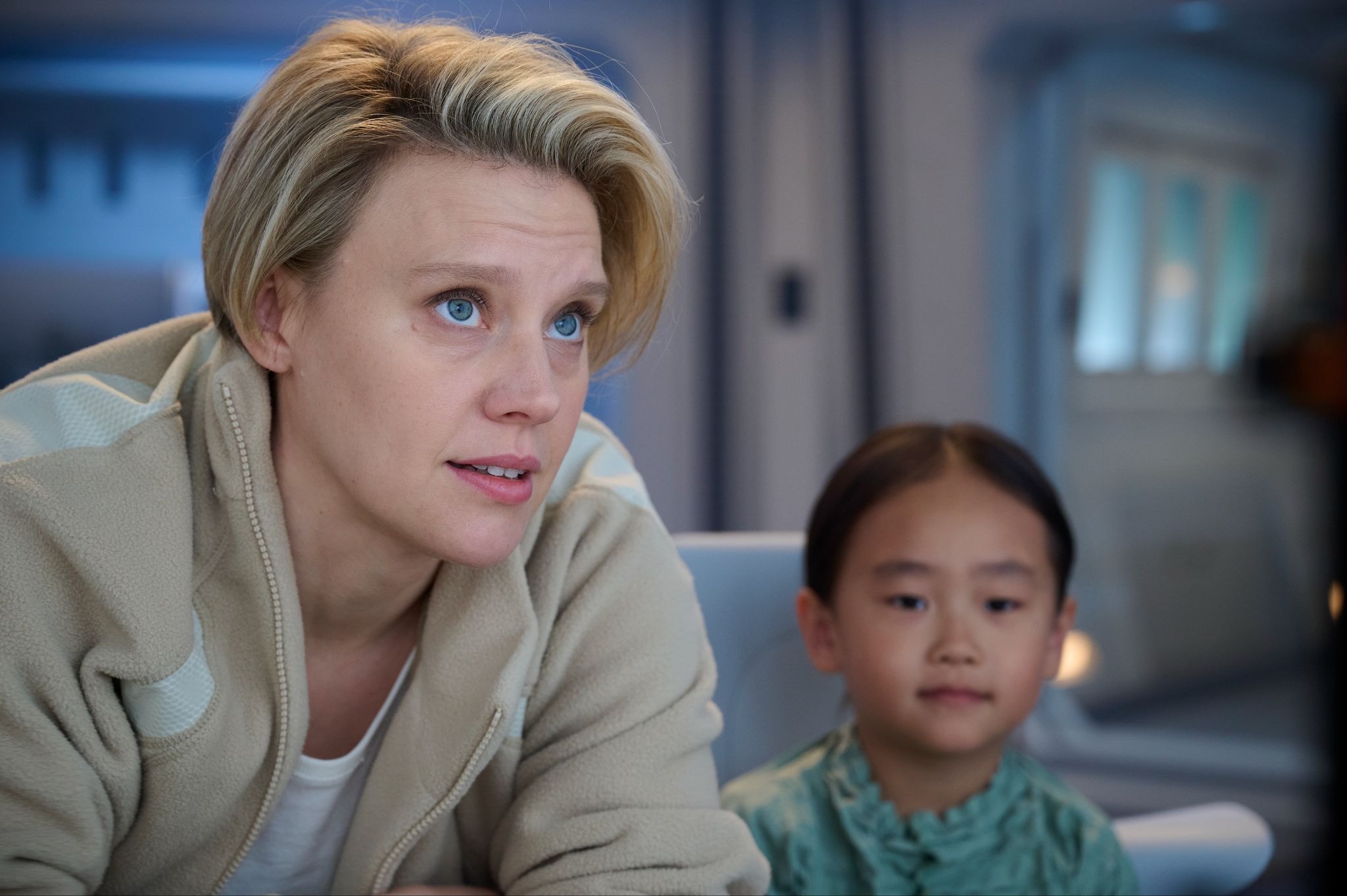
The film traces three parallel storylines separated by thousands of years yet linked through a single, small object: an acorn. In one timeline, a Neanderthal family — Thorn (Jorge Vargas), Hera (Tanaya Beatty), and their daughter Lark (Skywalker Hughes) — fights to survive as they encounter an evolving human species. In the present day, graduate student Claire (Rashida Jones) begins studying prehistoric remains just as she builds a life with fellow academic Greg (Daveed Diggs). And centuries in the future, a long-lived spacefarer named Coakley (Kate McKinnon) shepherds the next generation of humanity aboard a starship bound for Kepler-16b, guided only by an AI companion and echoes of the past. While the film avoids a conventional three-act build, the threads consistently weave together around major life events — birth, loss, discovery, reinvention — underscoring a thematic throughline that reverberates across eras.
Stanton’s direction emphasizes visual and emotional parallels more than narrative mechanics. Childbirth in one timeline matches another, as does grief, invention, and curiosity. These cross-cuts are the film’s heartbeat, and they rarely feel forced. The approach is closer to philosophical sci-fi in the vein of A.I. than genre spectacle — intimate and reflective rather than sweeping.
While the ensemble is uniformly strong, McKinnon is the film’s standout. As Coakley, she plays centuries of isolation, duty, and longing with a restraint that still allows her natural warmth and her well-timed comedic instincts to peek through. It’s a departure from her more anarchic screen persona, and one that proves she can anchor a story built on subtle emotional gradations.
Jones and Diggs also work well together, navigating aging, partnership, and changing priorities, though the film gives less time to their later-life chapters than it could. The Neanderthal cast brings physicality and tenderness to scenes that might otherwise feel purely conceptual.
Thomas Newman’s score instantly evokes Stanton’s Pixar collaborations, especially WALL-E, but with additions — choral voices, more organic textures — that distinguish this as its own tonal universe. The music does much of the film’s connective work, gliding between stone-age landscapes, university labs, and sterile starship corridors without breaking the spell.
Ola Maslik’s production design is equally strong, giving each timeline its own visual logic while incorporating subtle echoes between them. The future sequences, in particular, balance sleek minimalism with tactile detail. Mollie Goldstein’s editing makes the triptych structure possible at all: scenes flow into one another with a gentle rhythmic clarity that keeps the film moving even without a conventional dramatic engine.
Despite the film’s grand thematic reach — time, evolution, purpose — it never becomes preachy or overbearing. There’s an occasional wryness baked into each timeline, especially in the present-day story, that helps the film avoid feeling self-serious. Stanton trusts audiences to interpret the parallels without underlining every idea.
While the film is designed to drift between eras instead of escalate, the lack of a traditional third act does leave the conclusion feeling more like an elegant fadeout than a thematic culmination. The ideas resonate, but the final moments don’t quite achieve the profound lift the film gestures toward.
The film’s central answer — that time is fleeting and human behavior remains consistent across generations — is gently expressed yet also familiar. Sci-fi fans will appreciate the execution, though the message may feel like well-worn territory rather than revelatory insight.
In the Blink of an Eye is a thoughtful, well-crafted sci-fi fable that aims high and mostly reaches its mark. It’s never heavy-handed, never pretentious, and never less than visually graceful. While the ambition outpaces the emotional impact in certain moments, the performances — especially McKinnon’s — combined with Stanton’s assured direction and Newman’s stirring score create a film that lingers. It may not redefine the genre, but it offers a meaningful, often beautiful reflection on what connects us across time, evolution, and vast distances.
I give In the Blink of an Eye 4 out of 5 stars.
In the Blink of an Eye will stream on Hulu beginning February 27th.