
Sundance Review: Nat Geo’s "Time and Water" Is a Stunning, Soul-Deep Meditation on Memory and Melting Ice


Introducing National Geographic’s Time and Water at its Sundance premiere, director Sara Dosa reflected on why she wanted to tell this story: “Love can transcend time.” By the end of the screening, and the standing ovation that followed, it was clear she had made a film that does exactly that. Following her acclaimed Fire of Love, Dosa once again merges scientific inquiry with lyrical human storytelling, this time through Icelandic writer Andri Snær Magnason, who turns his family’s legacy into an emotional time capsule of memory, grief, and the disappearing glaciers that shaped them.
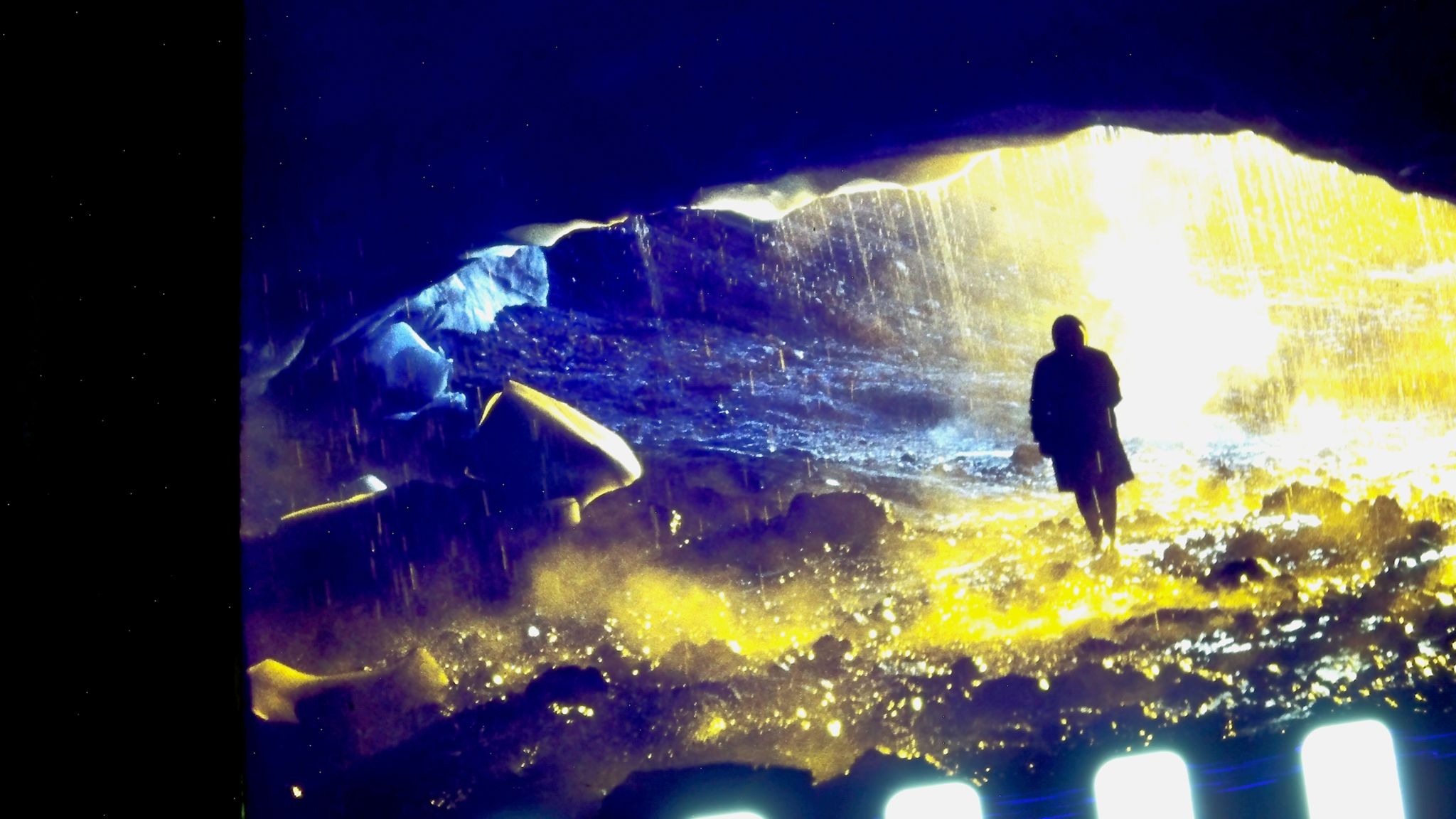
The film begins with a simple but devastating gesture: Andri opening a time capsule he buried in 1997, filled with home videos of the glaciers that his family had documented for generations. From that intimate act, Dosa expands outward into a larger meditation on how glaciers, like families, record history. Two of Andri’s grandparents met, fell in love, and honeymooned around Vatnajökull, a glacier so meaningful to them that Grandpa Árni claimed he could smell spring arriving from its thaw. When Andri is tasked with writing a eulogy for Okjökull, the first Icelandic glacier officially declared dead, he must reconcile the fading of his homeland with the fading of his elders, and the question of what memories remain when so much is slipping away.
Dosa keeps the science accessible but meaningful. Ice cores become a metaphor for deep time, carrying sediments, bubbles, and histories that melt and scatter as glaciers retreat. Moderately scientific yet deeply emotional, these insights give Andri’s narration a grounded, elegiac quality. When he concludes, “Our time is unlike any time before,” the line lands with the force of truth.
The film’s strongest achievement is the way it interweaves family lore with environmental urgency. Andri’s work as an archivist — recording a dying tradition of Icelandic rhimma from an elderly woman — mirrors the way ice holds stories until they melt. A lullaby sung to his son becomes a recurring motif, its translation withheld until the end when its meaning becomes poigniant. It’s a moment of emotional clarity that crystallizes the film’s themes.
Time and Water is built from an eclectic mix of materials: 8mm home movies, VHS footage, newly shot landscapes, photographs, clippings, and mythic illustrations. Instead of feeling disjointed, the film uses these transitions as part of its storytelling. One shot appears to burn through the emulsion of 8mm film and dissolve into a modern digital image — a visual metaphor for the erosion of time. When stills or clippings need enhancement, animator Lucy Munger brings them to life with gentle flourishes: newspaper headlines unroll across the frame, folktales animate themselves, and a myth of Thor slaying the serpent of Midgard becomes a painterly parable about human harm.
Dan Deacon’s music is airy, delicate, and often reminiscent of Owl City’s dreamy electronic palette. It gives the film a childlike wistfulness, echoing Andri’s memories while underscoring the fragility of what’s being lost.
At the Sundance premiere, the crowd rose in immediate applause. Andri himself admitted he was surprised by how much of his personal story made it into the documentary — details not included in his book but essential to why Dosa felt compelled to make the film. That shared vulnerability between filmmaker and subject radiates through every frame.
Nothing detracts meaningfully from the film’s impact. Its pacing is intentionally meditative; its structure elliptical. Viewers seeking a purely scientific climate documentary may want something more direct, but for everyone else, this is a rare work of nonfiction that approaches poetry.
With Time and Water, Sara Dosa crafts a companion piece to Fire of Love that stands entirely on its own. It’s an elegy, a love story, a scientific reflection, and a deeply human act of remembrance. This documentary honors the people and places we lose — and the stories we refuse to let melt away.
I give Time and Water 5 out of 5 stars.