
From Waikiki to Arusha: Joe Rohde Maps the Creative Philosophy of Floating Mountains at the Walt Disney Family Museum


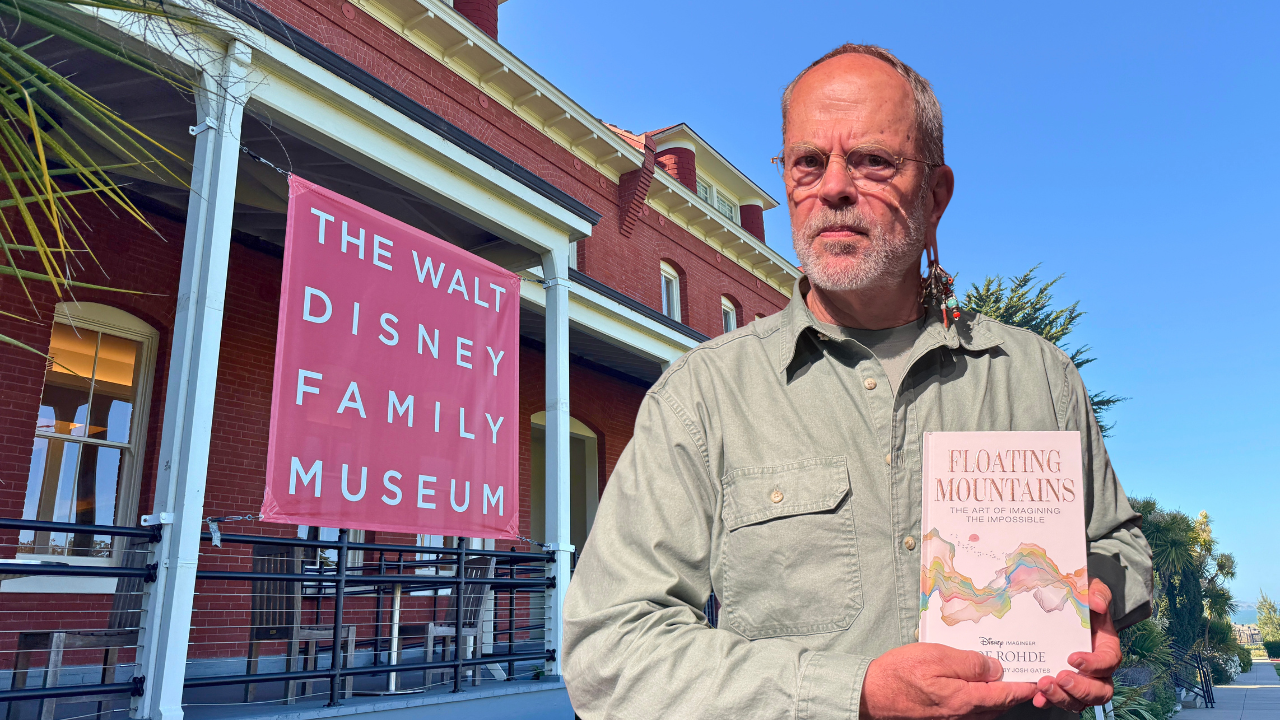
Disney Legend Joe Rohde spent 40 years at Walt Disney Imagineering leading projects like Disney's Animal Kingdom and Aulani, a Disney Resort & Spa. On Wednesday night, he brought lessons from that career to a sold-out audience at the Walt Disney Family Museum to celebrate his first book, Floating Mountains: The Art of Imagining the Impossible, published by National Geographic. The impossible, Rohde said at the outset, usually isn't impossible. People simply assume it is. And because the book is really a record of how he has worked, he explained that a tour of Floating Mountains is essentially a tour of his career.
Rohde began with a diagram from the book. Humans are narrative creatures, he argued, and even at the neurological level our brains assemble fragmented sensory data into a story about what is happening right now. If that is how people organize their thoughts, then story structure is a natural way to organize a team, and at the center of story structure sits the theme.
Rohde refers to theme in the literary sense, the way one might say the theme of Moby-Dick is man against nature. His diagram places the theme at the center, surrounded by successive rings of involvement: manifestation, advocacy, support, and dissent. This matters because a film director controls exactly what an audience sees through the tiny pinhole of a camera lens. Theme park guests roam freely and look wherever they like, so no single person can direct the experience. A themed environment needs many directors, but simply turning a team loose would be chaos. The theme is what keeps everyone pointed in the same general direction.
Rohde described creativity, before it turns into anything, as a kind of pathology: a way some brains respond to the world at a different rate than the baseline population. Creative brains take a beat longer with cognitive disambiguation, the reflex that identifies a chair as a chair. In that extra moment, Rohde's brain notices the chair has four legs like a dog, dogs are faithful, and suddenly there is a robotic service-dog chair that runs over to catch you when you lose your balance. Much of fostering creativity comes down to suppressing the habit of already knowing what things are.
He was once the subject of a study of creative people that kept him in an MRI machine for about an hour and a half. According to that research, high-performing creative brains behaved differently from everyone else only when they were told to do nothing. Rather than going quiet, those brains start playing a free-association game of ping-pong.
Harvesting that ability from a diverse group is how a team escapes the normal distribution curve. Designing to the bell curve leaves everyone competing in the same narrow margin, while creative people pick out the data points outside it and invest in them until a new curve forms. He likened it to asking an AI art program in 1870 to predict the art of the next decade: it would offer more nudes, drapery, and angels, and no Impressionists, even though the Impressionists were already at work. Walt Disney faced the same skepticism when he wanted to make a feature-length cartoon.
Rohde described himself as having two careers, one at Disney and one as a member of The Explorers Club working with Indigenous communities, scientists, and conservationists. He believes the protocols of real exploration closely mirror those of collaborative creation because, in both cases, you cannot know the end result. You can only know your motive.
Before Imagineering, Rohde taught art, art history, and theatrical set design at the high school he and his family attended. He was raised in a household that valued creativity, which he believes is why he sees creativity as a form of order-making rather than rebellion.
He grew up in the late 1950s and early 1960s in a crumbling old plantation house in the foothills above Waikiki, an upbringing that felt like another time and country and gave him the sense of distance he believes creative people need. His mother studied acting at the American Academy of Dramatic Arts. His father was a cameraman who worked on Planet of the Apes, Earthquake, Voyage to the Bottom of the Sea, Lost in Space, Batman, and Lancer. Young Rohde got to sit in the Flying Sub and roam the 20th Century Fox Ranch, so by his first visit to Disneyland, he already understood it as a designed place built with techniques he recognized.
Rohde read a passage from the book about Jean Charlot, a family friend in Hawaii whose home had an outsized impact on his imagination. Charlot was part of the Mexican mural movement of the 1920s, served as a field illustrator during the excavations at Chichén Itzá, and later wrote some of the first serious critical essays on Hollywood animation. After seeing Snow White and the Seven Dwarfs, Charlot argued that animation was a direct continuation of the great mural traditions, and Walt Disney invited him to teach art history and composition to the studio's artists. Alice Davis once told him that her husband, Marc Davis, learned postural composition from Charlot, which means the evocative poses in Pirates of the Caribbean can be traced back to Charlot's curriculum. Charlot's son Martin taught Rohde how to draw, and decades later Rohde hired Martin Charlot to paint the murals that surround the lobby at Aulani.
Rohde was hired by Imagineering in 1980 as a model builder to help with the layout of EPCOT Center, but admits he was terrible at it. He was used to creating theater models made of foam core and chopsticks, not the delicate, hyper-detailed work Imagineering required. He moved into concept illustration, working on some of the earliest concepts for what would become the Indiana Jones ride, and found that spending time in the concept room led people to ask him questions. Answering them with a liberal arts education sounded a lot like concept development, and that became his career.
Because he grew up in Hawaii without regular trips to Disneyland, Rohde felt less fluent in castle-park lore than his peers. During the experimental Michael Eisner and Frank Wells era of the mid-1980s, he took on non-core projects others didn't want. Most never happened, but one did: the Adventurers Club, whose design was directly inspired by Sir John Soane's Museum in London. Its development was wildly zigzaggy, Rohde said, which illustrates a point from the book: creative work is best pursued by a fixed motive rather than a fixed goal, because the goal will slide all over the map.
Rohde then showed an early 1992 map of Disney's Animal Kingdom, which he described as one of many versions. It included a "Genesis" entry that would become The Oasis, a dinosaur land, a Nature's Headquarters area that disappeared entirely, a Tree of Life with a different show beneath it, a large Asia safari that was never built, and a land called Mythia, which evolved into the abandoned Beastly Kingdom concept. The project wasn't formally financed until 1995.
At that early stage, the team structure was very flat. When Animal Kingdom began, it was just six people in a trailer with no one outranking anyone else, so every idea had to be advocated, defended, and attacked on its merits. He does not believe in the single visionary genius at the top of a pyramid. His original Tree of Life sketch was smaller and more conservative than what he built, and the final design resulted from collaborating with people who brought something else to the table.
To show his thematic diagram at work, Rohde used animals as subjects, not themes. Unlike the idealized, perfected world of an animated film, animals live, die, and poop in front of you. One value the team derived for the park was the intrinsic value of nature. He proposed several questions about how one would design within that philosophy.
- Would a place about the intrinsic value of nature be dominated by landscape or architecture? (Landscape)
- Would the place be formal or informal? (Informal)
- Would the architecture be pristine or eroded? (Eroded)
- Would the wood be smooth or rough? (Rough)
- Would a doorknob be shiny or dull? (Dull)
At that point, Rohde could ask everyone to imagine a chair in a restaurant for that park, and he would trust each of them to design one that belongs. He would not need to see the proposal. That, he says, is how you direct. The result is a park that looks authentic but expresses its values, keeping it in harmony with the live animals it houses.
None of it was popular at first within the company. It took five years to convince the executives to build the park, and Imagineers themselves were suspicious of a design that rejected smooth and shiny design principles. When the team showed up at an early Association of Zoos and Aquariums convention, the reaction was essentially to ask who these Disney people were and what they could possibly offer. Building a coalition became a discipline in itself.
That coalition-building led to Aulani, which Rohde described as a two-horned problem. Few Hawaiians were excited about yet another 15-story beachfront hotel on Oahu, and the island already had dozens. To find a margin, the team pinned up advertising art for tropical resorts around the world and removed everything redundant: the tanned couple on the beach, the daiquiri by candlelight, the massage table. The only thing left was the Indigenous people of each place. A trip to Hawaii, they concluded, must actually be a trip to Hawaii, and the resort would be shaped by Hawaiian ideas about hospitality, family, land, and narrative.
Rohde shared two results nobody could have planned. The first is the 'Ōlelo Room, a lounge dedicated to the Hawaiian language, where nearly everything is labeled in Hawaiian with a pronunciation guide, and bartenders are required to speak the language. It’s the first hotel venue in Hawaii with a Hawaiian language requirement, and people drive 45 minutes from the University of Hawaii just to have a drink somewhere they can speak it.
The second is the piko stone. Before construction, kahu Aunty Nettie Tiffany surveyed the site and marked its spiritual center, or navel, with a stake. Two months before opening, she told Rohde he needed a stone to mark it, a problem since 20 feet of fill now covered any local rock. Rohde remembered the fossilized coral unearthed while clearing the site years earlier, found the right piece, and Aunty Nettie consecrated it. The stone now sits at the center of the resort as a genuine Hawaiian cultural shrine. Rohde also made the audience promise that, if they return to Hawaii, they will spend two hours in the Hawaiian Hall at the Bishop Museum in Honolulu before visiting Aulani.
Rohde's work on Aulani opened the door to a second life of expeditions, conservation, and art-science collaborations, which began in a Himalayan village where he lived for a time. This led to deliberate communal-painting expeditions that raise money for wildlife conservation. A 30-foot painting created with Inuit collaborators in the High Arctic is now circulating through museums in Canada. He contrasted the Inuit preference for esoteric imagery, such as a seal in the light of an oil lamp, with Tibetan collaborators in Nepal, who asked for something as literal as a woman milking a white-faced yak with two calves, while still debating its meaning fiercely.
All of this leads to Rohde's current work with the late Jane Goodall on Dr. Jane's Dream, an experience center in Arusha, Tanzania. Arusha is East Africa's safari hub, and the way flights arrive and depart means most travelers spend a day there. That creates a captive audience that can afford a visit and is already interested in wildlife.
Rohde had known Goodall since the Animal Kingdom days, when she was one of the park's advocates and advisors. She asked him to sketch a conceptual framework for the center roughly a decade ago, then later told him the building was nearly done, and she wanted him to design the exhibits, despite his retirement. He assembled a group of volunteer designers who work for free so that only the African artisans get paid.
He likens the result to Meow Wolf more than a science center. Visitors move through a dreamlike environment, including a Gombe room, where the goal is not to read about Goodall but to explore and discover as she did. Nothing is realistic by design, because something too familiar invites a glance rather than investigation. The animals are made of recycled metal and carry information about themselves on their own bodies. Another room explores her global impact and the Roots & Shoots program; the Voice of Jane Theater surrounds guests with her voice in three-dimensional sound; and a stained-glass multiplane jungle roughly 25 feet tall and more than 80 feet wide encloses the main space, mirrored by mosaic tile on the opposite wall.
Goodall saw the project in progress before she passed away a little over a year ago. The team flew him out for a consultation because he was the last person to review the plans with Goodall herself. Rohde expects the center to be fully complete in a couple of years, with nearly all of the carving, painting, metalwork, ceramics, and stained glass done by African craftspeople.
Rohde closed by returning to his diagram. His approach is to replace the leader with the theme and move the leader out to one of the rings, and which ring can change. Giving people that autonomy pays off in two ways. Responsibility keeps people alert, much as a driver watches the road while a passenger does not, and that engagement breeds leadership that makes delegation possible. Despite the accolades he receives, Rohde says none of his projects were built by hand like some hobbyist in a garage. Without the people who collaborated on them, they wouldn’t be what they are. That is what Floating Mountains is about, and he hopes readers will apply it to their own collaborative work.
One poignant moment came during the audience Q&A, when Rohde was asked about Walt Disney’s personal influence on him. To Joe Rohde, Walt's underappreciated gift was gathering the tough, wild artists of an era when choosing art meant poverty and estrangement, and getting them to collaborate selflessly with each other and with him. He pointed guests to the museum's new Awaking Beauty: The Art of Eyvind Earle exhibition, where Walt discusses how hard it was to get work that didn't keep looking like Disney, which is why he brought in Earle. Walt built a culture of collaboration that outlived him, and it is the culture that allowed Joe Rohde to do what he did.
Floating Mountains: The Art of Imagining the Impossible by Joe Rohde is available now from National Geographic wherever books are sold. Awaking Beauty: The Art of Eyvind Earle is on view at the Walt Disney Family Museum through April 18th, 2027.
(Please note this article contains affiliate links. Your purchase will support LaughingPlace by providing us a small commission, but will not affect your pricing or user experience. Thank you.)