
From Storyboards to Screen: Pixar's "Hoppers" Story and Animation Teams Share How the Film Was Made


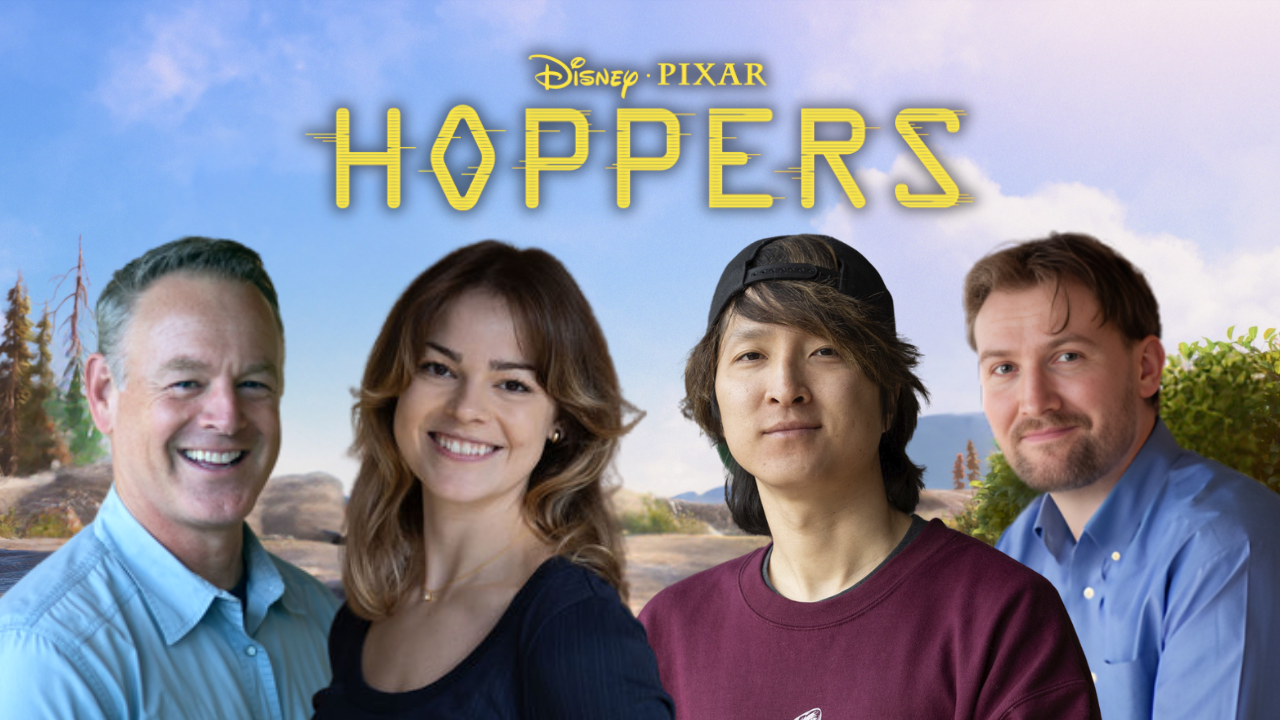
At a recent panel held at the Walt Disney Family Museum, four members of the Hoppers production team — story artists Margaret Spencer and John Cody Kim, and animators James W. Brown and Cody Lyon — walked an audience through the film's journey from rough thumbnails to finished sequences. What emerged was a portrait of a production built on iteration, trust in simplicity, and a near-constant negotiation between what story artists can draw and what animators can physically pull off in three dimensions.
Spencer opened by framing the process: it takes roughly five years to make a Pixar film, beginning with a director alone in a room with a pen and paper, eventually expanding outward through story, editorial, layout, and animation before reaching the downstream departments that handle shading, rendering, and effects. Story artists, she explained, are closest to the beginning of that chain — responsible for visualizing the script, pitching scenes to the room with improvised sound effects included, and maintaining a macro view of the film's structure, including things the audience may never consciously notice but will feel.
A through-line of the panel was director Daniel Chong's guiding philosophy: keep the motion sincere and believable, and trust that the story is funny enough on its own. Brown described the early animation tests the team ran to calibrate Chong's taste — walk cycles, character tests, scene tests — and how each iteration pushed the department away from broad, Looney Tunes-style exaggeration and toward something more grounded. When animators over-performed a scene, Chong consistently pulled them back toward stillness. When George moved too much, he felt less lovable. When he just stood there with wide eyes and arms slightly out, he became the sincere heart of the film.
Lyon illustrated that lesson through his own early experience on the production. For a teaser shot of Dr. Sam and Dr. Nisha explaining how body-hopping works, he came in swinging — big gestures, maximum performance — and Chong rejected it outright. The funniest version, it turned out, was the one closest to the storyboards: deadpan, small, and letting the absurdity speak for itself. Lyon noted that nearly every animator on the show went through a version of that same realization.
The panel's most detailed segment focused on the film's uproarious "Jerry vs. Shark" sequence, which Kim broke down from its earliest brainstorming incarnation (including an alligator in a potato truck) through four years of revision that eventually produced Diana the shark, a cheerful apex predator with bowling-league manners. Kim pitched a portion of the sequence live for the audience, walking through storyboards the way the team would have presented them internally, complete with sound effects. What emerged from story then had to survive contact with layout, editorial, and finally animation — each department adding new ideas and constraints. A tunnel was added for dramatic lighting. A side-mirror shot solved the problem of keeping George and Mabel in frame simultaneously. The birds carrying Diana were reanimated from a wild, disorganized flock into a precision strike team at Chong's direction.
The physical comedy generated by the characters' proportions was a recurring subject. Lyon and Brown both described the creative problem-solving required when arms simply cannot reach where the script needs them to go. For a shot of Loaf grabbing Jerry's phone, the solution was having Loaf use his mouth to adjust his grip — which not only solved the problem but deepened the character. For Titus, whose arms are proportionally even more extreme, the team concealed the impossibility of putting a crown on his own head by hiding the action across a cut. The audience, as Brown noted, bought it.
Throughout the panel, all four speakers returned to the same principle: the storyboards are a guide, not a constraint. The entertainment is already in the drawings. The animator's job is to find it there and not lose it on the way to the screen.
Pixar’s Hoppers is now playing in theaters.