
TCM Classic Film Festival: "Alice in Wonderland" 4K Restoration World Premiere Review


Walt Disney's Alice in Wonderland has always been a film that found its audience with a delay. When it debuted 75 years ago, it left audiences bewildered, and Walt himself reportedly unsatisfied. It took two decades of college film rentals and a psychedelic 1974 re-release before the film earned the reputation it holds today as one of Disney's most visually inventive features. On Friday morning at the El Capitan Theatre in Hollywood, the TCM Classic Film Festival marked that anniversary with the world premiere of a brand-new 4K restoration, and after seeing it on the big screen, the film has never looked more like itself.
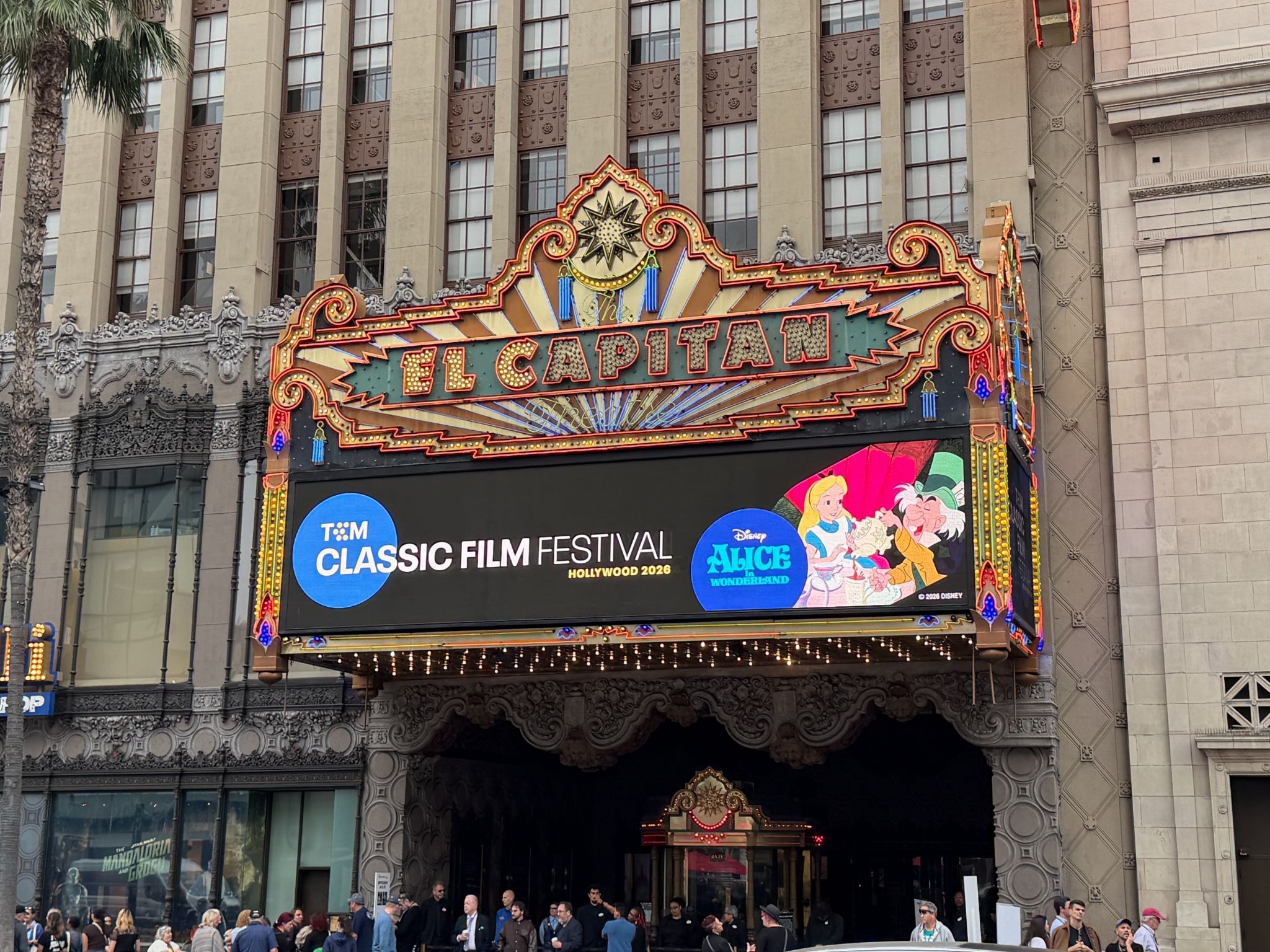
Before the screening, TCM Classic Film Festival Director Mark Wynns welcomed the crowd and introduced actor and comedian Mario Cantone — best known as Anthony Marentino on Sex and the City and And Just Like That — who hosted a lively on-stage conversation with legendary Disney animator Andreas Deja.
The Pre-Show Conversation
Cantone opened by putting the film's unusual history in context. A box office disappointment on release, Alice was quietly rediscovered in the early 1970s when college rental numbers began climbing unexpectedly. Disney leaned into the moment with its 1974 re-release, subtly marketing the film's dreamlike quality to a generation newly receptive to it — a rehabilitation similar to what Fantasia had undergone years earlier.
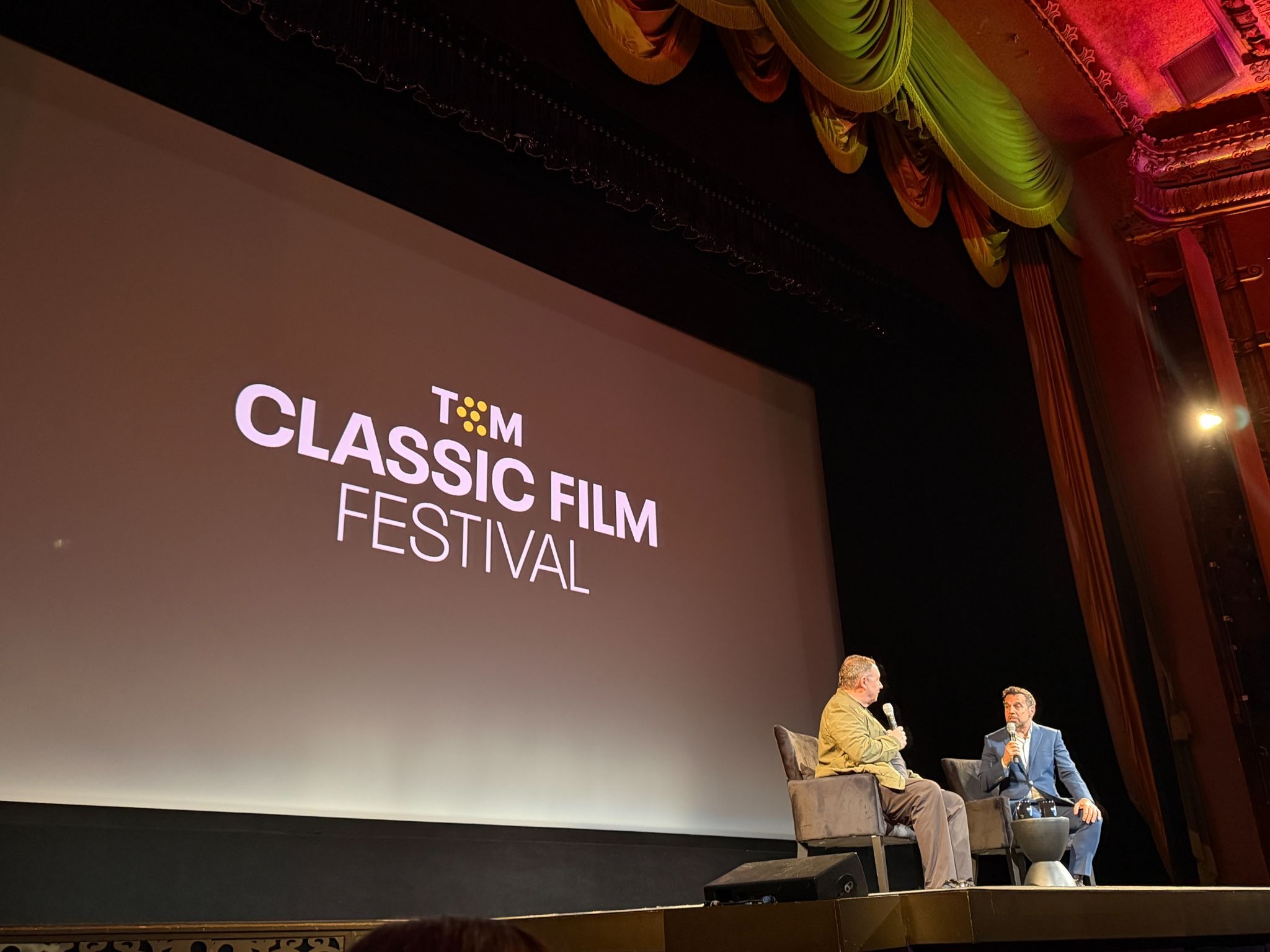
Deja traced his own path to Disney back to a letter he wrote to the studio at age ten after seeing The Jungle Book. The studio wrote back with advice that initially confused him: don't draw Mickey Mouse — go to the zoo, study animals, learn anatomy. It wasn't until a rerelease of Bambi that it clicked. "I saw this little deer wobbling across the screen," he said, "and I thought, whoever drew this had to know where the rib cage is, where the head connects with the body."
Deja entered Disney through Eric Larson's training program, where he was paired in his first year with a fellow young artist who "drew a little different" — Tim Burton, who had studied animation and worked on The Black Cauldron before departing to pursue his own projects. Deja stayed, and the career that followed included supervising animation on some of the studio's most beloved characters.
For King Triton in The Little Mermaid, Deja revealed that the character's commanding physicality was drawn directly from his own father. When his dad would scold his older sister, Deja recalled, he would get very close, looming large with his hands. "I used all those gestures on King Triton," he said, and only told his father years later that he'd been the model. As a fun fact, Deja also shared that the sea king’s iconic nipples were internally referred to as “olive nipples,” due to the shade used by the paint department.
Cantone, who had been set to voice a character in the ill-fated American Dog (retooled as Bolt) — a project whose collapse, he shared, left him devastated as a lifelong Disney fan — admitted his encyclopedic knowledge of animation history caught Deja off guard when they first met at the studio. The two bonded further in Paris, where they both attended Disney 100: The Exhibition.
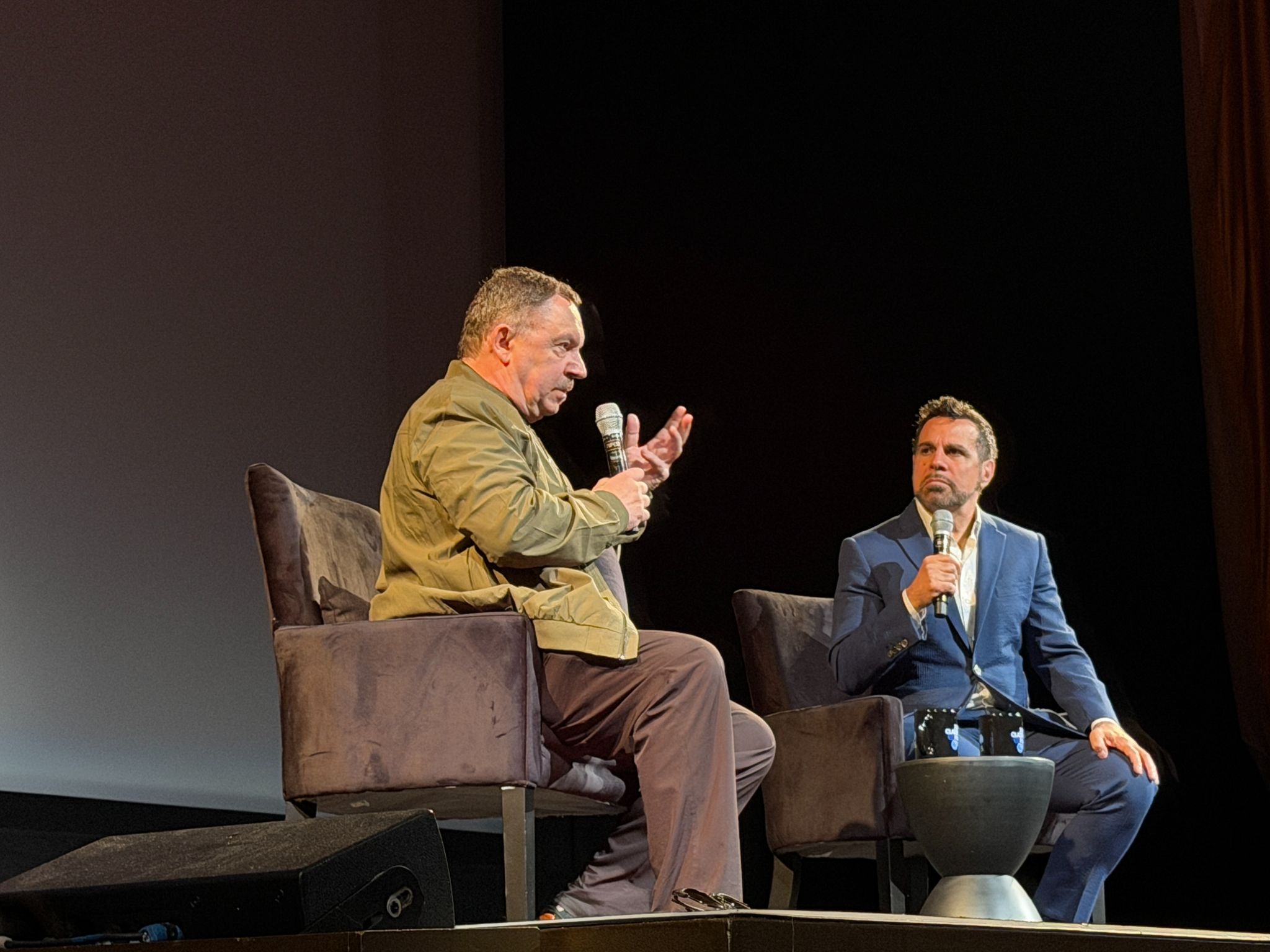
On Alice itself, Deja called it "a trip" — a film that keeps audiences genuinely disoriented in a way that feels joyfully intentional. Cantone noted that while most of the film draws from Lewis Carroll's Alice's Adventures in Wonderland, several sequences, including the flowers segment, originate in Through the Looking-Glass. Deja named the Mad Tea Party as his favorite sequence, with Cantone pointing out that Ed Wynn improvised extensively during live-action reference recording sessions, with the audio then manipulated in post to fit the animation.
Deja also previewed an upcoming large-format coffee-table book on Disney character designer Milt Kahl — whom he described as responsible for designing roughly 90% of all Disney characters in his era — developed in partnership with Disney. He indicated that individual volumes on other members of the Nine Old Men may follow.
The Restoration
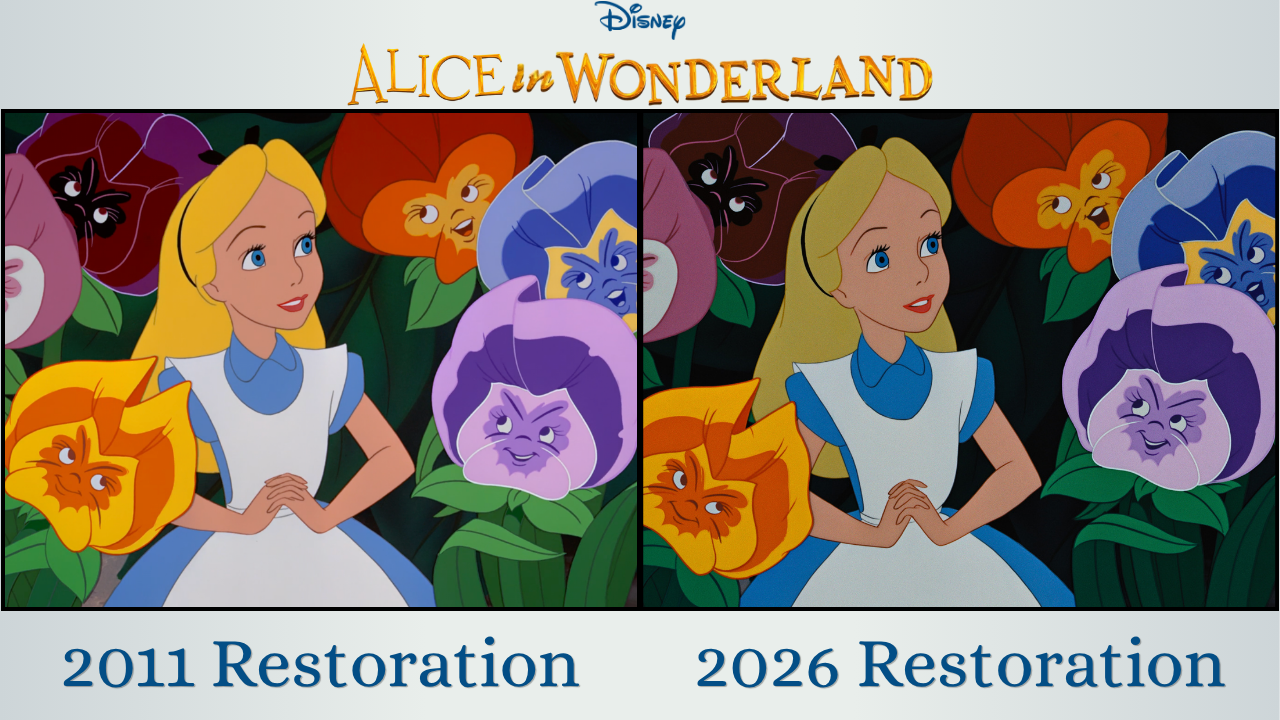
The new 4K restoration was scanned from the 35mm nitrate original camera negative, and the difference from the previous Blu-ray transfer — the 2011 restoration currently streaming on Disney+ — is immediately apparent.
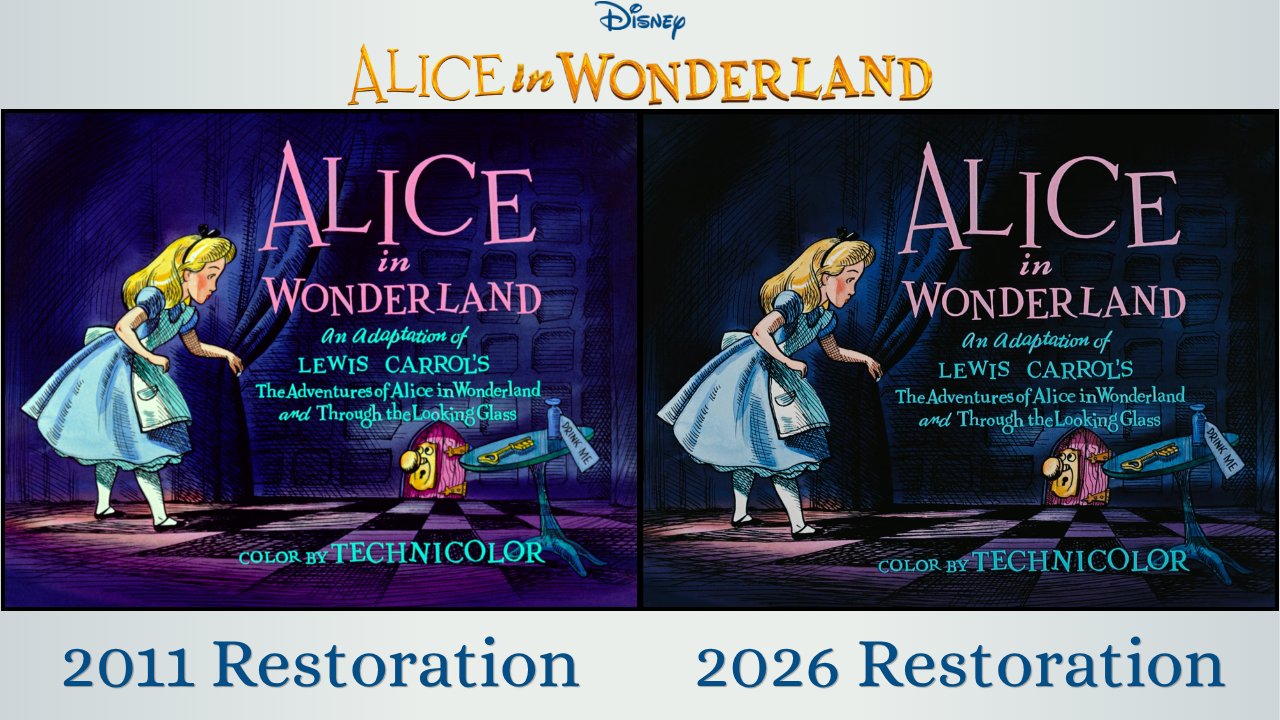
Line art in the opening credits is strikingly crisp. A light, natural grain is present throughout — a deliberate choice that the 2011 version largely suppressed. Most notably, the color palette has been recalibrated toward the pastel tones of Mary Blair's original concept work. Alice's hair reads as a soft, muted yellow through most of the film rather than the bright golden blonde of the earlier transfer, with warmer hues reserved for sequences like "All in the Golden Afternoon" and "Painting the Roses Red," where they feel intentional to the design.
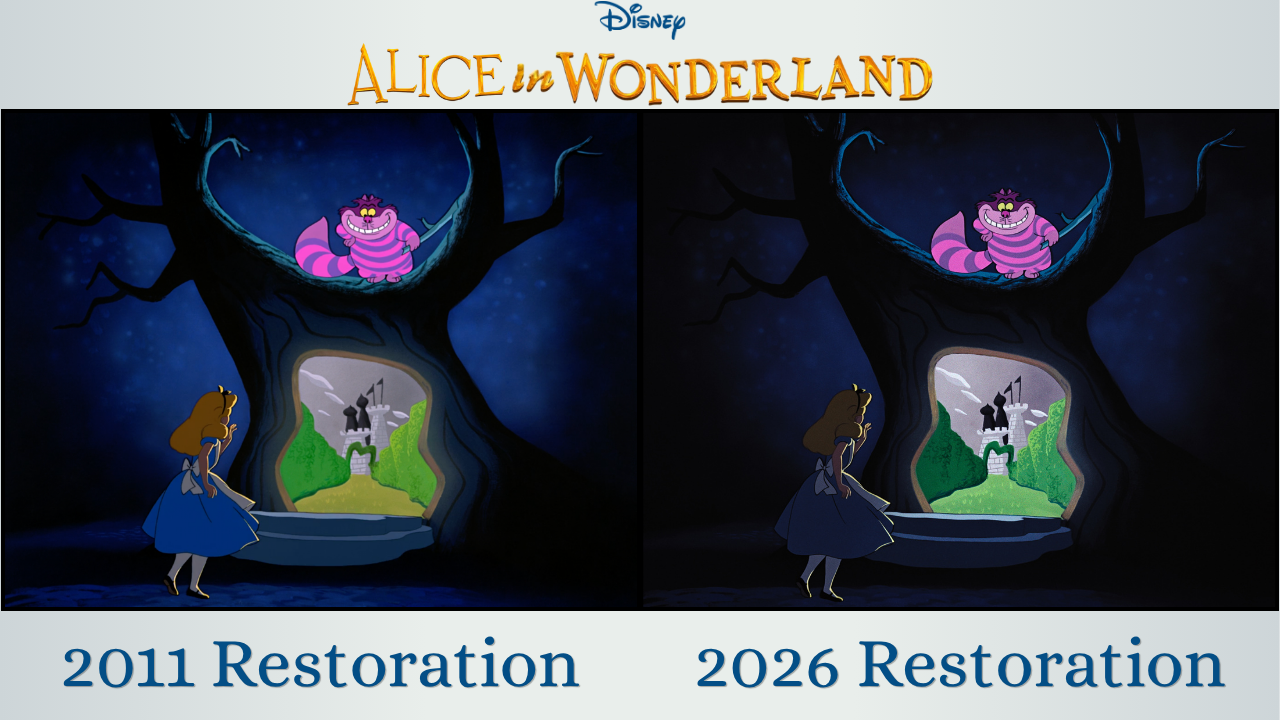
The Tulgey Wood and Cheshire Cat sequences — built on deep black backgrounds — are especially revelatory. In earlier home video presentations, those same dark passages were riddled with white dust particles; here they are clean and inky in a way that honors the original design intent. Seeing the film projected at the El Capitan also surfaced small details easy to miss at home. One discovery: the Doorknob's handle-nose rotates with his expressions as he speaks — a piece of character animation that lands differently at a mile high, or ten feet tall.
The new restoration of Alice in Wonderland arrives on 4K Ultra-HD on May 5th.