
"It Wasn't Just a Crime Story": Inside Hulu's 'Friends Like These: The Murder of Skylar Neese'


Hulu's new three-part docuseries Friends Like These: The Murder of Skylar Neese revisits the 2012 disappearance and murder of a 16-year-old West Virginia girl whose closest friends turned out to be her killers. But rather than approach the story as a straightforward procedural, the series — directed by BAFTA Breakthrough Brit Clair Titley (The Contestant) — takes what Titley calls an "inside-out" approach, centering the voices of Skylar's peers and Skylar herself. I spoke with Titley, former FBI supervisory special agent and polygraph expert Dr. Rob Ambrosini, and Ariah Johnson, one of Skylar's classmates who appears in the series, about why this story still resonates, the creative choices that set it apart from typical true crime, and what they hope viewers take away.
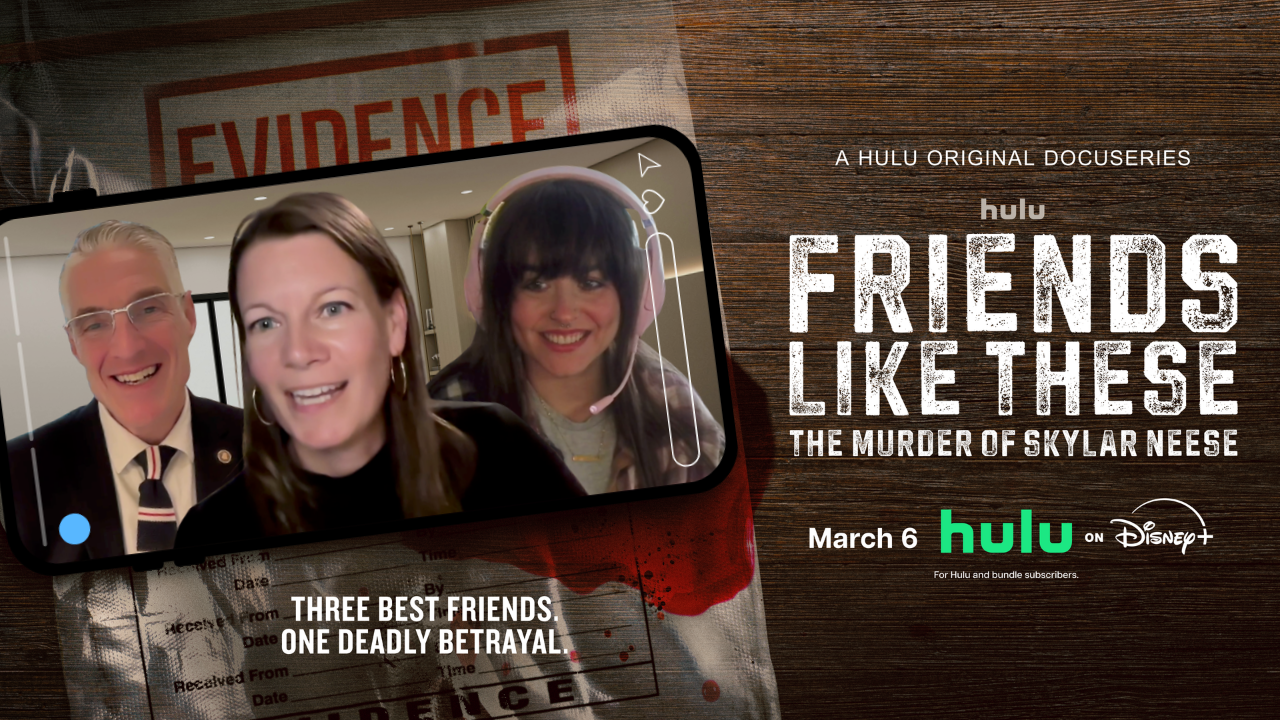
The series grew out of a development process at Dorothy Street Pictures, which brought Titley on board after one of their producers came across a magazine article about the case. What drew Titley in immediately was its contemporary relevance, even though the events unfolded more than a decade ago.
"This story had been told a lot as sort of a procedural thing, but not really from this perspective of her friends, but also Skylar as well," Titley said. "The first thing that got me was Dave and Mary's story — as a mother of a pre-teen at the time, I could only imagine what they were going through. But then quite quickly I started empathizing with Skylar as a 16-year-old. My 16-year-old self kind of really started to understand what she had been going through."
That empathy translated into a deliberate creative decision: rather than speak about Skylar only through others, the filmmakers wove in her own words to give her, as Titley put it, "control of her own story again."
One of the series' most striking qualities is its visual style — social media messages scratched into locker surfaces, tweets appearing on football fields, marker-style graphics for interviewee names in place of traditional lower-thirds. Titley explained that these choices were rooted in a desire to immerse viewers in the specific world of a teenager in 2012.
"We took a lot of inspiration from teen movies — the color palette, everything we used, we created this color palette to thread throughout that felt very much like a teen movie, as far removed from your traditional true crime series as possible," she said. "The way social media was at that time, teenagers felt it was almost like an extension of their communication. We wanted to show how it was integrated into their world — but also that it was there in plain sight for adults to see, if they'd have looked."
The effect underscores one of the series' central arguments: that the language teenagers were speaking online was hiding in the open, visible to anyone paying attention.
Dr. Rob Ambrosini, who conducted polygraph examinations as part of the investigation, admits he was apprehensive about participating in the documentary. After 24 years with the FBI — during which he conducted more than 3,000 polygraph exams — he was accustomed to staying quiet about cases even after retirement.
"This one really stuck with myself and the other agents and investigators that worked on it," he said. "Even without the polygraph, we all knew that the two young students in this case were not telling us the truth. It was a way to confirm what everyone was thinking."
What surprised Ambrosini most about the finished series was hearing the story through the eyes of Skylar's classmates — a perspective he never had access to as an investigator. "I didn't have the privilege of talking to them when I was working on this case," he said. "Hearing how it affected them personally — that betrayal, to see and hear that from them — was so striking to me, even years later."
For Ariah Johnson, who still lives in the area and has family members attending University High School, filming her interview at her old school wasn't as jarring as one might expect, but reflecting on that period of her life was another matter. She described a significant friendship fallout of her own in college that reframed how she thinks about what happened to Skylar.
"It made me think about how something like that could have gone so differently — in both my case and in Skylar's case," she said. "There were so many other ways to go about having a friendship fallout. As much as it hurts to have that fallout with your friend, it kind of put things into perspective. It could have been a lot worse."
Titley praised the courage of Johnson and the other peers who participated, noting that their involvement required them not only to revisit a tragedy but to return to a deeply vulnerable chapter of their own lives. "There's something so profound and affecting about that," she said. "They sat next to the perpetrators in class. It wasn't just returning to this awful thing that happened; it was returning to a time of your life when you were so vulnerable."
When asked what they hope viewers take away, all three circled back to the same thing: Skylar herself. She would have turned 30 just weeks before the series' premiere.
"I hope people remember what it's like to be 16 — how vulnerable a time that is — and reflect on that in terms of social media use," Titley said. "But most importantly, I think what we'd all love is for everybody to remember Skylar, who was a wonderful, funny, caring person."
Friends Like These: The Murder of Skylar Neese premieres Friday, March 6th, on Hulu.