
From LEGO to Maul: Lucasfilm’s Development Team Explains How Star Wars Animation Gets Made at LightBox Expo


Lucasfilm’s creative development executives took the stage at LightBox Expo in Pasadena on October 24th for a panel titled “Star Wars Animation: How Stories Get from Idea to Screen.” Josh Rimes, Vice President of Development and Production; Jane Riegler, Creative Executive in Animation Development; and Matt Martin, Senior Creative Executive, walked through their very different paths into a galaxy far, far away, explained how projects ranging from LEGO Star Wars to Star Wars: Maul – Shadow Lord take shape, and closed with advice for the artists in the room. John Romulo of Lucasfilm moderated the conversation.
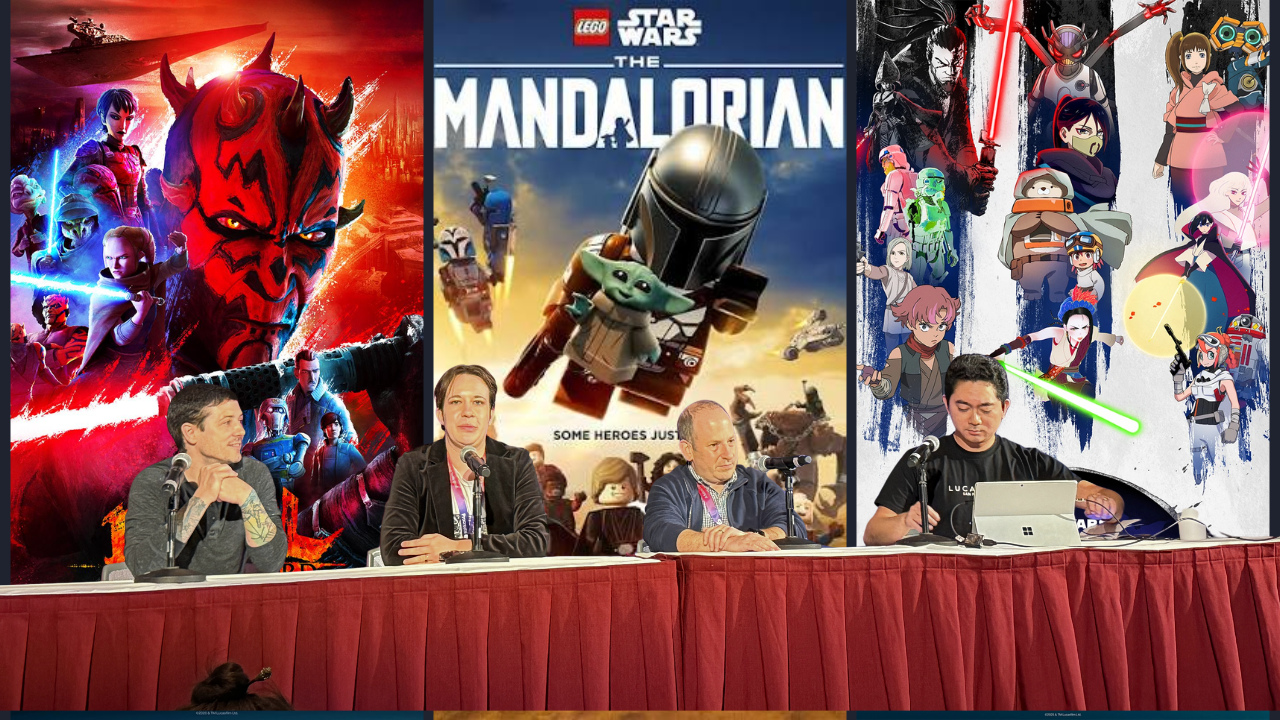
Rimes grew up in Pennsylvania and went to college there before moving to Los Angeles for a string of entertainment internships. One of his early jobs was at Tornante, the company Michael Eisner founded after leaving Disney, where he worked on the stop-motion series Glenn Martin, DDS before the company found its breakout hit in BoJack Horseman. He was never a professional artist, but always loved story. During those years, he developed projects with players across the industry and met writer Matt Michnovetz, now the head writer of Maul – Shadow Lord. The two go back roughly 15 years. Rimes eventually spotted a development posting at Lucasfilm and has been with the company for 11 years, crediting that path with keeping him open to anything.
Riegler studied television at NYU and moved to Los Angeles, where she worked her way through development roles at several companies and found herself gravitating toward genre material. Star Wars appealed to her because of the endless alternate stories it offers to explore. She noted that her career didn't follow a straight line, and told the audience that if their own journey doesn’t look like a neat ladder, that is completely normal.
Martin has been with Lucasfilm for close to 20 years, and he got his start by volunteering at conventions like Comic-Con and Star Wars Celebration while he was still in school. A lifelong fan who admitted to knowing far too much about Star Wars, he met the people running StarWars.com through his volunteer work and landed a job on the site. There he worked on editorial content and video before eventually taking over social media. When Disney acquired Lucasfilm, and the company prepared to make films again with a more connected approach to storytelling, a team formed to oversee that effort, and Martin knew that was where he wanted to be. Today he works across video games, publishing, and animation, helping keep everything in the galaxy connected.
Asked to define animation development, Rimes said it’s a complex answer with a simple core: every project starts with character. Star Wars stories are not always about spaceships and starfighters. On LEGO Star Wars: The Freemaker Adventures, for example, the team focused on a family of scavengers and two brothers audiences could invest in, then worked out how their story tied into the larger saga. From there, the team leans on the themes Star Wars returns to again and again, like the hero’s journey and family, but story and character always remain at the heart of it.
That approach also shaped Maul – Shadow Lord. Rimes explained that after the success of The Bad Batch, which followed clone characters into the era after Order 66, the team began looking for other characters to explore. Maul was a favorite, and the stretch of his life before his return in Star Wars Rebels offered something close to a blank slate for new stories.
How does Lucasfilm Animation balance its zanier projects with its darker ones? Riegler said the LEGO titles reach broad family audiences, which is where much of the studio’s comedy lives, while other series serve smaller but deeply passionate fanbases. Part of the job is deciding what kind of story fits which audience.
Martin added that Star Wars started as a mix of genres and tones, and even the original 1977 film pulls from many different influences. That gives storytellers permission to turn the dial darker in some places and toward pure fun in others.
Rimes pointed to streaming as a major benefit, opening the door to experiments like Star Wars: Visions. He noted that George Lucas drew heavily from samurai films when creating Star Wars, so handing the galaxy to anime studios felt like a natural extension of the franchise’s DNA. The anthology has since grown to three volumes.
On how those projects are developed differently, Rimes noted that LEGO Star Wars has been around for nearly 30 years, dating back to 1999. For a whole generation of fans, LEGO is their entry point into Star Wars, the same way the films were for earlier generations. Riegler said it comes down to knowing what each audience wants. LEGO Star Wars: Rebuild the Galaxy leaned into internet memes and online humor, while Maul – Shadow Lord is a darker, villain-centered story. Martin said that despite those different tones, the team works to maintain a level of authenticity so every Star Wars story still speaks to the others.
Asked about the most rewarding part of the job, Rimes said Lucasfilm is unusual among production companies because the team gets to see projects through from soup to nuts. That includes development, bringing on writers and directors, building the crew alongside the Lucasfilm Animation team, working with marketing and consumer products partners, and finally launching the show to audiences.
Riegler loves hyping up her colleagues across the company and watching how many small fandoms can exist within one giant fandom, with fans getting invested in even the smallest details. Martin, who works across multiple mediums, said one of his favorite things is watching a character that began in one place show up somewhere else, like an animated character jumping into a video game.
The launch of Maul – Shadow Lord brought plenty of those moments. Rimes recalled the show’s announcement at Star Wars Celebration Japan and the huge response that followed. Riegler, who described herself as a former fangirl on Tumblr and Instagram, said it has been surreal to be on the other side, watching fans create art, memes, and their own interpretations of the show’s new characters. Martin said spotting fans in costume as characters from the series is what keeps the team going.
The second half of the panel focused on advice for aspiring creatives. Riegler encouraged the audience to lead with passion, noting that the people she works with genuinely love what they do. Martin agreed, saying he hires people based more on their passion than their qualifications because he can tell they will go out of their way for the work, and he has never regretted it. Rimes stressed networking, encouraging attendees to stay in touch with people from college and their first jobs. Many of his peers from his assistant days have moved up in the industry and remain his support system.
On growing once you land the job, Riegler said she had to build her current role from scratch. Her advice was to stay humble, ask questions, and accept that mistakes are part of how everyone learns, while finding ways to make the role your own. Martin reminded the audience that great ideas can come from anyone, above or below you, and said Lucasfilm’s culture encourages everyone to speak up. Rimes said the first year in any job is about learning how to do it, and even after 11 years, he is still learning every day.
The executives also discussed the skills their work demands. Rimes said learning how to talk to artists and give useful notes is essential, describing the role as part ally and part coach. Riegler said adapting her communication style is key, since executives, directors, writers, and artists all speak differently, and part of her job is bridging those gaps.
Looking ahead, Rimes acknowledged that the industry is in a turbulent moment, with changes in technology and the state of the business, and said the answer is to adapt, support one another, and stay focused on human stories about characters. Riegler said she leans on those same north stars, adding that it is easy to be hard on yourself or feel overwhelmed and that learning to roll with things is a valuable skill. Martin said he tries to keep a positive outlook because every job has its frustrations, but at the end of the day the team gets to make Star Wars.
Romulo asked each panelist which Star Wars themes resonate most with them. Riegler pointed to choice, and the idea that it is never too late to make a different one. Martin described Star Wars as a modern myth built on fables anyone can relate to, with themes of good versus evil that kids can learn from and adults can still enjoy. Rimes highlighted the master-and-apprentice relationship rooted in samurai stories, from Luke’s training with Yoda onward. He said the Force permeates everyone, but what matters is how hard you are willing to work and train, which he called an important message for kids.
The panelists also reflected on what storytelling means to them. Riegler described it as a way to connect with people by seeing the world through a character’s point of view and the relationships they navigate. Martin said storytelling is how people learn to interact with one another, and Star Wars shows the right and wrong ways to do that in a safe environment. Rimes said stories offer an escape to new worlds and new perspectives, which he called especially important for kids.
Asked about surprises along the way, Rimes said there are surprises every day, but Visions stood out. Traveling to Japan, seeing how anime studios approach storytelling differently from the West, and trusting those studios to make Star Wars their own felt like a big risk, and he said it paid off. The panel also marveled at how flexible the franchise has proven to be, with room for everything from preschool shorts made around the world to darker fare. Martin, whose work touches theme parks and instructional content as well as animation, said every medium has its own ideal way to tell a story, from linear animation to games and parks where guests experience it for themselves.
The panel closed with parting words for the audience. Rimes urged artists to keep pushing themselves outside their comfort zones, whether that means writing a screenplay or trying a new kind of story, noting that in today’s creator economy, everyone has a camera in their pocket. Riegler reminded attendees that everyone on stage has been where they are, recalling her own days as a college student in the audience at New York Comic Con, and encouraged them to keep going to panels and making connections. Martin left the room with the idea that everything in life can be inspiration, adding that turning a difficult experience into a story can even free you from it.
For anyone in the room hoping to one day work on Star Wars, the message was clear: lead with passion, stay curious, and remember that the people on stage once sat in the audience too.