
Sundance Review: "The Invite" Turns Domestic Discomfort Into Sharp Comedy


Olivia Wilde’s The Invite opens with the Oscar Wilde line, “One should always be in love. That is the reason one should never marry,” and the film proceeds to examine that sentiment with sharp precision. Set almost entirely within the apartment of Joe and Angela, a couple already fraying at the seams, this chamber-piece dramedy explores dysfunction with a mix of discomfort, humor, and emotional clarity. With Olivia Wilde working on 35mm and leaning heavily into the language of staged intimacy, the film turns a single evening into a pressure cooker where honesty becomes both fuel and accelerant. The film premiered at the Sundance Film Festival.
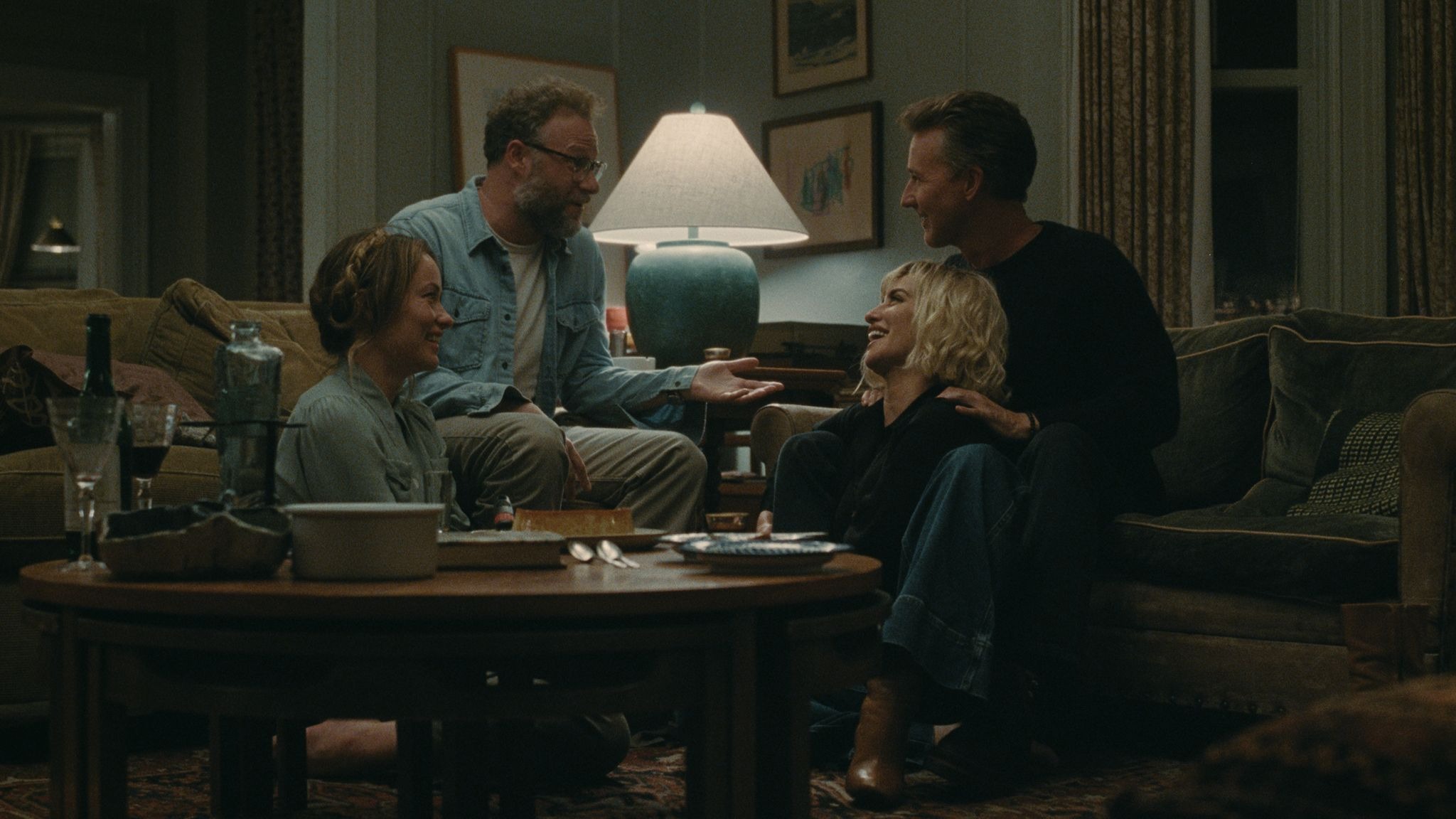
Joe (Seth Rogen) returns home from teaching music to find Angela (Olivia Wilde) frantically preparing a dinner for the upstairs neighbors, Hawk (Edward Norton) and Pina (Penélope Cruz). Angela insists this is an “apology dinner” for the couple’s construction noise; Joe sees it as an unnecessary concession to neighbors whose late-night escapades keep him awake. What begins as a forced social obligation quickly spirals into a night of crossed boundaries, emotional landmines, and clashing energies as the two couples navigate honesty, resentment, and temptation, all without ever leaving the confines of the apartment.
With only four actors and one primary location, The Invite depends on its ensemble, and they deliver an airtight, symbiotic performance. Wilde, Rogen, Norton, and Cruz each work in perfect opposition and harmony, playing characters whose contradictions fuel the comedic tension. No one overshadows another; the ensemble functions like a chamber quartet, each performer essential to maintaining the film’s volatile rhythm.
The most striking achievement is Wilde’s direction. Rather than treating the apartment as a limitation, she weaponizes it. The staging evokes the precision of theatrical blocking while remaining fully cinematic. Tight closeups, controlled camera movement, and a clever use of mirrors and reflections break up the geography and keep the space alive. It has shades of the small-set suspense of Hitchcock’s Rope — not in genre, but in the way the walls seem to tighten around the characters as the evening unravels.
The film’s two couples arrive with opposing energies: Joe and Angela are chaotic and threadbare; Hawk and Pina seem impossibly serene. Watching those dynamics fracture, invert, and collapse is where the film finds its richest comedy. Hawk’s calming spiritual confidence, Pina’s disarming interest in Joe’s music, Angela’s need for order, and Joe’s resistance all collide in ways that feel both outrageous and painfully recognizable. Much of the film’s humor stems from these mismatched emotional wavelengths rather than any slapstick setup.
The cinematography by Adam Newport-Berra uses tight framing to amplify eye acting and micro-expressions, crucial in a story driven by unsaid grievances coming to light. Devonté Hynes’ score leans into unsettling bass strings, withholding piano entirely until the story earns it — a satisfying payoff given Joe’s fraught relationship to the instrument. These choices give the film a sense of lived-in emotional texture that keeps its single location from ever feeling static.
At 107 minutes, The Invite occasionally lingers on beats long enough for the energy to sag. A tighter 90-minute version might have amplified its impact without sacrificing character depth. These lulls aren’t frequent, but when they appear, they slow the momentum of an otherwise finely calibrated dramedy.
The Invite is a sharply observed, often hilarious, and surprisingly empathetic exploration of what happens when unspoken desires and resentments erupt over the course of one ill-timed dinner party. Wilde’s direction brings confidence and specificity to a film that could have felt stage-bound, and the ensemble delivers performances perfectly attuned to its escalating awkwardness. While the pacing occasionally wavers, this is a richly crafted, darkly funny look at the fragility of modern relationships — and one of Sundance’s strongest film this year.
I give The Invite 4.5 out of 5 stars.