
Sundance Review: “I Want Your Sex” Is a Bold, Hysterical Standout


Before the Sundance Film Festival premiere of Gregg Araki’s I Want Your Sex even began, the writer-director teed it up as an “audience-friendly wild ride,” and it’s hard to argue with the promise. The film lands with the kind of immediate confidence that comes from a filmmaker who knows exactly what tone he’s after and has the cast to pull it off. Wickedly funny, visually electric, and propelled by two performances that keep raising the stakes, I Want Your Sex plays like a glossy fever dream. It’s bold, it’s ridiculous, and it’s anchored by a surprisingly earnest emotional undercurrent.
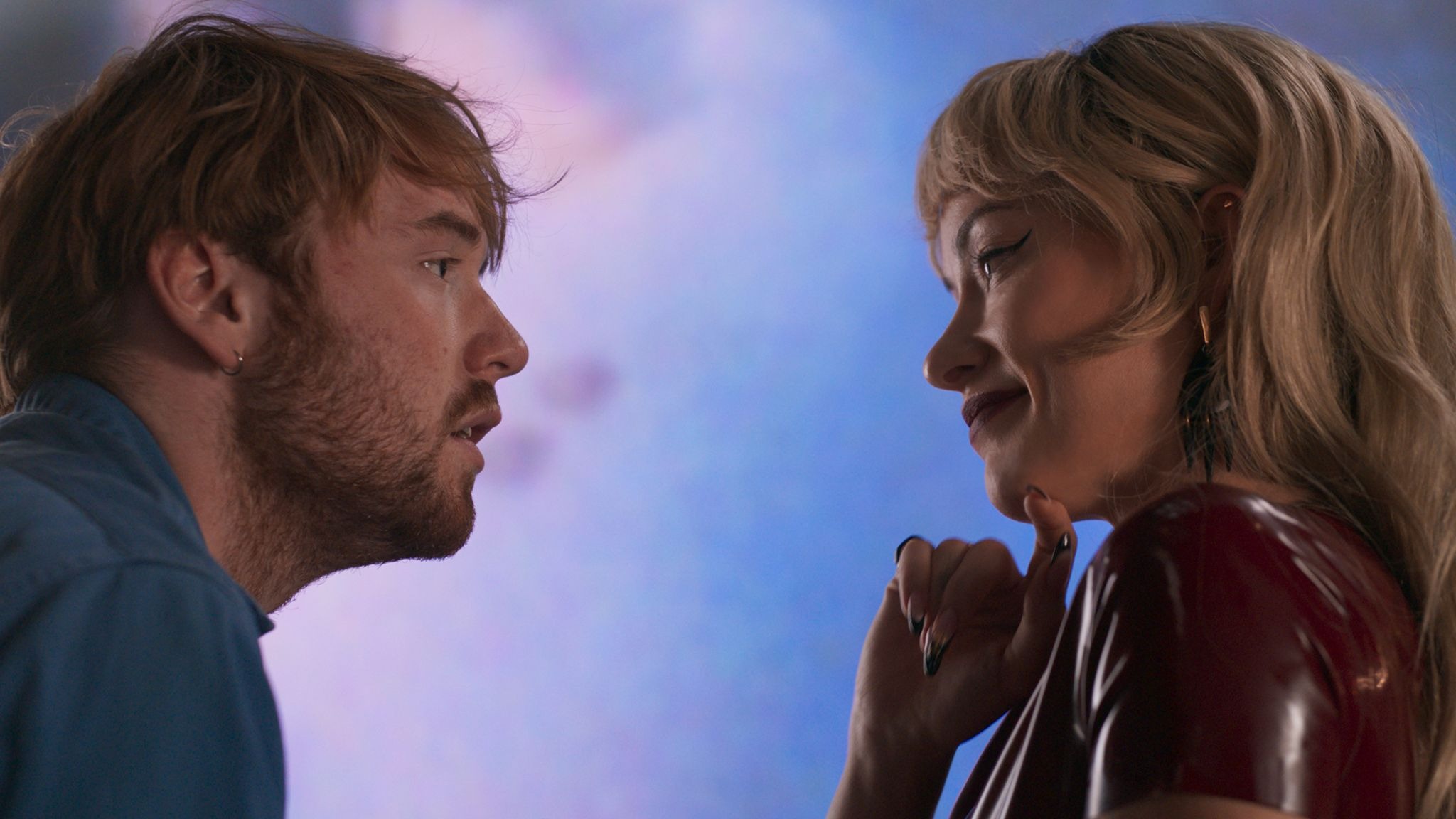
When a directionless young man named Elliot (Cooper Hoffman) lands a job assisting provocative Los Angeles artist Erika Tracy (Olivia Wilde), he’s quickly pulled into her intoxicating world of confidence, control, and creative chaos. What begins as flirtation escalates into a charged dynamic that disrupts every corner of Elliot’s personal life, blurring the lines between mentorship, manipulation, and desire as Erika prepares for a career-defining gallery show. Told through Elliot’s recollection during a police interrogation, I Want Your Sex becomes a sharply funny, stylized spiral about power, obsession, and the cost of becoming someone’s muse.
I Want Your Sex is often laugh-out-loud funny, but the biggest laughs don’t come from trying to top itself with outrageous moments (though it certainly enjoys a few). The humor lands because Araki builds a very specific dynamic and lets it play. The film’s funniest scenes spring from the push-and-pull between Erika’s commanding certainty and Elliot’s overwhelmed eagerness — a dom/sub power dance expressed less through explicitness than through tone, posture, and a constant escalation of “you can’t be serious” requests and reactions. Elliot’s wide-eyed devotion makes him a perfect comic instrument, while Erika’s composure turns every line into a weaponized purr.
Wilde gives Erika Tracy the kind of presence that transforms a room: funny, intimidating, and impeccably self-possessed. There’s a flicker of Miranda Priestly in the performance — that ice-cold authority, the sense that everyone else is a prop in her day — but Wilde makes Erika distinctly her own. She’s not simply cruel or seductive; she’s strategic, theatrical, and constantly calibrating how she’s being perceived. That’s crucial, because the film’s story hinges on perception: what’s real, what’s performance, and what happens when someone mistakes the two.
Just as importantly, Wilde reveals the character’s fragility without asking for sympathy on cue. In the Q&A, Araki called the film a “tragic love story,” and Wilde’s performance is the reason that idea scans even amid the comedy. You can feel the ache under the polish — the fear of fading relevance, the hunger to be seen, the control freak desperation of someone trying to turn their life into an artwork before the world looks away.
Hoffman plays Elliot as a young man whose identity is still under construction — pliable, impressionable, and a little too eager to be chosen by someone who seems to know exactly who she is. That pliability becomes the engine of the film: Elliot is funny because he’s constantly trying to keep up, but he’s also tragic because he doesn’t recognize how disposable he is in Erika’s story. Hoffman threads that needle beautifully, keeping Elliot sympathetic even as his choices become increasingly chaotic.
This is the rare “bad idea” relationship movie where you completely understand why it happens — not because it’s romanticized, but because it’s staged like a gravitational event. Erika doesn’t just attract Elliot; she consumes his attention, rewrites his priorities, and makes him feel like he’s finally living inside something that matters. Their scenes crackle with danger and comedy in equal measure, and Araki smartly lets the relationship’s energy do the heavy lifting rather than over-explaining psychology.
The film’s palette is playful and heightened, with color and lighting choices that make the art world feel like a seductive alternate reality. Erika’s wardrobe, her space, and the gallery’s atmosphere aren’t just production value, they’re part of the storytelling. The whole film has a prismatic sheen that matches its tone: bright, stylized, and slightly unreal, as if you’re watching someone’s memory of a disaster that still feels strangely glamorous.
Daveed Diggs is excellent as Vikktor, the pragmatic gatekeeper who recognizes the relationship’s consequences even if he can’t fully prevent them. Margaret Cho and Johnny Knoxville bring a dry, amused edge to the interrogation scenes that keeps the framing device brisk rather than heavy. Mason Gooding’s Zap, Elliot’s coworker who moves through desire with effortless confidence, functions as both comic contrast and a source of quiet pressure, highlighting just how unprepared Elliot is for the world he’s tiptoeing into. And Chase Sui Wonders brings real emotional weight to Apple, grounding the story’s collateral damage.
Also: longtime Araki fans get a bonus layer. Araki noted in the Q&A that he’s tucked in Easter eggs and cameos from familiar collaborators — including Jimmy Duvall, Michael Hitchcock, Darcy Marta, and others — a reward for viewers who come in with a history, even if the film plays perfectly well for newcomers.
There’s an easy surface-level echo of The Graduate in the idea of a young man being pulled into a destabilizing relationship with an older, more dominant figure — but I Want Your Sex doesn’t live there for long. Araki’s film is far more interested in performance, control, and the commodification of experience than in forbidden romance. The film’s third act climax opens the film, which also feels like an homage to Sunset Boulevard, another doomed romance involving an older woman and a younger man.
I Want Your Sex is a confident, wildly funny Sundance entry that understands the power of tone and knows exactly how to walk the line between outrageous comedy and emotional consequence without tipping into anything graphic. It’s a film about obsession and control that’s delivered with a grin, a film that looks like a candy-colored fantasy even as it spirals into humiliation, fallout, and reinvention.
Araki credited the cast in the Q&A with making the film work, and it’s hard to disagree — “Directing is 99% casting,” he said, and I Want Your Sex feels like proof. Olivia Wilde is hypnotic, Cooper Hoffman is terrific, and together they power a story that’s as entertaining as it is unsettling in hindsight. It’s an “audience-friendly wild ride,” yes, but it’s also, beneath the laughs, a sharp little tragedy about what happens when someone turns a person into material.
I give I Want Your Sex 4 out of 5 stars.