
Interview: The Newton Brothers on Scoring "X-Men '97" Season 2, Rogue's 12-String Guitar, and the Weight of Destiny


The Newton Brothers know a thing or two about high drama. Between Mike Flanagan's horror catalog, the record-breaking Five Nights at Freddy's, and Marvel's Daredevil: Born Again, composers Andy Grush and Taylor Newton Stewart have built a career on scores that swing between intimate dread and full-blown spectacle. For X-Men '97 Season 2, that range gets put to a very different test: honoring Ron Wasserman's synth-driven '90s sound while following the X-Men into an arc that stretches all the way back to ancient Egypt and the rise of Apocalypse. With the season's soundtrack from Hollywood Records now streaming, I sat down with the Newton Brothers to talk through their process, from the spreadsheet battles over which of nearly 100 cues make the album, to the 12-string guitar that unexpectedly became Rogue's sound this season.
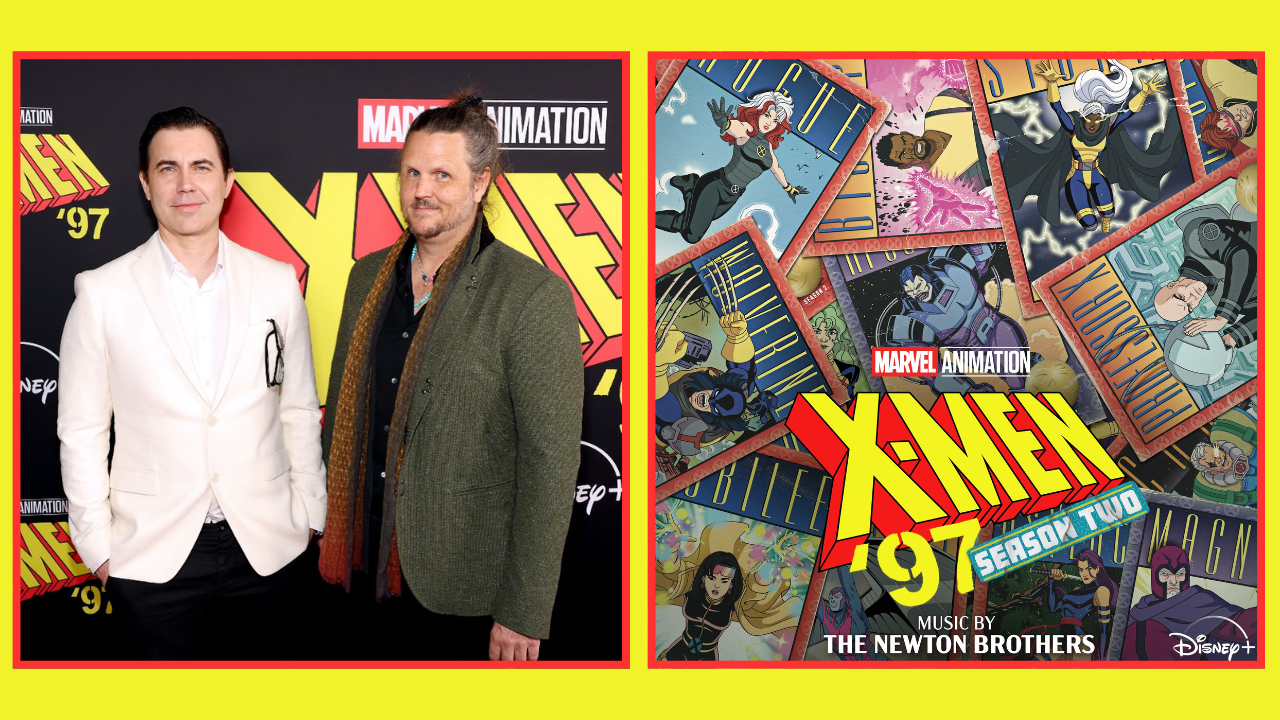
Alex: For a show that's fairly synthesizer-heavy, how did you balance going to ancient times while still keeping it very X-Men: The Animated Series in tone?
Taylor: I think we have a lot of experience with that, even just in the first season, with putting in a little bit of that '90s flare throughout. It can't be too modern; it can't be too '90s; it has to walk that line. And we also wanted it to become more modern as the seasons go on. So we approached this the same way, just with ancient Egypt added in, and we both love that kind of stuff, so it was really easy.
Alex: I know you've talked a lot in other interviews about the theme song specifically, but I'm curious about the typical, average background music on the series. Was there a lot you studied from the original animated series to try to capture a tone or quality that would take adult viewers back to when they were kids watching in the '90s, while still feeling new and fresh?
Andy: Yeah, 100%. What Ron did on the original, he brought so much energy, punch, drive, and emotion. So the first thing we did was rewatch the original. It's funny, you remember things a certain way, and what they actually are and what you remember are always a little different. So it was good to revisit it and go, "Oh wow, he was using all these synths, and this writing style." It was about starting there, then taking that information and using it for what we were going to write for the episodes.
Alex: You two are pretty eclectic with your musical taste and the instruments you pull from. Was there anything in Season 2 that felt very outside the box for you creatively?
Taylor: Nothing really stood out instrument-wise, but there were specific things that were challenging in terms of going against the grain. We scored episode 8 with a definite intention of what we were trying to accomplish, and it ended up they wanted to go from a different perspective, more from the character. So sometimes making those shifts is a unique challenge, because you weren't thinking that way, and you have to recalculate. But in terms of instrumentation, we felt pretty comfortable.
Andy: Yeah, the only thing that was really outside the box was, I've had this 12-string guitar since I was in 8th grade, and we've never used a 12-string on anything. Not because it's a bad instrument; it just doesn't work most of the time. But it works this season, and it becomes a whole thing for Rogue, especially toward the end of the season with her. Nothing groundbreaking, but it was really fun to put on there, and it's very effective, very out front and present.
Alex: You two work a lot in live-action, including a lot of horror, and you did Daredevil: Born Again. Is there anything about X-Men '97 being animated that makes you feel more free? I've talked to composers who've done both, and they often feel animation gives them more license to play than live action. Is that the case for you on this show?
Taylor: There's something in this particular style of the show where we can go really big, and then all of a sudden really small, and then really big again, and I don't think every project allows for that. Sometimes it's about being restrained, with a longer ramp to get to the end. With this one, there's so much happening in such a compressed amount of time. It's amazing how short these episodes are, only 30 minutes, but because so much happens in the storytelling, the writing needs to reflect that. That's what makes it fun. It gives us the freedom to do a lot more than, say, The Haunting of Hill House, where it's four chords and two seconds of space, which is great too, but a very different beast.
Andy: Yeah, and I think animation gives you an invitation for suspension of disbelief, which I feel like you kind of have to have in all storytelling, fiction or non-fiction. I think it's interesting to hold that as part of who you are as a viewer, as someone who takes in art and stories. Animation is like, "Hey, leave your shoes at the front door, you're going to see some pretty wild things here. Let's go." Whether it lands with you or not is up to your interpretation, but I think it opens that door more than live action maybe.
Alex: When it comes to assembling tracks for the streaming albums, did you get hands-on input on which tracks made it?
Taylor: We were definitely involved in picking the cues and tracks. Unfortunately, there's so much music that it's always challenging to fit it all within that volume. We discuss it, we actually vote on it, because you don't want to disappoint fans by leaving off a track. We had a little of that in Season 1, like "where's this dance track?" So it's challenging, but we're very much involved in curating the music, which is obviously a lot of fun.
Andy: Taylor and I keep a deep spreadsheet as we're building the album. It starts ridiculous, like 95 tracks, which is insane. We're always leaving comments on tracks, even ones we disagree on, like "will the fans like this?" One of us says yes, the other says no, we don't know. And then sometimes we cut something and the album comes out, and it's all over Twitter: "Where is that track?" And we're just like, "Oh man, we tried."
Alex: Is there anything you're most proud of from this show?
Taylor: I think episode 8 was the most involved in terms of everything going on and interweaving themes and emotion, which made it probably the most challenging and the most fun for us. I can't speak for Andy, but for me, that was the one.
Andy: Yeah, and I think the arc of destiny this season is a big thing. Apocalypse is a huge part of the season, and Nathan/Cable's arc of destiny within that Apocalypse timeline, and what it all means, pays off very beautifully throughout the whole season, even in the first couple of episodes, with the way everything is teed up, introducing us to Apocalypse and the whole rise of Apocalypse. All of it is very well done, and it was very exciting to be part of this season because there's so much to draw from in that story.
Taylor: He was a hero. He became a villain.
Alex: And we love an anti-hero. Thank you very much for your time and congratulations again on all the success.
X-Men '97 Season 2's original soundtrack, featuring the Newton Brothers' full score, is available now from Hollywood Records on Spotify, Apple Music, Amazon Music, and YouTube Music. X-Men '97 Season 2 is streaming exclusively on Disney+.