
"The Art Form Finally Adapting to Us": How Disney Made "Songs in Sign Language" With the Deaf Community, Not Just For Them


Hyrum Osmond has spent nearly 23 years at Walt Disney Animation Studios, supervising animation of Olaf on Frozen, serving as head of animation on Moana, and co-directing Olaf Presents for Disney+. But his latest directorial effort, Songs in Sign Language, is pretty close to home. Hyrum’s father is hard of hearing and never learned sign language, so their communication was hindered.
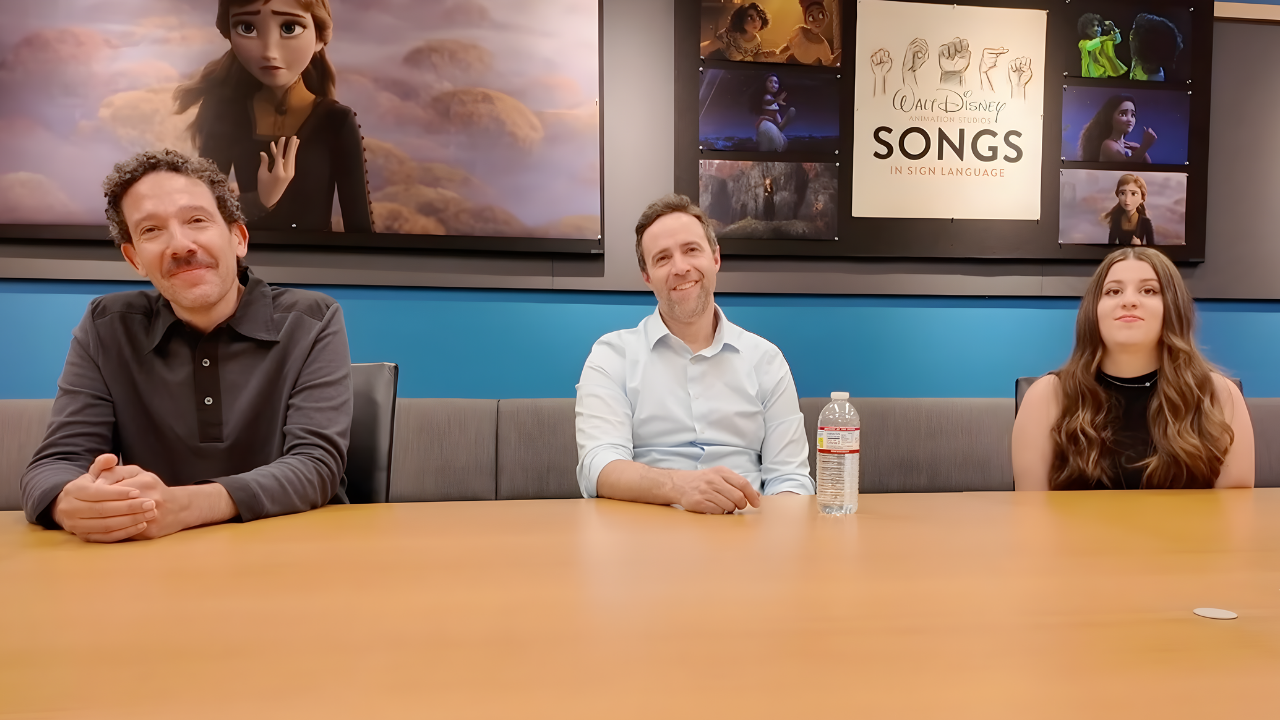
"Growing up, I never learned sign language," Osmond said at a recent press panel for the project. "I felt a lot of regret because I could not connect with my dad." That regret, left unaddressed for years, eventually became a pitch, and that pitch became Songs in Sign Language, streaming on Disney+ April 27th. "This project stands as a symbol of that," Osmond reflected in our roundtable. "We can take down those barriers." The question, for a long time, was how.
Getting Songs in Sign Language to the screen took years of conceptual work, followed by a remarkably compressed production. "This was a slow burn," Osmond explains. "I'd had ideas a long time ago for what this potentially could be. It had to start small, and then it progressed. And then right toward the end is where it was all hands on deck — it went pretty fast. The production took place within a matter of months for the majority of it."
The slow pace of the early years was intentional. "It had to be right," Osmond says. "We couldn't just slap sign language on top of something. We knew it had to be genuine, and so we did our homework. We were okay with it taking a little while to make sure that it was correct."
When the pitch was finally made to studio leadership, the response surprised even Osmond. "It wasn't a situation of me having to sell this," he says. "From the get-go, the studio just saw the vision of what this is and how important this could be. Jennifer Lee and Clark Spencer — they saw it."
For DJ Kurs, Artistic Director of Deaf West Theatre and Osmond's key creative partner on the project, the sell was equally uncomplicated. "It was an easy sell for me because there was a purpose," Kurs said (via a sign-language interpreter). "Art is personal, of course, but the intent and the impact this project will have was very exciting. The origin of the story is the most beautiful."
With the green light secured, the first major decision was which songs to reimagine. The team wanted range. "We Don't Talk About Bruno" from Encanto and "The Next Right Thing" from Frozen 2 represent nearly opposite ends of the emotional spectrum — one a propulsive, multi-character ensemble number, the other an intimate solo built on grief and gathering will. "'Bruno' is a very different song than 'The Next Right Thing,'" Osmond notes. "'Next Right Thing' is much more subdued and emotional. We really wanted to play with that difference." The addition of "Beyond" from Moana 2 brought a third distinct register: expansive, physically demanding, and rooted in a specific cultural identity that would require its own casting approach.
There was also a practical consideration. "Technology changes very quickly," Osmond explains, "and we wanted to pick songs that we could still access and utilize within our current tool set." The "Bruno" sequence — with nearly 30 characters, full choreography, and off-screen lyrics that required repositioning — was also specifically championed by Disney Animation president Clark Spencer. "Clark really wanted us to do 'We Don't Talk About Bruno,'" Osmond recalls. "We knew it was going to be a ton of work, but I'm glad he pushed for it because it turned out great."
Deaf West Theatre, founded in Los Angeles in 1991 as the first permanent resident theater for Deaf actors in the United States, had spent more than three decades building a reputation for productions that treat ASL as a performance language in its own right. Their Broadway production of Spring Awakening, which earned multiple Tony Award nominations, had brought that approach to a national audience. For Kurs, who has led the company since 2012, the Disney collaboration arrived with a familiar anxiety. "Deaf West has traditionally, since the beginning, always collaborated with the larger theater business, the hearing world," he says. "Sometimes it worked, sometimes it didn't. I found that working with people with open minds and open hearts allowed for productive collaboration. Hyrum being so open, aware, and ready, willing, and able to take on the project — that tells me the artistic result will be affected by that spirit entering the project. That was a great relief."
For sign language reference choreographer Catalene Sacchetti, the project represented a personal milestone. "This is my first big project," she says. "I've done a lot of translation work on my own, but this is my first time doing something for a large institution like Disney." When Kurs approached her about joining the collaboration, her answer was immediate. "I met Hyrum and felt immediately like it was going to work wonderfully because of the people, the work environment. Everyone was so passionate and committed to making this work and making this equivalent experience available to deaf people."
Osmond describes the working process as something categorically different from a typical studio-vendor relationship. "When you try to set out and do a big project, sometimes you can think about it as: these people do this, we do this, you do that. From the very beginning, we connected. We crafted this thing together. This was not 'you do your part, I'll do mine.' We really worked together to make sure this was right."
One of the clearest distinctions the team drew throughout production — and one that shapes the finished work — is the difference between accessibility and artistic integration. An ASL interpreter in the corner of a frame meets an accessibility standard. Songs in Sign Language does something else entirely.
"When you have an interpreter or a deaf signer in the corner, that's always good for providing access, for providing information," Sacchetti explains. "I get my equal accessibility met. I experience the same thing the hearing person is experiencing. This project is different because of the artistic approach to the music, to the emotion, to the story. I can relate to the character. Moana, Mirabel — I can feel like, 'Oh, I'm one of you. You're one of me.' That connection to a character is something the Deaf community has never had the opportunity to experience when it comes to entertainment. That's never been done."
Kurs frames it in terms of the art form itself. "It's not only about representation, but about the art form itself," he says. "We're creating a new form of art. This is something that's different but the same — it's like looking at a different side of the same prism. Not checking off boxes. This is, in fact, a new art form." Kurs also speaks to the deeply personal dimension of signing: "You can't separate the signer from what's being said. You just can't." What that means in practice is that the performers' individual personalities, their cultural backgrounds, their ways of moving through space — all of it is present in what ends up on screen.
The animation team faced a question early in the process that turned out to be more complex than expected: beyond the hands, what else needed to be rebuilt? The answer was: almost everything.
"We had the chance, when this was all done, to do a composition of the old film with the sign language version just on top — just to kind of see," Osmond recalls. "And it's very different. So much of what you do in sign language is in the face. If the face isn't right, it's something totally different." The team worked extensively on facial expressions, eyes, and brows. "I would say most of the face that you're going to see is new," Osmond confirms. "A lot of times when you're animating to dialogue, the face will reflect the inflections of what's happening. That's very important. I learned that."
There were also deliberate decisions about what not to sign. In "We Don't Talk About Bruno," the lyric "I grew a gut" — which lands alongside a visual gag of a gut actually appearing — was ultimately left unsigned. "Originally, we did think about signing it," Sacchetti explains, "but we realized that if we sign it, then all the action is happening at the same time. It would be funnier, for comedic purposes, to let the action speak for itself. We don't want to give the audience the sign before they're going to see it, or have them miss the joke entirely because they're watching the signing." Kurs adds: "We didn't want to diminish the moment. We found the balance between art and intention." For Osmond, it connected to a long-standing principle at the studio. "Disney Animation has a strong focus on restraint in our performance," he says. "That's what I love about sign language — the ability to convey something with very few signs. Not to overdo it. Not to overdo the moment."
Two of the three sequences carried cultural specificity that required deliberate casting decisions. For "Beyond," which features Moana, the team sought reference actors with Pacific Islander heritage. "We made the effort to find native signers from that culture," Kurs explains. "Moana is from the Pacific Islander community, and we wanted to get that nuance. There's so much stoicism in that culture, more specific cultural traits that I actually learned from the actors during this process." For "We Don't Talk About Bruno," set in the Colombian-rooted world of Encanto, Colombian actors who are Deaf were cast — and they brought more than ASL to the work. "They used some of their signs mixed with American Sign Language," Kurs notes, "to make this collaboration much deeper and richer. The nuances were all captured through the actors we chose."
For Kurs and Sacchetti, the question of what Songs in Sign Language means isn't abstract — it's personal history made tangible. "I'm a little older than Catalene," Kurs says. "I remember growing up — there were no subtitles. No closed captions, nothing like that. You just watched the characters move on the screen, and that was entertaining enough already. And later on in my life, when captions came up, it was like: oh, that's what they were saying… To see the doors open over the years to get to this point, this moment in time, is incredible."
Sacchetti describes a parallel experience. "I watched Disney princess films on repeat growing up. I loved them all. I found myself fascinated by them — but the meaning behind the story? I didn't have a complete understanding until I became older, when I could watch them again with captions." The gap between engagement and comprehension, she explains, is exactly what Songs in Sign Language closes for the next generation. "For very young children, they're not going to have access with captions. Because of that, I feel I never fully understood anything until I became an adult. With this project, I think there's going to be an incredibly different impact on future generations of deaf children — because they'll be able to watch something that's in their language, presented to them."
Kurs sees the cultural resonance extending even further. "Sign language is taught in many homes, but often not in homes that have deaf children," he notes. "What's exciting to me is that you get the Disney seal of approval for sign language. On a political level, that's very powerful. Sign language is now in the mainstream because of Disney, in that sense."
Asked to name a single standout moment from the three sequences, each of the three collaborators went somewhere different — and each answer illuminated something true about the project.
For Sacchetti, it's the scene in "Beyond" between Moana and her grandmother. "It's so powerful because you're seeing the music, you're seeing the scenery, you're seeing the sign language — and then there's conversation happening as well. There's communication between them. While I was working on it, I had completely forgotten about that. I was like: oh, there's a conversation. There's going to be spoken dialogue that's going to be signed as well. In that moment, in that scene, all of the ways in which I express myself as a deaf person were engaged at once. It's very normal in that particular moment for two people to be having just regular conversational dialogue. That hit me very, very strongly because of the authenticity it had."
Kurs points to the dining hall sequence in "We Don't Talk About Bruno" — eight performers signing simultaneously in eight different choruses, the most technically demanding scene in the collection. "Two centers looking at each other and finding acceptance in each other," he says. "That added a layer of meaning that I experienced as a deaf person that made that scene very important to me."
And Osmond, after nearly 23 years at the studio, animated the final shot of "The Next Right Thing" himself. "There's a lot of pain in that song," he says quietly. "Pain that builds to a release on that very last shot, which I got to animate. That was just super powerful for me to be able to do."
It is, in every sense, the story of someone finding a way to finally connect. When asked at the press panel what he hopes audiences take away, Osmond said five words: "I just hope we can connect more."
Songs in Sign Language premieres April 27th on Disney+.