
Review: With "Songs in Sign Language," Disney Animation Finally Makes Something for the Deaf Community


We’ve all seen videos of the pure joy a deaf child experiences when they meet their favorite character at a Disney theme park and discover that they can communicate with them in ASL. The message underneath the exchange is simple and enormous: I see you; you belong here, too. Disney Animation's Songs in Sign Language is that moment, scaled to three of the best musical sequences in recent Disney history — and rendered in the studio's own medium.
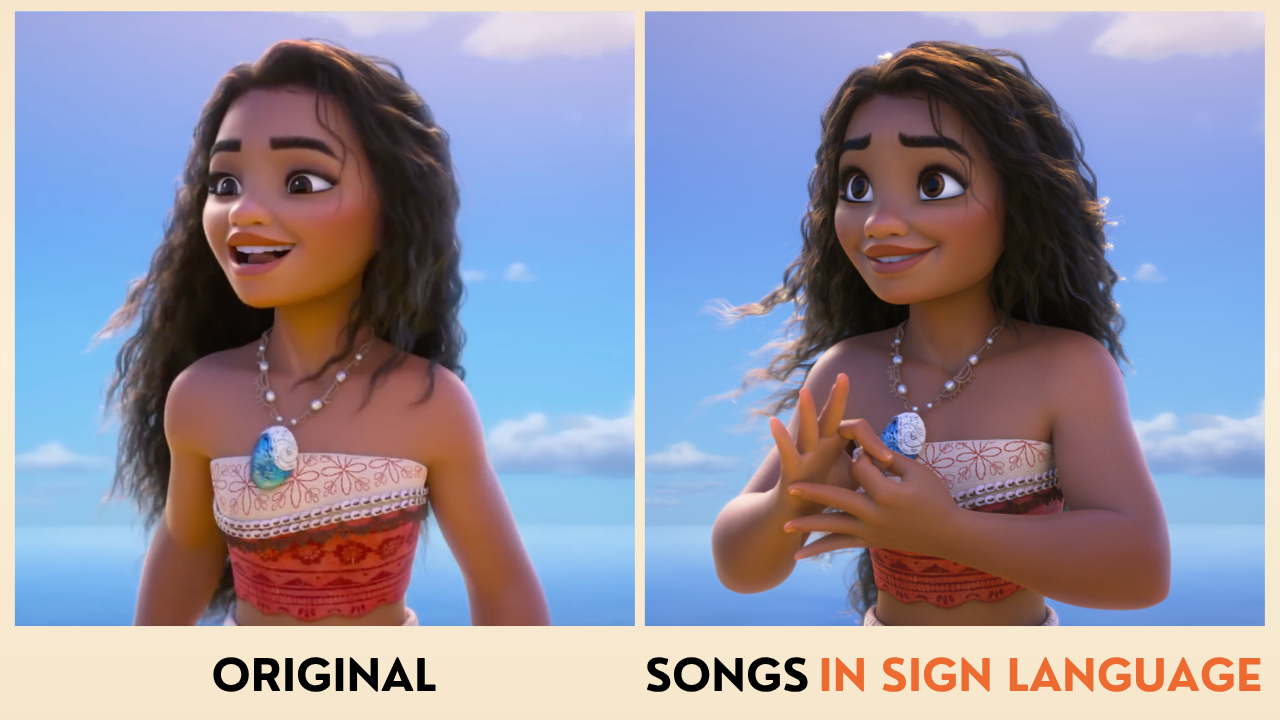
Songs in Sign Language reimagines three songs from Disney animated films in American Sign Language — "The Next Right Thing" from Frozen 2, "We Don't Talk About Bruno" from Encanto, and "Beyond" from Moana 2. This isn’t sign language layered on top of existing footage, but a new, reimagined animated performance designed around ASL performance and choreography. The result is something the studio has never done before and something the medium is remarkably well suited to.
The characters move differently. Their bodies, their faces, the space they occupy — all of it is new. A team of more than 20 animators created the majority of the footage from scratch, using reference shoots with Deaf West Theatre's performers as a foundation. The result feels, for the first time in Disney's history, like something made in the Deaf community's own language rather than translated into it.
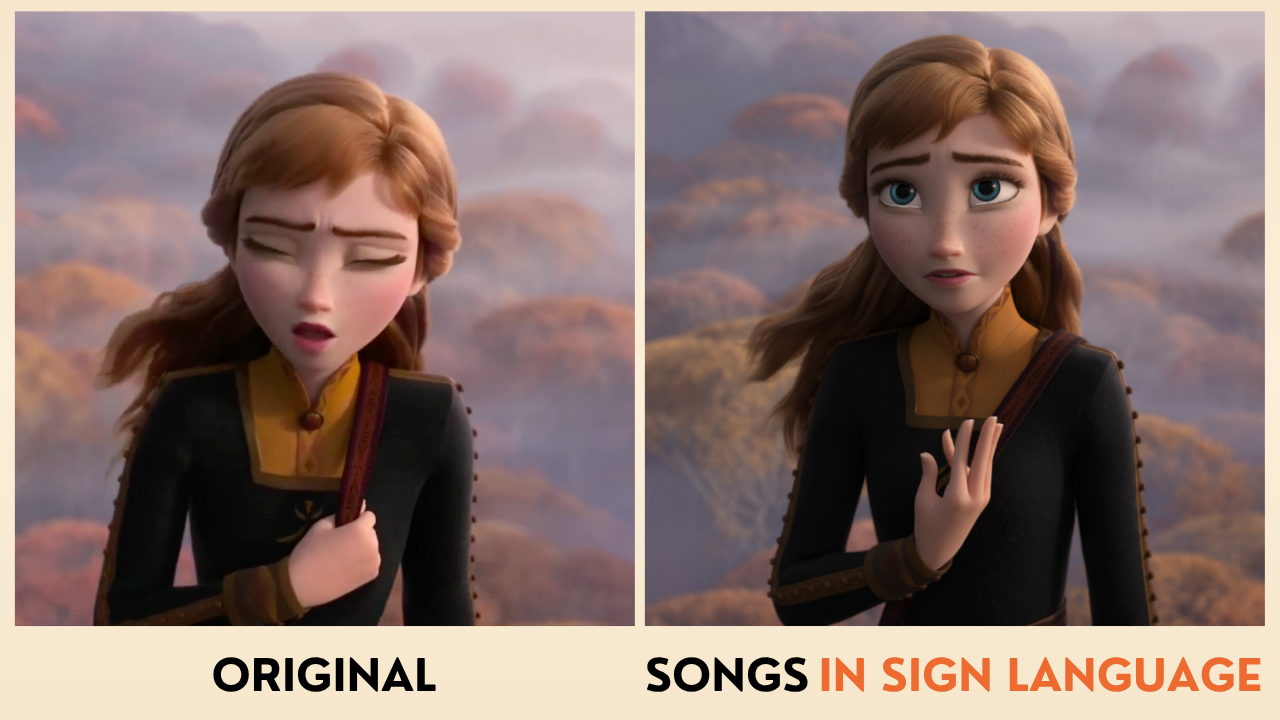
"The Next Right Thing" is the quiet heart of the collection. Anna alone in the dark, signing through grief and the slow gathering of will — it's the most emotionally precise of the three, and an ideal proof of concept for what ASL performance can do in animation. Where the original song asks you to feel what the lyrics describe, this version makes you watch someone's whole body carry the weight of the moment. Hands, face, posture — all of it is the performance.
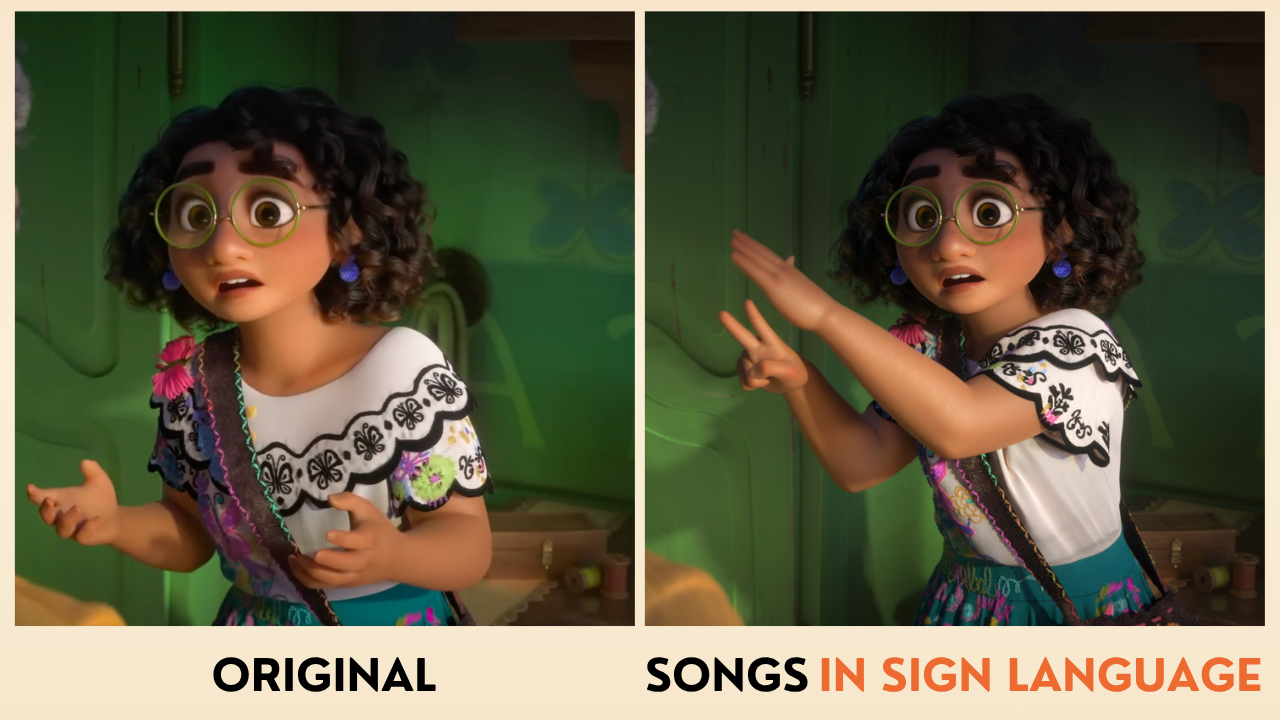
"We Don't Talk About Bruno" is the most technically audacious. With nearly 30 characters, full choreography, and off-screen lyrics that had to be repositioned so Deaf viewers wouldn't miss a word, it is a genuine production achievement. It is also, frankly, a delight — familiar and kinetic and newly layered in a way that rewards attention even if you've seen the original sequence a hundred times. The energy of the ensemble performance translates completely.
"Beyond" lands somewhere between the two — expansive where "Next Right Thing" is intimate, grounded where "Bruno" is propulsive. Moana signing through physical exertion, sometimes with one hand as the climbing demands it, shouldn't feel natural, but it does. The sequence makes a quiet case that ASL performance in animation doesn't require stillness or special accommodation — it can exist inside action and movement without losing anything.
For viewers who don't sign, what registers first is how beautiful the performances are to watch. ASL is a three-dimensional, spatial language signed with the entire body — hands, face, torso, eyebrows, and the physical space around the signer all carry meaning simultaneously. In animation, where every element is intentional, that means the characters in these sequences are doing something with no equivalent in standard Disney animation: every inch of their bodies is storytelling at once.
The collaboration with Deaf West Theatre is what makes that possible. Founded in Los Angeles in 1991 as the first permanent resident theater for Deaf actors in the United States, Deaf West has spent more than three decades building a reputation for productions that treat ASL not as a translation but as a performance language in its own right — what they call a "ballet of language." Their 2015 Broadway production of Spring Awakening, which earned multiple Tony Award nominations, brought that approach to a national audience. Here, they bring it to Disney Animation's characters, with sign language reference choreographer Catalene Sacchetti shaping the performers' work alongside Artistic Director DJ Kurs. The sequences were choreographed, not transcribed. That distinction matters enormously in what ends up on screen.
Walt Disney understood almost from the beginning that stories travel further when they speak to people in their own language. When Snow White and the Seven Dwarfs reached international markets, the localization was so thorough that on-screen text was redrawn in each region's language. In the decades since, Disney has maintained one of the most extensive dubbing programs in entertainment, producing alternate-language versions of their animated features in dozens of languages with performances that feel native rather than adapted.
ASL has been the gap in that commitment — not through intention, but because conventional filmmaking has no clean mechanism for it. You can add subtitles. You can add a picture-in-picture interpreter. But you cannot, in a live-action or traditionally animated film, have the characters themselves sign. Disney Animation can. The animated body is infinitely controllable, and every hand shape, facial expression, and spatial relationship can be specified exactly. Songs in Sign Language is the realization of that potential, applied to the part of Disney films that has historically been most inaccessible to Deaf audiences — the songs. It is overdue, and it is worth the wait.
Director Hyrum Osmond, who grew up with a Deaf father, has said that this project was, in part, an act of repair — a way of building a bridge he didn't build early enough. That personal motivation gives Songs in Sign Language an emotional sincerity that goes beyond its considerable craft. It isn't a check-the-box. It is a genuine attempt to do something the studio should have found a way to do long ago, executed at the highest possible level.
For Deaf audiences and ASL users, this will land as something specific and significant: the art form finally adapting to them. For everyone else, it is a reminder of what animation can do that no other medium can.
I give Songs in Sign Language 5 out of 5 stars.
Songs in Sign Language premieres Monday, April 27th, on Disney+.