
The Star That Started It All: How Disney Animation's "Versa" Turned Personal Grief Into Cinematic Wonder


Walt Disney Animation Studios' new short Versa plays differently once you know where it came from. It comes from a real nursery that a husband and wife who couldn't go in together for a long time after losing their infant son. It comes from a baby shower themed to "Twinkle, Twinkle, Little Star" and "When You Wish Upon a Star." From all of that, Malcon Pierce — a 16-year Disney Animation veteran whose credits span Frozen, Moana, Raya and the Last Dragon, and more — made a short film. We got to talk with him during a recent press day at the studio about his short, the first entirely animated by Disney’s Vancouver animation studio, although very much a collaboration with the team in Burbank.
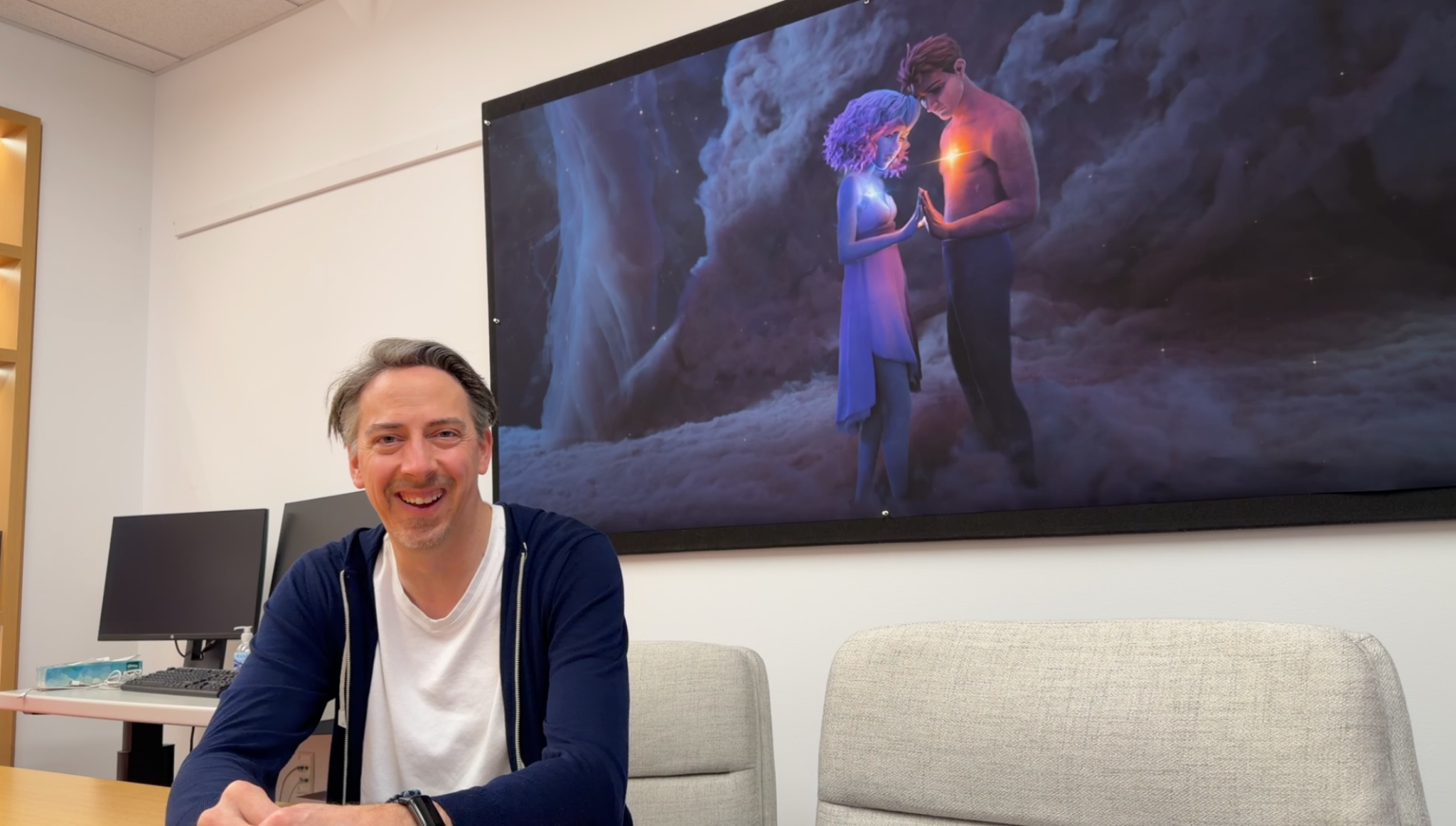
The earliest version of what became Versa had nothing to do with grief. "I drew this dancer," Pierce recalled, "and I was like, oh, wouldn't it be cool if it did, like, a pond ripple like in Fantasia? And I tried to draw these little ripples, and I did such a bad job. It looked like clouds. I was like, oh, wait. It's like a galaxy."
That accident of a sketch sent Pierce toward outer space. Not long after, he went stargazing with friends who pointed out the Albireo system — a binary star, two points of light orbiting each other, one blue and one yellow. "I remember so clearly seeing that," he says, "and being like, oh my god. It's such a romantic idea."
He had imagery. He had a setting. What he didn't have was a reason. "I've got the visuals, but I don't feel like I've got something I'm really connecting to from a story standpoint," he remembers thinking. It wasn't until he turned inward — to the loss of his son Cooper during the production of Moana, and to the star motifs that became the family's way of keeping Cooper present — that the short found its engine.
"For a long time, I had an idea in my head about how awesome it would be to capture the magnitude and beauty of the cosmos," Pierce recalls in the film's production notes. "I never really felt like I was able to come up with the right story to match the imagery. During the production of the first 'Moana,' my wife and I lost our infant son, Cooper, and it was such a reset in both of our lives." His baby shower themes were "Twinkle, Twinkle, Little Star" and "When You Wish Upon a Star," and the family placed a crystal star in their window that would shine rainbows across the room in the mornings. "This led to an epiphany moment," Pierce said, "and I began thinking about this great loss and how it transformed these characters."
"I found that once I surrendered to going for that idea," he said at the recent press panel for the film, "it really started to self-motivate."
The moment Pierce decided to pursue the idea more seriously, there was one person he wanted to tell first. He had worked closely with Jennifer Lee on Frozen more than a decade earlier, and the conversation that followed — a couch, an hour and a half, a studio executive willing to listen — set the project in motion.
"We sat on a couch and talked for an hour and a half," Pierce recalled, "and she was super supportive of the idea. That was really the first moment of me wanting to pursue this further. She gave me great advice about how to think about the story and how to share it with other colleagues. I count that as my first production meeting." Lee, who served as executive producer on the finished short, remained involved throughout. "Jenn would always say, when I would present to her," Pierce noted at the presentation, "'You're able to speak to this much more clearly and much stronger every time.'"
From the beginning, Pierce knew he wanted Versa to be music-driven — a direct descendant of Fantasia. His specific touchstone was the sequel’s “Firebird Suite” segment featuring the spring sprite, a character whose organic movement and expressiveness he had long admired. "I wanted to do a little bit of that," he says. Early pitch materials included Fantasia imagery alongside other inspirations: turn-of-the-century illustration, sculpture, and the kinetic energy of circus performance.
But a musically driven short about celestial beings needed movement that felt grounded rather than weightless. The answer came from ice skating. "What I loved about the skating is that you could have someone moving very quickly without moving, if that makes sense," Pierce explained. "They're grounded, but fluid, with a kinetic energy. And the more we looked into it, the more it started to just make sense — the orbit, the circles."
To capture that movement as animation reference, Pierce found cinematographer Jordan Cowan through a YouTube channel on which Cowan, a former competitive ice dancer himself, had documented his specialty camera rig. Rather than filming skaters from the outside, Cowan skated with his subjects, giving the footage an interior perspective unlike anything shot from a fixed position. Olympic silver medalist Ben Agosto and choreographer Katherine Hill blocked the characters' movements in Colorado Springs; the brother-sister team of Oona and Gage Brown provided additional skating reference. Animation supervisor Sigurdur Thorhannesson, himself experienced with dance and skating, animated the climactic celebratory sequence in which the reunited characters move together and share a kiss.
Two other moments from the Disney canon surfaced during production as quiet design reference points. The cloud bassinet in Hercules was similar enough to Versa's nursery that Pierce's team was deliberate about distinguishing theirs. And the final image of Versa — in which the couple's lost child appears in the sky as a constellation — was never planned as a callback to The Princess and the Frog. It simply arrived. "The Princess and the Frog wasn't intentional," Pierce says with a smile. "But it fits."
The centerpiece visual metaphor of Versa — the characters shattering before reassembling in a new form — came together through conversation with two Disney colleagues. Director Chris Buck shared personal thoughts with Pierce about how grief has a way of splitting a person open. The image resonated immediately. Pierce knew the characters needed to break. But he didn't want them to simply reassemble as if nothing had happened. "I feel like you don't really heal fully from grief," Pierce said. "You develop a relationship with it. You learn how to keep it with you instead of keeping it at arm's length."
It was Liz Watson, director of creative development at Disney Animation, who offered the missing piece during a development conversation: kintsugi, the Japanese art of repairing broken pottery by filling the cracks with gold. "As soon as we opened it up," Pierce recalled, "it was one of those moments where it's like — yes, you cracked it. Because there's no dialogue, and they can't say 'I'm healed, but it's still in me.' The visual just says it." The characters in Versa return to each other carrying their fractures in gold — transformed, not repaired. The brokenness is the beauty.
Paul Felix, whose production design credits include Raya and the Last Dragon, Big Hero 6, and Lilo & Stitch, provided the visual foundation for the characters and their world, bringing back Pierce's early descriptions of "nebulas, beautiful and sculptural," as ten concept paintings that immediately clarified the direction. Story artist Mark Kennedy — head of story on Tangled and Wish, with more than 35 years of contributions to Disney Animation — helped shape the emotional beats into a workable structure.
Versa is the first production completed entirely at Disney Animation's Vancouver studio, and the technical ambitions of the film pushed that team into entirely new territory. The characters — luminous, gaseous, self-illuminating — required a pipeline that simply didn't exist yet. "Usually our pipeline is relatively linear," Pierce explained. "You have a design, then you model them, then look, then lighting, then effects. But because the characters were somewhat translucent and self-illuminating — and there's soft movement within their shapes even when they're standing still — we needed effects and lighting involved almost from the modeling stage." The result was something unusual: entire pipeline departments that rarely share the same room were suddenly building vocabulary together from the beginning, well before production animation began.
The environments presented their own challenge — keeping the cosmos from feeling like an undifferentiated void. Production designer Ryan Lang's solution was a set of pre-built cloud shapes, "nebula Lego pieces" that the team could compose and recompose to give each scene a sense of geography. Three anchors structured the film's space: the nursery, a peninsula extending outward into open cosmos, and what the team called the "battle dome" — the arena where the characters come apart. Inspired in part by images from the James Webb Space Telescope, the backgrounds rank among the most visually ambitious environments the studio has produced.
Pierce describes his wife Keely as his "spiritual executive producer" on Versa — not a formal title, but an accurate one. She was present for every stage of the project, from the earliest pitches to the most difficult creative decisions. One of those decisions was how directly to portray the couple saying goodbye to the child they lost. Pierce was initially inclined toward something more symbolic. Keely was not. "She was such a strong encourager," he recalled. She drew on their own experience: the hospital introducing them to the nonprofit Now I Lay You Down to Sleep, which provides infant loss photography to families at no charge. A nurse — Carly, who remains a close friend of the family — and Keely herself had encouraged Pierce to participate at the time. The goodbye in Versa is in the film because of Keely’s encouragement.
"I wanted it to open the conversation," Keely says in the film's production notes, "and say that you'll never be the same and you'll never be okay, but you're going to rebalance yourself and walk through life with that new balance. It can be just as beautiful, but different."
She also, indirectly, reshaped the film's entire color palette. Pierce had designed the mother character in warm peach tones and the father in blue. When he showed Keely, she said she'd be blue — she was moody, she said; blue fit her. Pierce came in the next day and announced he'd been rethinking the color scheme for story reasons. The truth emerged later. The film's central chromatic language — cool blue for the woman, warm gold for the man — came, in no small part, from Keely's self-assessment.
Pierce had been developing Versa since 2013. By the time the finished short arrived on Disney+, his son Casper — born at the end of production on Moana, a rainbow baby in the truest sense of the phrase — was eight years old and had spent a good portion of his childhood watching the film take shape. During home work sessions, Casper would wander in and sit through reviews. One day, he picked up a pencil and drew a small star on the mother character's hair in a piece of reference artwork. Pierce sent the drawing to the lighting team as a joke. The lighter put the star in the film. It's there, visible in the frame where the mother's hair catches the light after she and the father reunite.
Casper has three freckles on his face that form a small triangle — he's called them his "constellations" since he was small. Those freckles appear on the face of the child at the end of the short. The child also glows with a rainbow-prism light around him, a deliberate nod to the term "rainbow baby." "Casper takes great pride in being in the film," Pierce said.
The night Pierce set up a screening in the Vancouver studio theater — for Keely, her mother, and Casper, sitting in the dark while Pierce sat in the back and hit play — the last card appeared on screen: *In memory of Cooper.* "It was great," Pierce said. "And it was really healing."
Pierce hopes audiences leave with something specific in mind. "What I would love for audiences to take away is to take an extra 30 minutes at bedtime to tuck in the kids," he said, "or hang a little longer when you hug your parents, or someone else, when you say goodnight. I was really scared to open up after Cooper's passing, but if you do allow yourself to be split open — you can actually have a relationship with folks you've lost through the acceptance of what happened, instead of running from those feelings."
Versa is now streaming on Disney+.