
"The Rocketeer" Returns: Nostalgia and Magic at El Capitan


The El Capitan Theatre holds a special place in my heart. Partly because I worked there, but also because it harkens back to when Disney was investing in experiences beyond their parks. The early 90s launched Disney Theatricals and the Anaheim Ducks, while also laying the groundwork for other offerings such as DisneyQuest, Disney Cruise Line, and the Disney Institute. While some of those endeavors were more successful than others, there was some excitement as Disney found ways to deliver their magic in new ways.
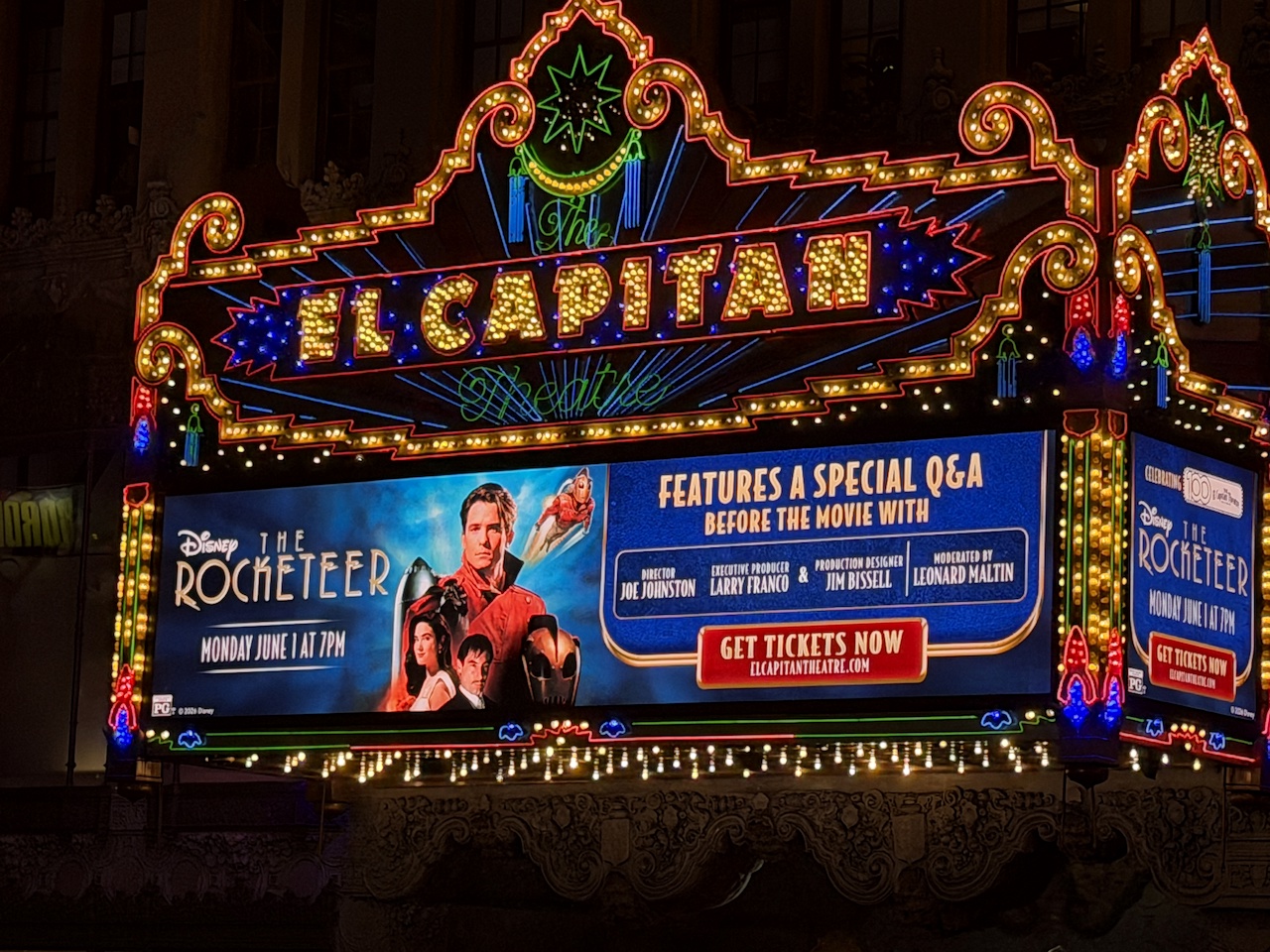
While not as adventurous as they once were, The El Capitan Theatre offered special experiences to each film that were creative and eventized each release. Whether it was a stage show for Toy Story, an interactive exhibit for Atlantis, or a skating rink for Ice Princess, there was always something to look forward to beyond the film. But it all started with the World Premiere of Disney’s The Rocketeer.
As part of the kickoff to the El Capitan Theatre's 100th Anniversary celebration, they held a special screening of The Rocketeer, accompanied by a special conversation with director Joe Johnston, executive producer Larry J. Franco, and production designer Jim Bissell, moderated by film historian Leonard Maltin.
For Johnston, The Rocketeer represented a major leap in his career. Fresh off the success of Honey, I Shrunk the Kids, which marked his directorial debut, Disney asked if there was another project he wanted to tackle. His answer was immediate.
Johnston explained that he was already a fan of Dave Stevens' graphic novel and was thrilled to learn Disney had secured the rights. While some changes had to be made for the adaptation, he emphasized that the creative team worked hard to remain faithful to Stevens' vision.
That dedication extended beyond the story itself. Bissell noted that Stevens had created a romanticized version of 1930s Los Angeles that never truly existed, yet felt completely authentic. The production embraced that spirit, crafting what Johnston described as a "love letter" to Southern California and Hollywood's golden age.
One of the most fascinating portions of the discussion focused on the film's practical effects and production design. Long before digital environments became commonplace, the filmmakers relied on old-school movie magic to bring The Rocketeer to life. Bissell recalled transforming a Long Beach seaplane hangar into Howard Hughes' aviation facility, complete with an elaborate Art Deco office set. He also described constructing the climactic zeppelin gondola sequence using a massive gimbal and a 120-foot painted backdrop that simulated Los Angeles thousands of feet below. "There was no CGI at all in the picture," Bissell noted, a statement that drew appreciation from the audience.
When discussion turned to casting, Johnston revealed that while several actors pursued the role of Cliff Secord, his first choice was always Billy Campbell. According to Johnston, Campbell not only resembled Stevens' original artwork but also possessed the all-American quality that defined the character. As for casting Jennifer Connelly, Johnston joked that there was little room for improvement.
Given Johnston's extensive history with George Lucas, it was inevitable that the discussion would touch on his years at Lucasfilm. Johnston praised Lucas as an extraordinarily generous mentor who helped shape his understanding of filmmaking. He described how Lucas often invited him into the editing room to explain storytelling decisions and visual effects planning. Johnston even recalled Lucas offering to pay for film school after Johnston expressed interest in expanding beyond visual effects work.
While The Rocketeer was not the blockbuster Disney hoped for when it was released in 1991, the affection surrounding the film was impossible to miss during the evening.
Franco recalled fighting for additional resources to perfect key sequences and shared a story about a visual effects shot that initially seemed unnecessary. When the film was first screened for audiences, however, that moment became one of the biggest laughs in the movie, proving the creative team's instincts correct.
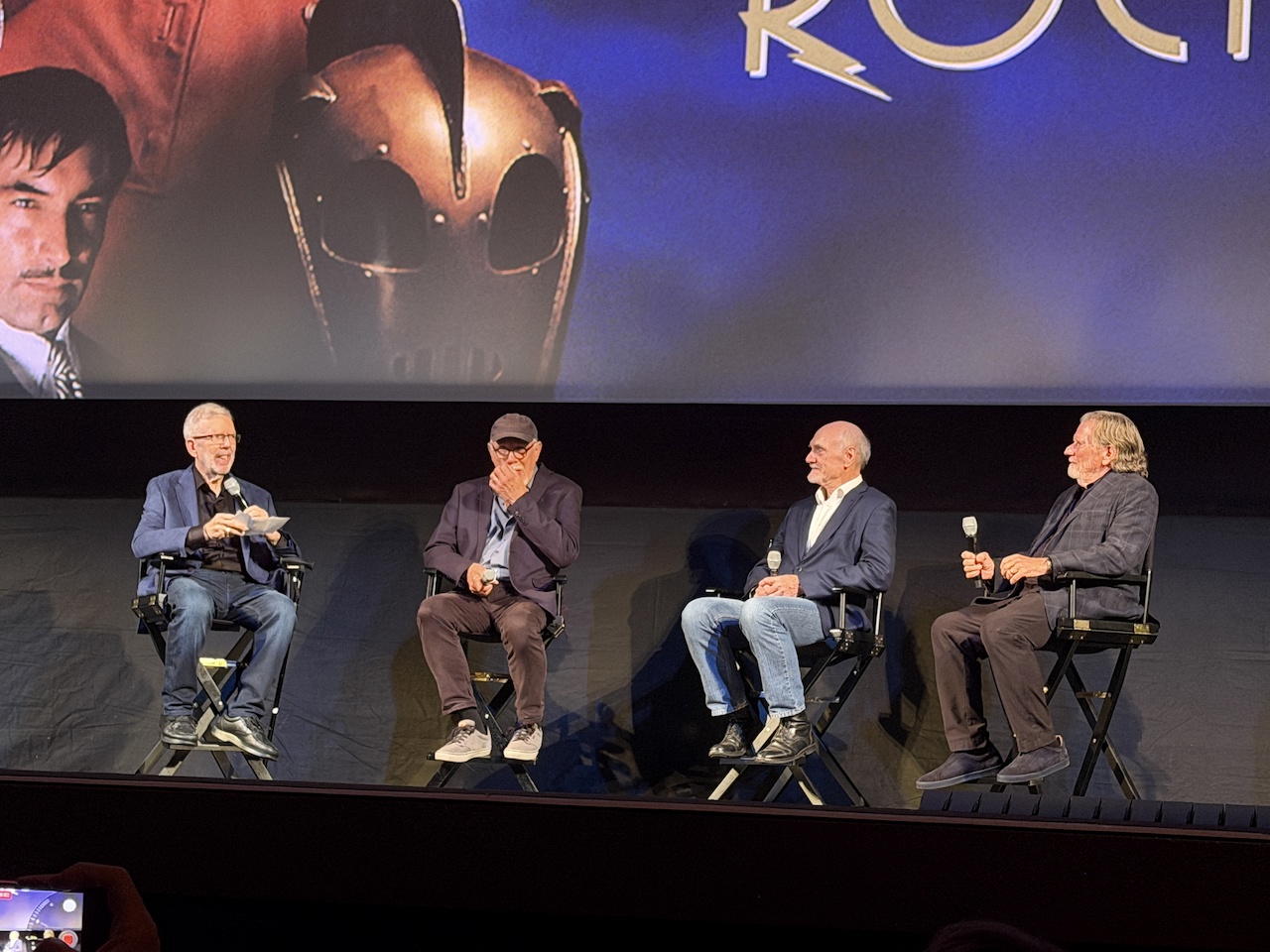
Johnston reflected on the film's legacy with particular fondness. Although he admitted he often struggles to watch his own work because he focuses on what he would change, The Rocketeer remains an exception. "It's such a joy to watch," he said, adding that he revisits the film every few years. He also singled out composer James Horner for creating what he considers one of the finest scores of his career.
Bissell and Franco echoed those sentiments, both describing the film as one of the proudest accomplishments of their careers. After decades in the industry and countless productions between them, The Rocketeer continues to stand out as a special project.
One of the evening's most emotional moments came when Johnston shared a recent email from Campbell, who was unable to attend the event. Writing from Norway, the actor said The Rocketeer still holds a special place in his heart and reflected on the friendships formed during production. He paid tribute to the late Alan Arkin, calling him a guiding influence whose kindness shaped the way Campbell has treated colleagues throughout his career. Campbell also praised Johnston for creating "a bloody wonderful film" filled with a love of movies and friendship.
As Maltin looked out across the packed auditorium, he remarked that it may have been the fullest audience The Rocketeer had ever played to. Whether or not that was literally true, the enthusiasm inside the El Capitan certainly suggested the film's reputation has only grown over the past 35 years.
For a theater celebrating a century of cinematic history, there may have been no more fitting way to begin its anniversary festivities than by revisiting a film that has evolved from an underappreciated box office performer into a beloved Disney cult classic. Surrounded by original props, stories from the filmmakers who brought it to life, and hundreds of devoted fans, The Rocketeer once again soared inside the theater that helped launch Disney's Hollywood era.
Upon conclusion of the discussion, an audience member shouted out “Make a Sequel,” to which Johnston replied that they keep talking about it. But as the famous El Capitan Theatre curtain show began, I was reminded what a special location we were in both for its Disney history and all that came before it.
These days, a lot of Disney’s investment is going to expanding their existing theme park business. As Disney fans, we love the parks getting the attention they have been getting. That being said, I hope that even with all the work happening around the globe, Disney still finds ways to try and bring unique experiences beyond the parks as well. While they may not all succeed, sometimes it is just worth taking a risk. After all, if Walt didn’t take a risk, there wouldn’t be any theme parks to invest in.