
Jon Favreau on Bringing "The Mandalorian & Grogu" to the Big Screen, AI Transparency, and Why He's Optimistic About Movie Theaters


Jon Favreau joined journalist Matthew Belloni on stage at CinemaCon this year for a wide-ranging conversation that touched on the technology behind The Mandalorian & Grogu, the film industry's complicated relationship with artificial intelligence, and what it will take to keep audiences coming back to the big screen. As one of the rare filmmakers with equal credibility in Hollywood and the technology community, Favreau was characteristically thoughtful — and occasionally self-deprecating — across all three fronts.
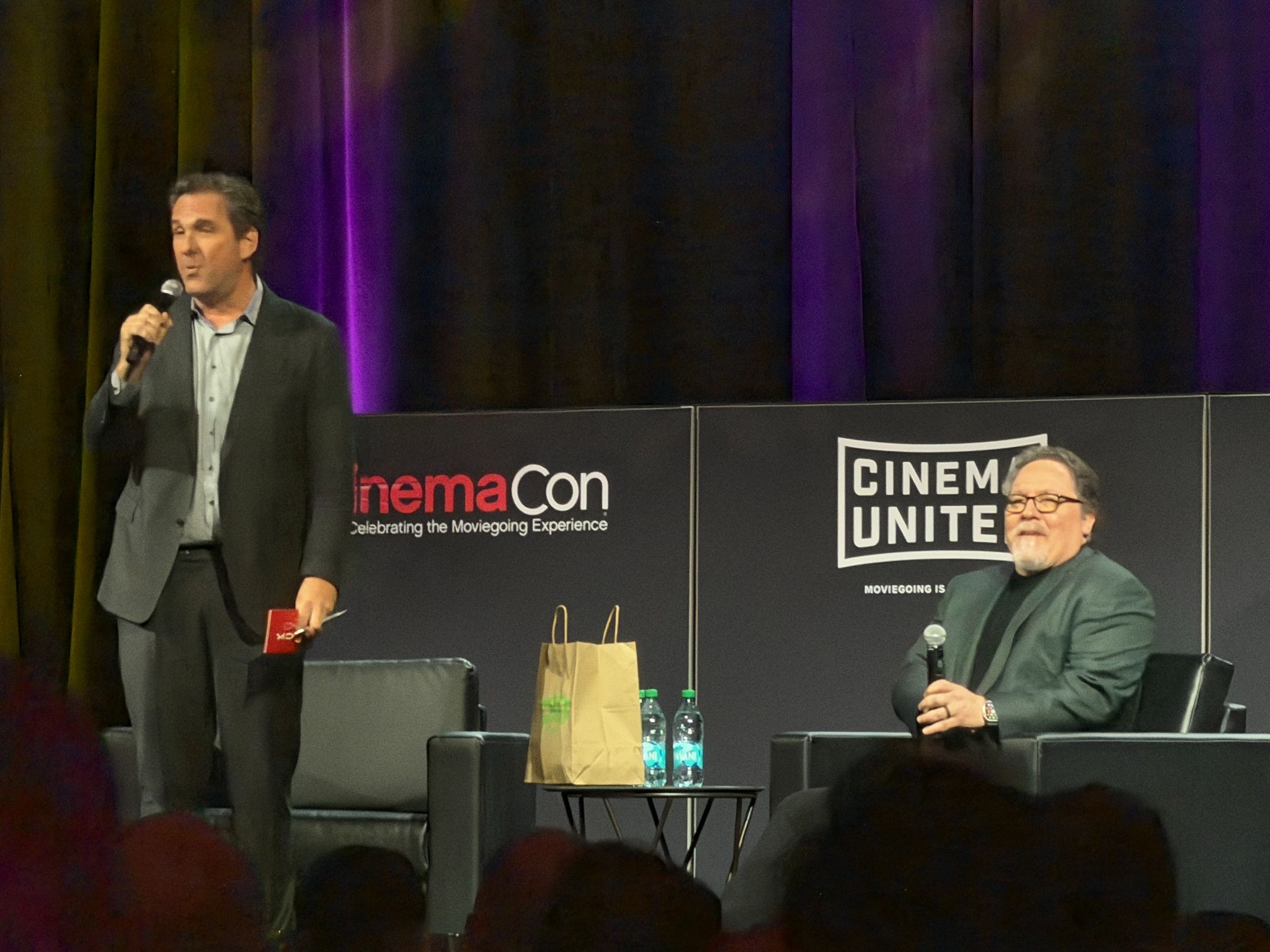
The conversation opened with a direct challenge to the perception that Favreau has abandoned practical filmmaking in favor of digital shortcuts. He pushed back firmly. While the LED volume technology he pioneered for the streaming series was born of necessity — compressed schedules, limited time for location work — the transition to a theatrical feature meant starting from a completely different set of assumptions. "We took the time to build vertical sets, to build practical sets," he said, describing constructed jungles, tanks, pits, and forests, with the volume retained primarily for interactive lighting and reflections. Stop-motion, motion control miniatures, and state-of-the-art CG simulations all coexist in the film, he explained: "It's a mixed bag. It's like a magic trick."
The deeper challenge, though, was one of audience access. With Star Wars absent from theaters for nearly seven years, Favreau said his guiding principle was to treat the film as a first-contact experience. "We have to treat it like the first season and the first episode of The Mandalorian — don't assume anybody's seen anything," he said, "but also make it clear to the people who've been with Star Wars for 50 years that this is something that is for them." He traced the franchise's enduring appeal back to George Lucas' own influences — samurai films, westerns, the pulpy cliffhangers of the 1940s — and described thinking about Star Wars "not just as a genre in and of itself, but as a lens for other genres." His goal, ultimately, is emotional: "There's a feeling that Star Wars gives you on the big screen when it's done well. And that's what we concentrate on."
He also addressed the franchise's future candidly. Belloni pressed him on whether Star Wars has inherent limitations as a mythology — a contained story that has been stretched. Favreau acknowledged the tension, pointing to fan backlash between Episodes 8 and 9 as a cautionary tale, while expressing confidence in the current stewardship. "I'm very fortunate that the people at Lucasfilm are first and foremost fans of Star Wars," he said. "If we're excited to see something, if we're excited for a storyline, if we're having fun telling that story, more often than not, people are feeling that." He was equally clear that his immediate focus is singular: getting this film to the screen. "There's not a Mandalorian trilogy in the works," he said. "Right now, this is about doing this and getting this to the screen."
One of the more unexpected reveals of the conversation was the discussion of Favreau's Disney+ series, Oswald the Lucky Rabbit, starring the character Walt Disney created before Mickey Mouse. Favreau described the project as mixing 2D animation with real-world environments, with animators working remotely across Los Angeles, Canada, and Spain, and framed it as an opportunity to explore a character with genuine historical weight who remains largely unknown to modern audiences. "It's a character that is established, but people don't know that well," he said, positioning it as a different kind of challenge than working within the well-mapped expectations of Star Wars or Marvel — a chance to build new real estate rather than tend existing territory.
When the conversation turned to artificial intelligence, Favreau was candid about the limits of his certainty. "Any time you answer a question about AI, it's going to have a terrible shelf life," he acknowledged upfront. His broader point was that the industry tends to lump very different technologies together under one loaded term, when in fact there's a wide spectrum of tools that deserve to be evaluated on their own terms. "Do you treat generative AI the same way you treat rig removal for wire shots, or segmentation when you want to separate a subject from background?" he asked. "There's a whole hierarchy of different technologies that we have to have a conversation about, and then have transparency as to what tools we're using so the audience understands what they're buying."
On generative AI specifically, he was direct: "For what I'm doing now, I have not used that." He added that each craft approaches the question differently, with directors focused on creative rights, actors on image protection, and studios on copyright and training data. "We're not yet having one consistent conversation across all the stakeholders," he said. The question of actor likeness scanning came up, and Favreau acknowledged it matter-of-factly as part of the current landscape — noting that at this point, Marvel has scanned him enough times that the question is somewhat academic.
On the technology he does embrace, Favreau pointed to Unreal Engine as central to his current filmmaking process — using game engine pipelines for previs, planning, and interactive lighting in ways that allow him to keep productions in Los Angeles with relatively lean crews. He described the convergence of film, visual effects, gaming, and animation toolsets as one of the most significant shifts in contemporary production: "Those stacks are starting to resemble one another. They share innovation." He also described using Apple Vision Pro on set to preview IMAX compositions in real time: "I'm making an IMAX movie, and I'm looking at a TV screen. No matter how big your TV screen is, it's not an IMAX screen." By building custom software on top of the consumer device, his team can evaluate shots in the correct aspect ratio before committing to them.
He also touched briefly on his long-running collaboration with Epic Games, which predates the Disney partnership with Fortnite. Through marketing activations on The Mandalorian and Ahsoka, Favreau has been embedded in Epic's creative process — attending meetings, presenting characters and costumes for battle passes, and generally wading into gaming culture as a creative partner. He framed it as consistent with a larger Disney philosophy that dates back to Walt: "That's a company that is very good at aligning those things, and it dates back to Walt Disney understanding that linear entertainment was the center of the flywheel that drove everything else."
Favreau saved his most optimistic energy for the question of movie theaters. "I'm feeling good this year," he said plainly. His diagnosis: premium large-format venues are outperforming because they offer something genuinely irreplaceable. "You're seeing most of the box office coming from theaters that are delivering experiences that you can't get anywhere else." His prescription was less about technology and more about hospitality, invoking a concept from the restaurant industry he called soigné — the feeling of being looked after at every stage of the experience. "If you feel looked after, that's going to be an experience you want to share with others, and you want to take time out of a busy schedule to do."
He also noted something that might surprise those who assume younger audiences have permanently migrated to their phones: "The Gen Z people that I'm in contact with, they like to go to the movie theater. They don't necessarily want to watch everything on their phone." The confusion, he suggested, is in the broader cultural discourse rather than in the data coming from engaged young audiences themselves.
He pointed to live music as a useful model. Album sales and streaming fees are diminished, he observed, but live performances are bigger than ever. "We need to figure out how to make it live. That's it. We have to be a live event where people come together." For Favreau — who traced his own journey from a kid watching Star Wars in a Queens movie palace in 1977, to usher, to extra, to character actor, to director — that's not an abstraction. "There's something valuable in here," he said of the shared moviegoing experience, "that is not replaced by anything that technology is."