
Disney Music Group Celebrates the Composers Behind Six FYC Series


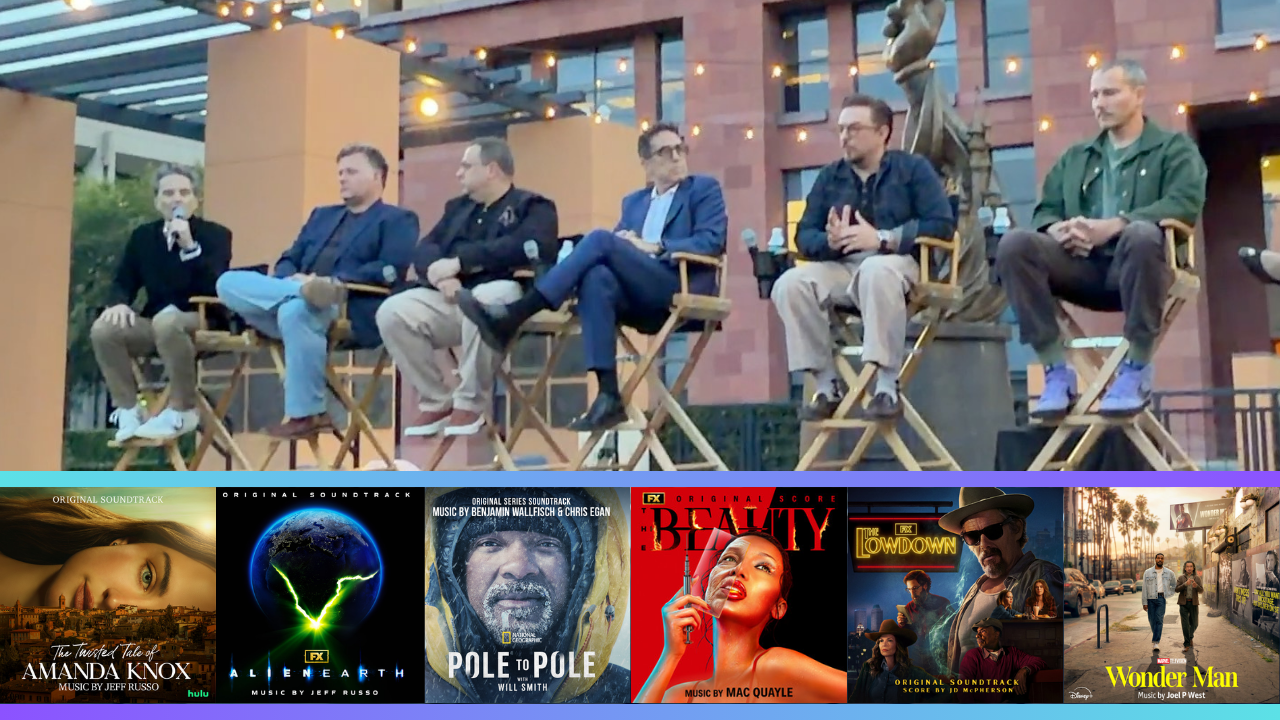
Disney Music Group recently hosted a gathering on the Disney lot to celebrate the composers behind some of the season's most acclaimed television scores. Moderated by composer and Recording Academy LA Chapter Board Governor Raashi Kulkarni, the panel brought together Joel P. West (Wonder Man), JD McPherson (The Low Down), Jeff Russo (Alien: Earth and The Twisted Tale of Amanda Knox), Mac Quayle (The Beauty), and the collaborating duo of Benjamin Wallfisch and Chris Egan (Pole to Pole with Will Smith). Each composer took questions from Kulkarni about their creative processes, their sonic approaches, and what it means to solve a storytelling problem in a way only music can. What emerged was a wide-ranging conversation about restraint, authenticity, and the strange intimacy of putting feelings into sound.
Wonder Man — Joel P. West
Wonder Man arrives as one of Marvel's most unexpected entries: a showbiz comedy steeped in Hollywood nostalgia, built around a character whose superpowers are more anxiety than spectacle. West, who previously scored Shang-Chi and the Legend of the Ten Rings, found that the show's irreverence actually demanded a more classically grounded approach than the franchise context might suggest.
Joel P. West came to Wonder Man with a clear conviction: don't try to match the Marvel sonic universe. The show had been pitched to the studio as something deliberately left-field, and the studio was on board, so West's mandate was simply to follow where the show wanted to go and trust that it would feel organically like Marvel. That meant grounding everything in character rather than franchise, and leaning into the show's deep love of classic Hollywood. The result is a score built around two distinct character themes and a love theme connecting them, a straightforwardly classic structure that gave West the scaffolding to get as weird as he wanted everywhere else.
The challenge, he explained, was figuring out which lane to stay in. With so much musical history to reference and so many nostalgic sounds available, the temptation was to follow a thematic arc tied to specific eras. What West landed on instead was almost the opposite: make the needle drops so eclectic and unrelated that anything could coexist in the show, and let the emotional arc come from stripping back to something simple and sincere. Every episode sounds different, and that's by design.
On the production side, West and his team leaned hard into vintage texture. A saxophone trio joined the orchestra to create a big, Rat Pack–inflected band sound. Old ribbon mics went on the rhythm section. A single ribbon mic was thrown in the back of the room for the orchestra. The show's extended timeline (it stalled during the writers' strike) actually gave them room to experiment in ways they might not have otherwise.
The element West is most proud of is also the one that most captures what Wonder Man is actually about beneath its comedic surface. Simon Williams's superpowers aren't framed heroically in the score; they're framed as anxiety. The powers come out when he's upset, angry, or overwhelmed, and West's job wasn't to score what they look like from the outside but what they feel like from the inside. Finding that motif took time and collaboration, but it became one of the score's defining elements: a superhero theme that's really about somebody struggling with something they can't control.
The Low Down — JD McPherson
JD McPherson is best known as a recording artist and songwriter, but his work on FX’s The Low Down, Sterlin Harjo’s noir-tinged crime series set in Tulsa, marks a confident arrival in the world of television scoring. McPherson spoke with Kulkarni about analog instincts, Tulsa's strange musical DNA, and the art of staying out of the way.
JD McPherson's path to scoring The Low Down is a decade-long story of a casual offer finally being called in. McPherson and showrunner Sterlin Harjo attended film school together and reconnected years later over a podcast conversation, during which McPherson offhandedly mentioned he'd be happy to contribute music someday. Twelve years later, Harjo took him up on it. McPherson described that leap of faith as a testament to Harjo's instincts: he knew McPherson loved the same films and the same music, and that turned out to be enough of a foundation.
The transition from recording artist to TV composer wasn't as jarring as it might sound. McPherson's argument is that narrative structure is narrative structure, whether you're writing a song or scoring a scene, you feel where things need to build, where they need to breathe, and when the bridge has to hit. What he had to do was trust those instincts in a new context and feel his way through.
The sonic world he built is deeply analog and deeply Tulsan. McPherson is a native of Tulsa, and he described the city as genuinely strange: art deco skyscrapers next to honky tonks, tribal license plates, and an extraordinary music scene. Sterlin Harjo wanted to make a love letter to that place, and McPherson leaned into it. JJ Cale and Leon Russell were natural touchstones, but the show's noir framework opened a much wider well. A friend who hosts a monthly noir night in Tulsa sent him an expansive playlist, and McPherson found that his assumptions about the genre were only part of the picture. There were string-heavy scores, unusual textures, and unexpected influences. He ended up pulling more from samurai films than westerns as a way of twisting the noir sensibility into something that felt authentically Tulsa rather than generically hard-boiled.
Rather than assigning characters full themes, McPherson built instrument palettes for each one, specific sounds that could slide quietly into a scene before a character fully arrived, functioning as a kind of pre-announcement. With so much sharp dialogue in the show, his job was less to lead than to hold things together underneath, the way a great rhythm section player serves a band without drawing attention to themselves.
The moment McPherson highlighted as his proudest came in episode three, when Lee (Ethan Hawke's truth-seeking journalist) ends up kidnapped at Keystone Lake by a group of men poaching paddlefish and selling the roe as beluga caviar, surrounded by ARs and inexplicable amusement park equipment, covered in fish blood, with John Doe of the punk band X playing one of the poachers. McPherson's read on the scene was simple: this isn't Tulsa anymore. So he abandoned his analog comfort zone entirely and went full synthesizer for the first time in his career. With help from music editor Emily Kwong, he found vintage synth sounds that still felt period-appropriate, then layered fuzz guitar on top. The result was something that broke from the show's established palette without feeling disconnected from it, and, as McPherson told it, represented a genuinely thrilling day in the studio.
Alien: Earth — Jeff Russo
Jeff Russo brought the Alien franchise to Earth for the first time in the FX series Alien: Earth, working alongside director Noah Hawley, with whom he has collaborated for nearly two decades. Speaking with Kulkarni, Russo described the challenge of honoring one of cinema's most iconic sonic legacies while carving out a genuinely new voice, particularly given that the show's very premise represented uncharted territory for the franchise.
Jeff Russo came to Alien: Earth with a specific structural challenge built into the premise: the franchise's two most iconic installments pulled in opposite directions: the first film essentially defined modern horror film, the second defined modern action, and his job was to find a new language that could hold both. The added wrinkle was that none of the Alien stories had ever been set on Earth, which meant the show's entire sonic context had to shift while still feeling connected to what audiences already knew.
Russo's way into that connection was a horn motif with a distinctive delay, drawn directly from Jerry Goldsmith's score for the original film. Beyond that single gesture of homage, the work became about merging the legacy of Goldsmith and James Horner with something genuinely contemporary rather than trying to recreate either.
The more defining principle of the score, though, is restraint. Russo and director Noah Hawley operate by a shared rule: never play music until you've earned it emotionally. The score should never be ahead of the story, never sitting on top of it. Silence is treated as a tool in its own right, a way of building toward a payoff rather than filling space. Russo also drew a distinction that shaped many of his choices: he scores what characters are feeling, not what they're doing, because the audience can already see the action. The emotional interior is what music can actually reach.
That philosophy produced one of the score's most striking decisions. Episode five is the only one set in space, a backstory episode explaining how the aliens come to Earth, and Russo initially approached it the way he'd approached everything else. It didn't work. The shots of open space kept resisting the music. What they arrived at was simply silence: no score at all. The vacuum of space, it turned out, didn't need a statement.
The emotional core Russo kept returning to was the literal loss of humanity in a story where children are removed from their own bodies and placed into synthetic ones. That theme also shaped the show's moral ambiguity. The corporations and the humans often read as the true villains; the aliens themselves are harder to condemn. Scoring that ambiguity, rather than resolving it, became the throughline.
The cue Russo is most proud of captures all of that complexity in miniature. There's a relationship between siblings; Wendy, a synthetic being Joe long believed dead, and the moment they're finally emotionally reunited needed music that could carry real feeling without sliding into romance. Russo acknowledged that emotional writing naturally pulls toward the romantic, and resisting that pull while still landing the scene with genuine weight was one of the hardest compositional problems he solved on the show.
The Twisted Tale of Amanda Knox — Jeff Russo
Russo also scored Hulu’s The Twisted Tale of Amanda Knox, a dramatization of a true story whose subject arrived pre-loaded with decades of media coverage and public opinion. The challenge wasn't just emotional, it was architectural: how do you score a true-crime story without pushing the audience toward a verdict?
Jeff Russo's starting point for The Twisted Tale of Amanda Knox was the same as most viewers': he thought he already knew the story. Reading the scripts changed that. What he found was a narrative that looked entirely different from the inside than it had from the headlines, and that reorientation became the foundation of his entire approach, telling the story from Amanda's perspective rather than from the position of a world that had already made up its mind about her.
The early episodes leaned into that perspective deliberately and warmly. Amanda arrives in Italy with genuine excitement, and Russo wanted the music to reflect that; playful, Italian in texture and feeling, capturing what it actually felt like to be a young person experiencing a new country. That brightness makes the turn darker when it comes, but Russo's priority was honoring her experience first rather than foreshadowing the crime drama that would consume it.
The central compositional challenge throughout was avoiding anything that pushed the audience toward a conclusion. Russo had extensive conversations with the producers about how to handle the relationship between Amanda and prosecutor Mignini, two people whose stories intersect in deeply complicated ways. The answer was consistent ambiguity. Playing either character too darkly would amount to editorializing. The score's job was to stay underneath the story and let viewers arrive at their own judgments, which meant Russo had to keep his own point of view almost entirely out of it.
That discipline extended to how he thought about the score structurally. Rather than building a grand overarching arc, he approached it character by character, trying to get under the skin of each person and score from their interior rather than from above. It's a more demanding way to work, requiring genuine empathy for figures the audience may distrust, but it's also what keeps the series from becoming a verdict in musical form.
The hardest single moment was the acquittal in episode seven. On the surface, it's a vindication, the full-circle release of years of wrongful imprisonment, but Russo couldn't play it as a clean emotional resolution, because the doubt surrounding the case never fully dissolved. He had to hold both things at once: the profound relief of finally being heard, and the shadow of uncertainty that never entirely lifted. Landing that scene without collapsing either feeling into the other was, by his own account, the most emotionally difficult thing he solved in the entire series.
The Beauty — Mac Quayle
Mac Quayle has been working with Ryan Murphy for twelve years, and The Beauty arrived as one of Murphy's most genre-spanning projects to date; sci-fi, body horror, thriller, action, and dark comedy all folded into one series. The anchor Murphy kept returning to was fear. Whatever else the show was doing, he wanted it to be genuinely scary at its core, and that instinct gave Quayle his entry point.
Murphy asked Quayle to write a main theme representing the central sci-fi concept the series is built around, a concept the show withholds from the audience early on. Murphy's description of what he wanted was characteristically specific: he called it "fifty sci-fi strings," a phrase he's apparently used before to describe a particular feeling rooted in the science fiction films of his childhood. What Quayle built to meet that brief was a combination of processed violin, theremin, and synthesizer, a creepy melody that slides between notes rather than landing cleanly on them. Once that sound existed, the rest of the score organized itself around it.
Underneath that central motif, Quayle constructed a dense sonic bed. A violin drone (six or eight tracks of violin all sustaining a single note but processed differently from one another, then sampled, filtered, and pitched) provided an unsettling undertone for the melody to float above. Deep, processed drums added weight below that. Together, especially in the early episodes when the show is deliberately withholding information, the effect is a score that makes the audience feel that something is deeply wrong before they can articulate what it is.
Despite that heavily electronic palette, Quayle pushed back on the idea that electronics can't carry genuine human feeling. The love theme between two of the show's characters is entirely synthetic, yet he described it as one of the most emotionally direct things in the score, built to reflect the specific brokenness of their relationship rather than romantic feeling in any conventional sense. There's also a single cue where he took the electronics in an entirely different direction, writing something that functions like classical music but sounds unambiguously like synthesizers, not a simulation of an orchestra but electronics playing in a classical idiom, inspired by a childhood love of Wendy Carlos's Switched-On Bach.
The scoring problem Quayle is proudest of solving involves The Beauty's transformation scenes. Early in the series, these sequences are violent and unwanted, something happening to characters against their will, and the music treats them accordingly. But later, at least one character chooses the transformation, believing it will be good for them. The same physical event needed to carry a completely different emotional meaning, which meant finding a way to keep the inherent violence of the transformation in the score while also conveying something closer to hope. Getting that tonal shift right, without losing either quality, was the hardest needle Quayle had to thread.
Pole to Pole with Will Smith — Benjamin Wallfisch and Chris Egan
Benjamin Wallfisch and Chris Egan have collaborated for nearly a decade. Egan conducts Wallfisch's individual scores, and the two have developed what Wallfisch described as something close to musical telepathy. That shorthand turned out to be essential on National Geographic’s Pole to Pole with Will Smith, a series that demanded constant negotiation between the personal and the planetary, the local and the sweeping.
The emotional spine of the show is the relationship that develops between Will Smith and Waorani elder Penti Baihua, and Wallfisch and Egan treated that brotherhood as the throughline holding all seven episodes together. But the score also had to carry the larger stakes (endangered species, threatened ecosystems, cultures hanging on against enormous pressure) without losing the intimacy of the human stories at the center of each episode. Getting that balance right, they said, was one of the hardest things about the project.
The practical challenge was just as demanding. In the jungle episode, the location sound was louder than anything they had encountered on a previous project. Birds, animals, engines, the full acoustic chaos of a living environment, and the score had to find a way to coexist with it rather than compete. That meant testing keys and harmonic progressions not for how they sounded in isolation, but for how they sat against specific environmental sounds. Some combinations clashed badly enough that the music had to come down. Others opened up a space where both could live at the same volume.
Wherever possible, the location itself became a musical ingredient. Environmental sounds were routed through oscillators. In one particularly dusty episode, nothing they tried for a shaker felt right, so they hollowed out fruit native to the region, filled it with beads, and used that instead. The goal wasn't ethnographic authenticity in a checkbox sense, but something more intuitive: making sure the DNA of each place was genuinely present in the music, not approximated from the outside.
The guiding discipline for both composers was never getting ahead of the story. Wallfisch described this as staying in the same time zone as the audience, reacting to what happens rather than anticipating it. The example he offered was a hunting sequence in Botswana that was supposed to end with a successful catch. Will Smith inadvertently ruined the hunt, and the tribe didn't eat that night. Scoring toward that outcome beforehand would have turned an unscripted human moment into a narrative beat. They waited, let it happen, and responded to what it actually was.
The overarching creative achievement Egan pointed to was one of the more unusual problems in television scoring: making seven episodes that each sound genuinely distinct from one another while still functioning as a single unified work. Pole to Pole has no circular structure; it travels in one direction, from the South Pole to the North Pole, and stops. Every episode required a fresh sonic identity, and yet the series had to feel like a complete whole rather than an anthology. Finding that balance across seven very different locations, cultures, and ecosystems, without a recurring home base to return to, was, by their own account, the most musically interesting problem the project presented.
Closing Thoughts
Taken together, the six projects represented a remarkably varied cross-section of what television scoring looks like right now, from Marvel comedy to body horror to true crime to documentary, and the composers' approaches were just as varied. What ran through every conversation, though, was a shared instinct toward restraint: the idea that music earns its place by serving the story rather than announcing itself. Disney Music Group's evening on the lot made a strong case that some of the season's most interesting work in that space is happening across its slate.