
Real or LED? ILM's StageCraft Team Puts LightBox Expo Audiences to the Test


Industrial Light & Magic's StageCraft technology has changed how film and television get made, and at LightBox Expo 2026 in Pasadena, two members of the team behind it pulled back the curtain. In "Virtual Production at Industrial Light & Magic," Justin Talley and Sonia Contreras walked the audience through the technique's history, explained how an LED volume works, and shared a stack of on-set stories, including a game of spotting what is real and what is on the screens.
Virtual production has become a buzzword over the last few years, but the presenters explained that its roots go back roughly two decades. On Steven Spielberg's A.I. Artificial Intelligence, ILM did’nt yet have real-time rendering, but the team composited pre-recorded footage behind blue screen on set so the director could get a sense of what the finished shot would look like.
Years later, on Rogue One: A Star Wars Story, director Gareth Edwards used a virtual camera to walk through digitally built environments on an ILM stage in London, finding and blocking shots himself. Some of the shots he discovered in those sessions made it into the finished film. This was one of the core promises of virtual production: giving filmmakers room to explore camera angles and lighting at the stage of production when experimenting is still cheap, rather than when the full company is standing around on set.
The next leap came from bringing effects that were traditionally handled in post, like the jump to hyperspace, onto the soundstage using LED screens. Compared to blue screens, LED screens give ships, glass, and actors natural interactive lighting and reflections that no one has to fake later.
They also describe what they call the "imagination tax." When three actors react to a tennis ball standing in for a monster, each one pictures a different creature, and the tough character can end up looking more frightened than the scared one. When everyone sees the same image on the walls, even a placeholder, the cast shares a sense of scale and a single collective imagination. The same goes for the director and the rest of the crew.
On Solo: A Star Wars Story, that shared view led to a shot nobody had planned. The director noticed the lightspeed effect from the LED screens reflecting in the eye of Han Solo (Alden Ehrenreich), and a new close-up was born, one that never would’ve been found on a traditional green screen shoot.
The camera on a volume stage is a normal film camera. What changes is that it’s tracked with motion capture, and a game engine renders what the presenters call a magic window: the portion of the LED wall the camera can see, drawn from that camera's exact perspective in real time. As the camera moves, the perspective shifts with it, which tricks the brain into reading the screens as a real world.
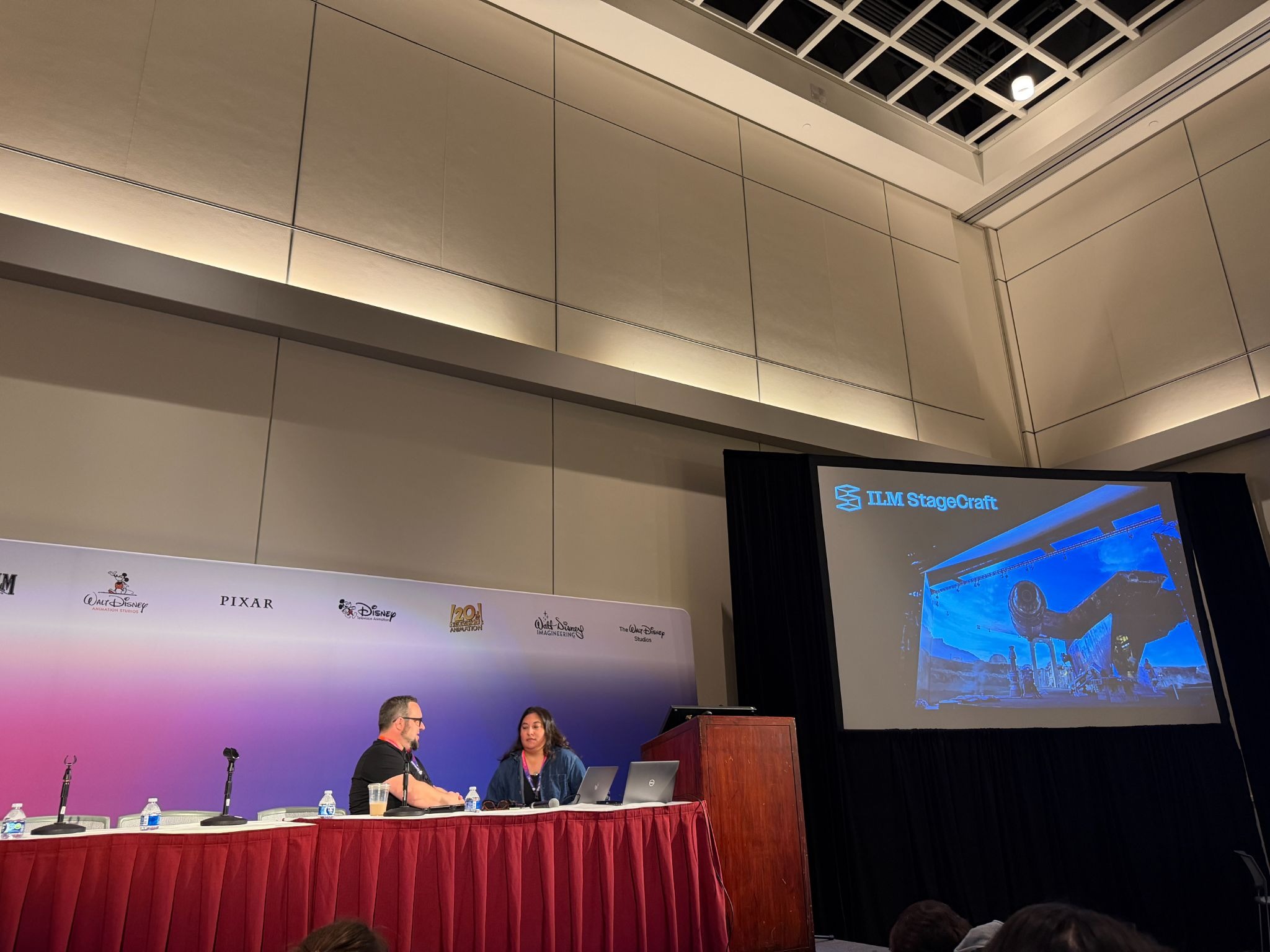
Because many of these environments are digital, the team can adjust almost anything on the fly, from brightness and color to the placement of trees and rocks, and can hold a sunset for hours. The operators work with an interface modeled on familiar compositing and color-correction tools, so artists coming from traditional visual effects can adapt quickly.
Contreras broke down a sequence from Obi-Wan Kenobi set on Daiyu, which was shot in the volume over several days. Side-by-side footage showed the view through the camera alongside a witness camera showing the stage itself, where the magic window was visible, while artists sat with the filmmakers adjusting details like the ground color so the physical set blended seamlessly into the screens.
The production stretched that single environment across many pages of script. Adding a wall to the middle of the set split the space into what reads as a separate location, and rotating the digital environment, swapping out cars, and turning off the neon signs transformed the same street into a back alley.
The presenters shared two stories about how convincing the illusion can be. On one forest shoot, a director asked the team to move a tree a little to the left, only for everyone to realize it was a real tree on the stage, and someone from another department would have to physically move it. On a show shot during pandemic lockdowns, a production assistant carried a long stick to enforce distancing, walked roughly 70 feet across the stage to tell two people to spread apart, only to find they were digital extras in the LED environment.
Another Obi-Wan Kenobi sequence showed how closely the team works with the art and production departments. To make the space feel larger, a camera was mounted on an RC car that wove around the volume, chasing young Leia through the set.
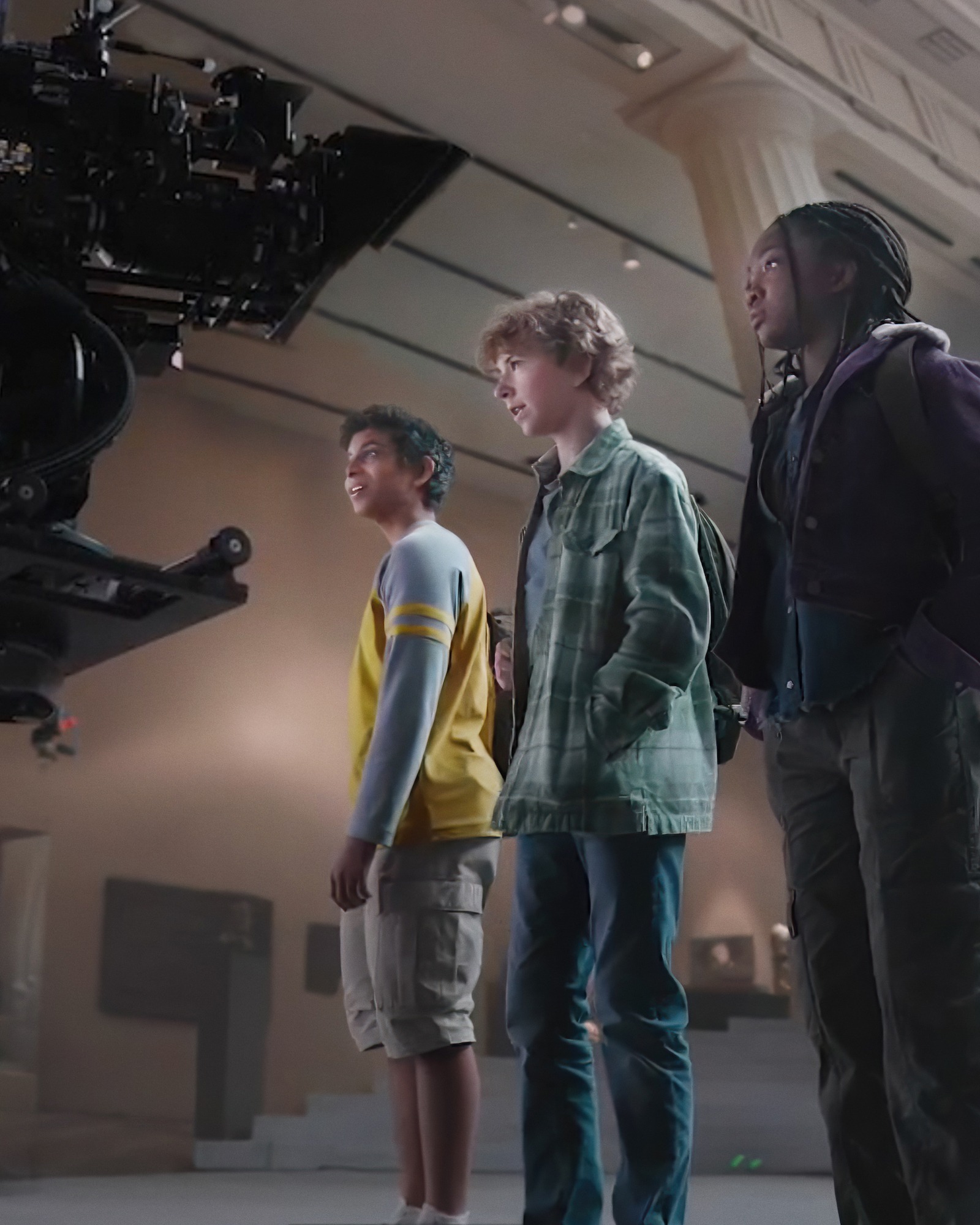
The presenters turned the session into a game, asking the audience to spot what is practical and what is on the walls. One example came from Percy Jackson and the Olympians. The production could not shoot at the Metropolitan Museum of Art for as long as it needed, so it recreated the Met on a volume set in Vancouver. To the audience’s surprise, the marble columns and statues were practical set pieces that blended seamlessly into the LED environment.
Another example from The Mandalorian was the Karthon Chop Fields, a junkyard environment the script described as something like Alcatraz in space. The team evaluated the script early to decide what belongs in the volume and what is better shot on location; for Star Wars, that often means the volume, since these worlds don't exist. Here, props were modeled digitally, then 3D printed and dressed by the art department to build a tabletop miniature, which was scanned and brought onto the LED walls. Matching physical props on set helped sell the illusion. The sparks in the final shot are practical, while creatures originally animated in stop motion were digitized and placed on cards that could be triggered on action.
Some of the biggest benefits are small details that are hard to add later. In Andor, a clear tea kettle catches an upside-down reflection of the world rendered on the LED walls, the kind of refraction the presenters said would be tricky to recreate in post but helps the audience's brain accept what it is seeing.
On The Mandalorian, the team created the illusion of a heavy, practical N1 Starfighter moving through Hangar 3-5 by keeping the camera and the enormously heavy ship set still and moving the environment instead, locking the two together so the motion reads as real. The visual trick is similar to the one Imagineers used on Indiana Jones Adventure at Disneyland when the ball approaches and it seems your vehicle is backing up (it isn’t).
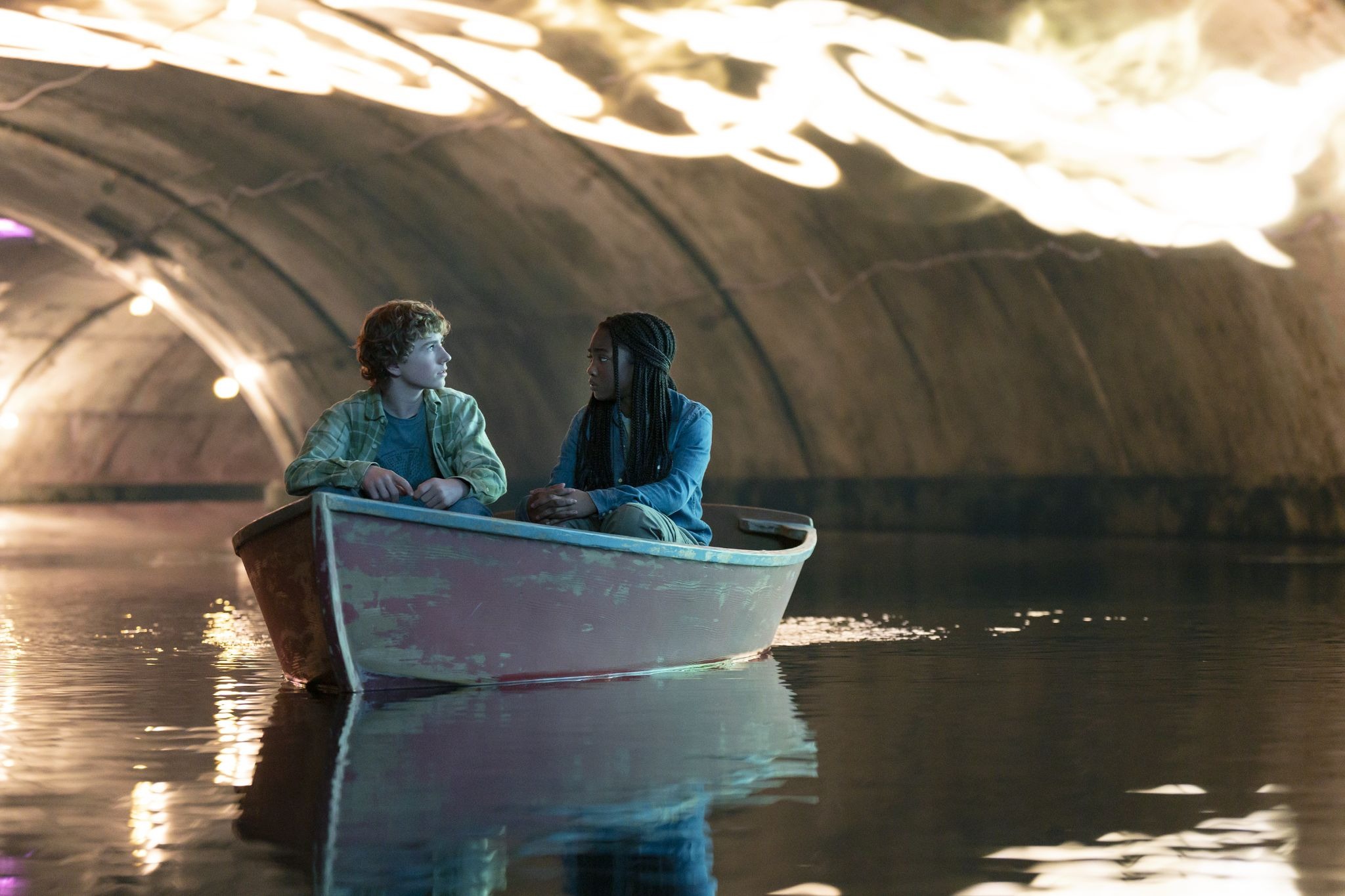
For Percy Jackson and the Olympians Season 1, the team was asked whether to bring the "Thrill Ride O' Love" boat attraction into the volume. The answer was to build a huge pool inside the stage. The water reflections came for free, and the director of photography played with the lighting from a control station, turning a knob to shift the light on the characters in real time.
The panel closed with a long continuous shot from The Book of Boba Fett, which required coordination across nearly every department. In the scene, Boba Fett walks through a building lobby and gets into a glass elevator. The LED walls trick you into believing they’re going up. When he steps out and the camera pans around, he is on a large practical set that had been just off camera the whole time, moved into place where the lobby had been. He then gets back in the elevator and arrives on a different floor, requiring both a physical and digital set change without a camera cut. The shot took half a day of rehearsal to get right.
During a Q&A, the panelists were asked when the volume is not the right tool. It all comes down to practicality. A set that appears for a single page may not justify the build, while one that recurs throughout a season may. Hard light is the biggest technical limit. The sun is a single, enormous light source very far away, producing crisp shadows that LED walls cannot replicate. When a scene needs direct sunlight, the team typically cheats it through windows or skylights and bounces large sources off mirrors to push them farther away, often with help from the grip department. Very dark environments are also tough, since the lights needed to illuminate the actors wash out the black levels on the screens.
On breaking into virtual production, the presenters say the team comes from a wide range of backgrounds, including traditional visual effects, film, miniatures, sculpting, camera and lighting, and even dance performers who moved into motion capture. Knowing the software matters, but much of the job is learned on the job.
Other questions touched on the technology itself. Everything on the walls renders in real time, so the team reduces polygon counts and puts elements like pre-rendered simulations onto cards. When a highly detailed ship needs to fly close by, a pre-rendered flight path can work, as long as the camera stays within a small range of movement. And while performers in motion capture suits have worked on the volume, the presenters noted that the stage can be a hostile environment for infrared-based capture systems, which can be overwhelmed by the lights.
As part of The Walt Disney Company, many of the ILM projects demonstrated at LightBox Expo just so happen to be streaming on Disney+, if you want to see their work in action. The volume effect is so well done that you don’t often pause to think about it while enjoying these movies and shows, but their work deserves to be celebrated. The panel was a great way to peel back the curtain on the technical wizardry that has always been at the core of what ILM does.