
Dr. Samuel Ramsey on "Secrets of the Bees"' Never-Before-Filmed Bee Behavior


National Geographic's Secrets of the Bees takes its place in the popular Secrets of documentary franchise — joining entries on elephants, whales, penguins, and octopuses — with a subject that producer and entomologist Dr. Samuel Ramsey describes as both familiar and wildly misunderstood. With more than 20,000 species of bees on the planet and a host of recent scientific discoveries reframing how we think about insect intelligence, the series promises to be as revelatory as it is visually stunning. I spoke with Dr. Ramsey ahead of the premiere about his dual role as scientist and producer, what the cameras captured for the very first time, and which bee superpower he'd most like to see James Cameron bring to Pandora.
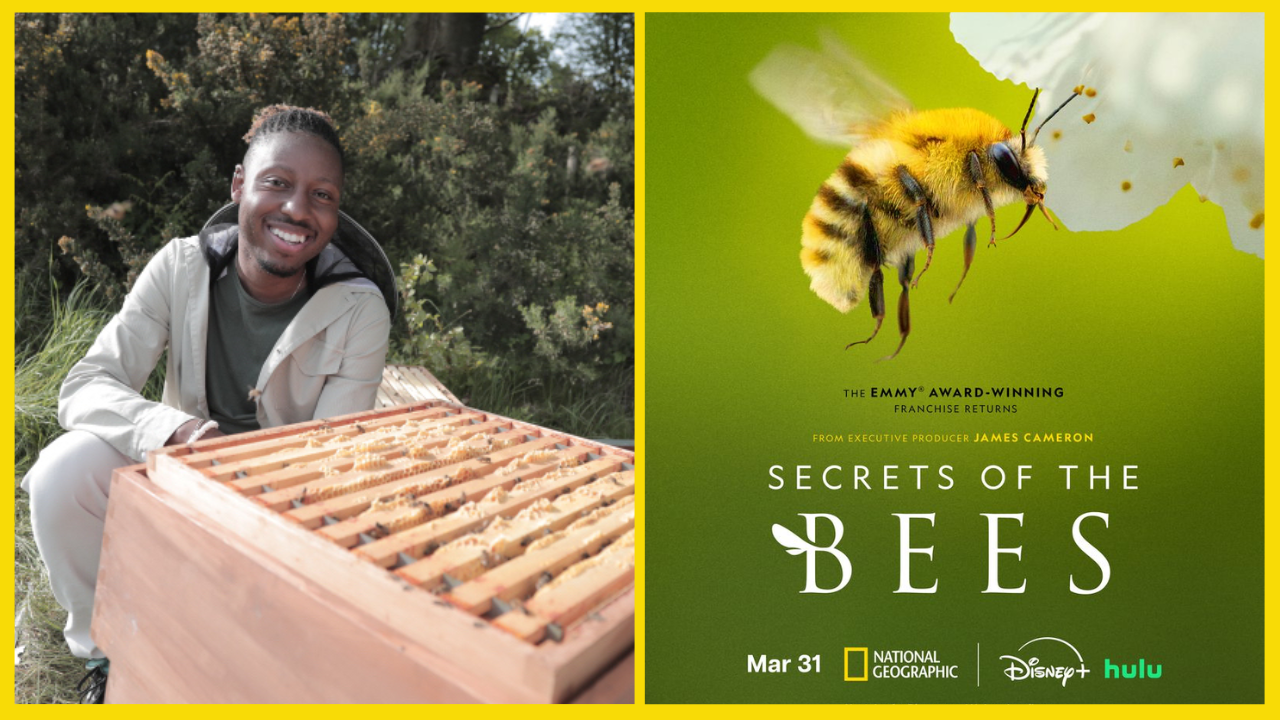
Alex: You're both a producer and an entomologist on this project — what drew you to it, and how did those two roles interact?
Dr. Ramsey: The ambition of the project was the first thing that excited me. Filming at least nine different species of bee, really getting up close and personal with each of them in a meaningful way — that's a huge undertaking. But it also gave me a chance to unite two of my passions: doing the research and showing people the things that make their jaws drop. When you see the cinematography and the epic scores they pair with it, I think you're really going to be affected by it.
Alex: James Cameron's fingerprints are all over this franchise. Were you already a fan of the Secrets of series going in?
Dr. Ramsey: Not just the Secrets of docs — James Cameron has had his fingerprints on a lot of my generation's life. Seeing the Avatar series, seeing someone construct an entire world that way — it was mindblowing. But what I didn't realize until working on this is how well that same approach translates to a world that actually exists. That same awe-inspiring quality Cameron brings to floating mountains? You can do something really similar by showing people whales, elephants, and now bees up close.
Alex: With 20,000 species to choose from, how did the team land on the nine featured in the series?
Dr. Ramsey: It was genuinely tough for me as a bee researcher. I kept saying, "Oh, we've got to show this one — bees collect resin from the dragon's blood tree and rub it all over their colony, it looks amazing!" And they'd say, "Here's our runtime." We really had to drill down and focus on which bees and which behaviors would help people understand bees from a completely different vantage point. That's what this franchise does best — it takes organisms everyone thinks they already know and proves them wrong. You'll definitely see my fingerprints in the Asia section, since that's my bread and butter. I've spent a lot of time running around Southeast Asia, and I really wanted us to highlight some of the incredible things Asian honeybees do.
Alex: Speaking of Asia — the series features the murder hornets, which felt very of-the-moment when they arrived in the news cycle during the pandemic. Do you think that cultural awareness was part of why bees became the next Secrets of subject?
Dr. Ramsey: Absolutely. Everybody knew about the murder hornets during the pandemic; everybody was worried about them, but they had no idea how bees actually fight back against these things. When I was brought on, it was partly because I'd spent time working to eradicate these hornets, both here in the US and when I was conducting research in Thailand, where they attacked many of my colonies. I had up-close knowledge of how to work safely around them, which turned out to be genuinely useful. And the bravery of the bees you get to see in those segments is quite remarkable — I don't know how bold I would be to just jump onto a gigantic hornet and attack it.
Alex: Was there anything captured on camera that surprised even you?
Dr. Ramsey: Yes — and it's literally the first time this behavior has ever been filmed. When a scout hornet arrives at a bee colony, its job is to scrape away some food, grab a bee, and chop it into what we lovingly call in the scientific community a "bee meatball." It carries the meatball back to its sisters like Costco free samples — "Hey, try this, there's an incredible source of protein just around the corner." Before they leave, they mark the colony with a pheromone that essentially condemns it. The rest of the squadron shows up, and the colony cannot survive.
We knew the bees had some awareness that this scent marker was there. What we had no idea they would do — and what we caught on film — is that they found leaves with a particularly pungent odor, chewed them up to release the volatile compounds, and then wiped them all over the pheromone marking. When the hornets came back, they couldn't find the colony. That was a genuine scientific discovery that came out of the filming itself.
Alex: The show also touches on the idea that bees have emotionally complex brains — and may even dream. What does that mean for how we think about insect consciousness?
Dr. Ramsey: I think human beings have a strong tendency to assume intelligence scales with brain size. Small brain, can't do complicated things. And then you discover that bees can solve complex puzzles and teach each other how to do the same to get a food reward. Whether they're truly dreaming, we'll probably never know — we can't truly peer inside a bee's brain. But what we do know is that the way they process the world around them is every bit as complicated as the way we do. And akin to dreaming is play — these insects play. That might sound whimsical, but it's a genuinely important scientific discovery. We have to stop assuming we, as human beings, are so unique that no other creature does what we do, because we're wrong at every turn.
Alex: You devote so much of your mental energy to bees — do you dream about them?
Dr. Ramsey: I do. A lot of my bee dreams are about fieldwork — finding species I've been searching for. My work in Southeast Asia involves sequencing the genomes of every bee species I can find, and there are a few that are incredibly hard to locate. There's one species that's only ever been found on a single mountain in Borneo. That one I've dreamt about for a while. We're going to find it.
Alex: For someone who watches the series and wants to actually help bee populations — what's the single most actionable thing they can do?
Dr. Ramsey: Remember that one of the most important things for their health is food — and a diversity of it. In a lot of the areas we live in, we work hard to keep our grass green and pristine, but grass doesn't provide food or shelter for bees. If people planted a pollinator garden, rewilded even a portion of their lawn, it would do so much for both managed and wild bee populations. And as I always point out, when you wake up on Saturday morning, and you don't have to mow the lawn, that's a pretty amazing feeling.
Alex: You've appeared everywhere from Khan Academy to the Today show. How do you calibrate your message for a National Geographic audience specifically?
Dr. Ramsey: The Nat Geo audience has actually helped me expand how I communicate to everyone else, more than I've had to moderate anything for them. They have a global view of problems by default. When I'm talking to that community, I'm already thinking about impacts on a great big, well-connected world — and that's shaped how I approach every other platform I work with.
Alex: Was there a scientist or explorer who inspired you as a kid — someone you can trace this path back to?
Dr. Ramsey: Jane Goodall comes to mind immediately. The impact she's had on behavioral research is extraordinary, and behavior in bees is something I feel has never received enough consistent attention. We assume we've already figured it all out, that there's nothing left to discover. Jane Goodall was someone who really inspired people to look more deeply at things they thought they already understood — and that's very much what I try to do.
Alex: Last question — bringing it back to James Cameron. Avatar is full of animal superpowers translated into Pandoran creatures. If you could put one bee superpower into a future Avatar film, what would it be?
Dr. Ramsey: The convection oven. Bees can swarm over a predator, decouple their wings from their flight muscles, and vibrate those muscles to generate a massive amount of heat and carbon dioxide — essentially cooking whatever they've surrounded. It's like being a superhero who can project heat in every direction. We show a version of it in the series. On Pandora, a creature with that ability would be incredible — and also really terrifying. But I feel like James could find a very cool place for something like that.
Secrets of the Bees premieres Tuesday, March 31st, at 8/7c on Nat Geo, and begins streaming on Disney+ on April 1st.