
SIGGRAPH 2026 Showcases The Incredibly Accurate Star System Brought to Life by ILM for "Project Hail Mary"


While getting a lot of recognition for its physical effects and practical shots, one of the more intriguing panels at this year’s SIGGRAPH conference in Los Angeles took a look at Industrial Light & Magic’s (ILM) contributions to Project Hail Mary.
_1.jpg)
The movie follows the story of science teacher Ryland Grace (Ryan Gosling), who wakes up on a spaceship light-years away from home with no recollection of who he is or how he got there. As his memory returns, he begins to uncover his mission: solve the riddle of the mysterious substance causing the sun to die out. He must call on his scientific knowledge and unorthodox ideas to save everything on Earth from extinction…but he may not have to do it alone.
With SIGGRAPH focusing on computer graphics and interactive techniques, we’re going to talk about something that is discussed at every SIGGRAPH Conference as of late it seems - The Gaussian Splat.
Imagine that you’re looking at a painting. With more common 3D graphics systems that you might see in an animated film, like those from Pixar, you’re looking at thousands upon thousands of very tiny triangles when looking at an object in the movie. If you were to see, say, the Pixar ball (or any other spherical object) you’re looking at thousands of tiny triangles, each with straight edges that - when used those thousands upon thousands of times - fools your eye into seeing the smooth round ball.
Now, imagine that you’re taking that ball and instead of using the triangles, you know use an airbrush, and to make that ball you are now spraying millions of tiny and soft dots of paint. When collected en masse, the brightest point is at the middle and gradually fades away as we get to the edges. As there are millions overlapping, we see that smooth looking ball, now made out of a tiny fuzzy blob of color.
In fact, that’s what the term Gaussian means (named after the scientist Carl Friedrich Gauss) - related to a bell-shaped curve that describes data where most things cluster near a central average and drop off symmetrically on both sides.
Using these Gaussian Splats is now becoming a bit more common in CG graphics, using the advanced technique for 3D scene reconstruction and real-time rendering instead of those more traditional polygon meshes (the triangles). An even better way to think about - looking out at a cityscape at night from a nearby hillside or even a plane. You don’t see the individual bulbs, instead seeing a cluster of glows that define the skyline or city’s layout. Now, hold that thought for a second while we jump to another topic.
One of the most ambitious astronomy projects ever undertaken, the European Space Agency’s Gaia Mission set out to create the most precise three-dimensional map of our galaxy. Launched back in 2013 aboard a Soyuz rocket, Gaia does not orbit Earth, and instead operates around the Sun-Earth L2 Lagrange point - about 1.5 million kilometers from Earth. Instead of pointing at individual targets, Gaia is constantly spanning with two telescopes. As Gaia spins, the stars drift across its enormous detector arrays, observing stars many times, with observations being collecting from different viewing angles. The data accumulated is not just stars, but also asteroids, quasars, and other galaxies.
Not waiting until the mission is complete to publish the date, instead it has published increasingly comprehensive catalogs over time, becoming foundational resources for modern astronomy. The mission was completed in 2025, but data is still being processed and released.
Ron Radeztsky is a longtime graphics and engine programmer at ILM and Lucasfilm, best known for his work in real-time rendering, game engines, and VR experiences as opposed to more traditional visual effects. As he explained during the presentation, he also started as a physics major with a degree in Astrophysics, saying working on Project Hail Mary was a wonderful chance to get back to that kind of science.
Radeztsky tapped all that Gaia data to create an engine that would take realism in space to a whole new level. After all, Project Hail Mary be technically be a science-fiction film, but it leans more into grounded, real, factual science as opposed to other titles in the genre - including others from Lucasfilm and ILM.
Ron’s mission: to build a star system engine that would render realistic starfields based on actual data, as it would be seen from the Tau Ceti system - 11.9 light years from Earth.
Instead of creating a simple matte painting or backdrop with little white dots, Radeztsky set out to build a scientifically accurate 3D starfield that could be viewed from anywhere during Hail Mary’s journey. Most space movies “cheat.” If going for a semblance of accuracy, they might take a 2D star map into a sphere, or just throw a bunch of rendered white dots as points to look like stars.
With Project Hail Mary more of a hard sci-fi film, all the images used for backgrounds and shots with the starfields should be based on that real star data - all pulled from Gaia’s DR2 data sets, which itself offered nine terabytes of data. Nine. Terabytes. So much data that started to prove problematic as they went through it. The team eventually got even more data from the mission that preceded Gaia, Hipparcos, which measured the positions, distances, and motions of stars from Earth’s atmosphere.
The survey sets were made for hard data and numbers, not necessarily for visuals and pictures. The team would find that with the data constantly coming in, datasets would often be duplicated, so they went in and found the extra copies to eliminate from all the data they were trying to manage.
.jpeg)
Even doing that though, the data set was too large for local storage, making their systems run slow. So, Radeztsky set out to write a custom C++ code designed for speed and size with a custom GPU rendered also for speed and quality. With this system and the all those images based on real star data, the engine he built could also determine accurate star colors, with latitude and longitudinal coordinates that could be camera-tracked and adjusted as needed for flexibility with the camera shots.
Visual matching with reference images from Earth would also help calculate (along with all that data) the correct star positions and magnitudes that would correct as seen in a viewpoint from Tau Ceti. Most importantly, the system would also provide high resolution images with anti-aliased stars - that way you don’t have jagged little lines or flickering pixels as the camera moves.
But what’s the best, most efficient way to save memory and time rendering all these points of light in a 3D galactic map?
A Gaussian Splat.
Instead of rendering billions of pixel points - which would tend to alias during camera motion, the engine renders the Gaussian splats into good airy approximations and assist with that anti-aliasing effort. Collected into Gaussian Blobs, each could also be tuned deal with variant pixel sizes as needed for the camera’s location in the 3D galactic map. Over a billion Gaussian stars were plotted accurately, which also allowed for natural Magellanic Clouds to appear. In the galaxy shots where you can see them in the film, there were no visual tricks like pictures of dust or anything that were added to the images. They were naturally created with a billion blobs of light.
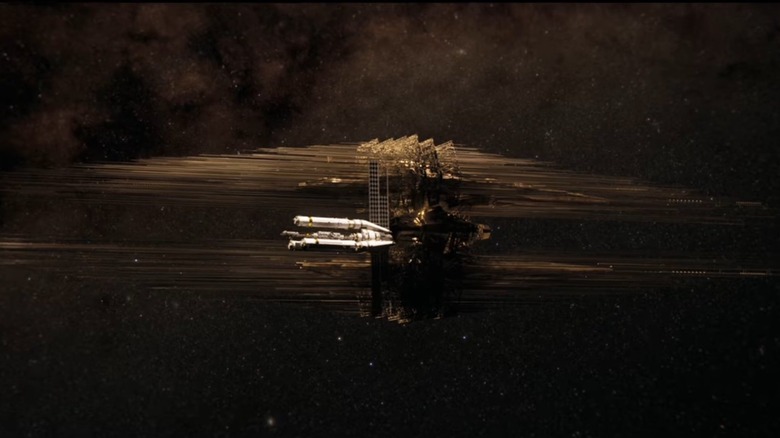
The color comes from the varying degrees of spectral data was that found in the Gaia research, all brought to life accurately through the engine created for the movie.
The team touts that these over 1 billion stars are rendered within 10cm of their actual coordinates, making this the most accurate rendition of the star system ever committed to film. During the panel, it was challenged and I pass this to you - find Orion’s Belt. When Grace is in our own solar system, it’s easy to spot just like here on Earth. When he gets into the Tau Ceti system, it’s still visible, just from the more accurate angle from how that star system would see it.
While the film had several hundred VFX shots from ILM, this might be the most fascinating aspect discussed at SIGGRAPH, and though they mentioned no future use of this engine specifically - I can’t imagine they created it to never use it again.
Project Hail Mary is now available on digital and physical media.