
TV Review: Hulu's "The Nightmare Upstairs" Is True Crime for the TikTok Era


Hulu's latest true crime docuseries, The Nightmare Upstairs: What Happened to Ty and Bryn?, pulls viewers into a shocking family standoff that captivated the internet, and it's one of the more compelling entries the genre has seen in recent memory. In an era when social media has reshaped everything from politics to celebrity, it was perhaps inevitable that it would eventually reshape family court. What no one could have predicted was that two teenagers in Provo, Utah, would be the ones to prove it.
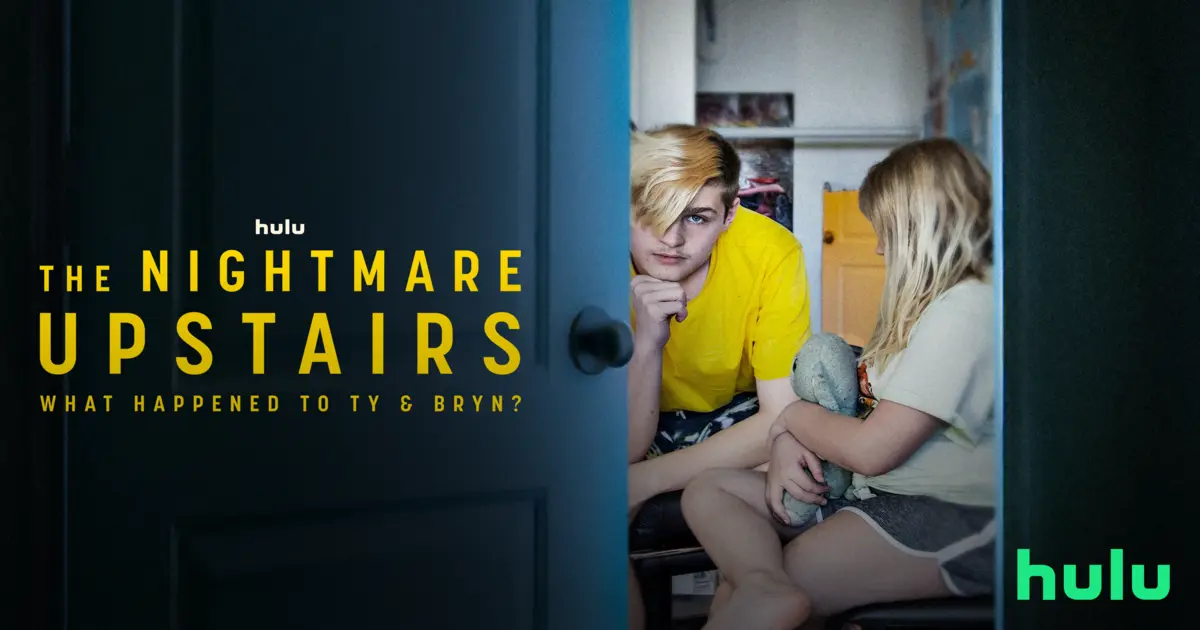
The two-part series chronicles the fractured relationship between siblings Ty and Brynlee Larson and their father, Brent "BJ" Larson, following the divorce of their parents. The first part methodically lays the groundwork: the whirlwind romance and Las Vegas wedding between BJ and Jessica Zahrt, their subsequent divorce, Brynlee's early allegations of sexual abuse, and Ty's later recovery of repressed memories through therapy. Despite a custody battle, the state continues to mandate supervised visitation with their father, a decision that sets the stage for everything that follows.
Part two is where the series retreads the more familiar material. Faced with a court order that could send them to a controversial reunification program, Ty and Bryn barricade themselves upstairs in their home for 54 days, livestreaming their standoff to tens of thousands of TikTok viewers. It's a remarkable moment in the intersection of family law and social media, a system that typically strips power away from children suddenly forced to contend with public opinion in real time. That viral spotlight ultimately pressures the judge to reevaluate the case and allow cameras into the courtroom.
What sets The Nightmare Upstairs apart from the true crime pack is that social media angle. In a genre saturated with cold cases and murder investigations, this one is distinctly contemporary — and, notably, doesn't end in death. That makes it a more digestible watch, even if it's no less emotionally heavy.
The documentary draws on new interviews with Jessica Zahrt, Ty and Bryn themselves, BJ's mother Joleen Larson, detective Aymee Race, BJ's second ex-wife Sandy, social worker Michelle Jones, Jessica's attorney Wesley D. Hutchins, and investigative reporter Hannah Dreyfus. Joleen's participation is among the series' most striking elements, a grandmother navigating the painful loss of contact with her grandchildren while defending a son whose actions the documentary quietly but unmistakably calls into question.
To its credit, the series never positions itself as the arbiter of truth. BJ declines a new interview, appearing only in a written video message at the end appealing to his children. The filmmakers frame the story as a chronicle, not a verdict. But the cumulative weight of testimony, particularly Sandy's account of BJ's controlling behavior that mirrors the cause of his first divorce, makes the closing epilogue feel slightly dissonant. The audience will have drawn its conclusions long before BJ's message plays, and the series' studied neutrality strains a little under that reality.
At its core, The Nightmare Upstairs is a story about a fractured family — not in the conventional post-divorce sense, but in the far more complicated territory of alleged child abuse, competing narratives, and a legal system struggling to protect kids it can't quite hear. It's sad, it's maddening, and it's worth your time.
I give The Nightmare Upstairs: What Happened to Ty and Bryn? 4 out of 5 stars.
The Nightmare Upstairs: What Happened to Ty and Bryn? is now streaming on Hulu and Hulu on Disney+.