
Interview: Nat Geo "Chilean Mine Rescue" Directors on the Footage No One Expected to Find


When Chilean Mine Rescue: Race Against Time directors James Parris and Chloe Campbell first approached the story, they already had the outline of the 2010 Copiapó mining disaster. What they didn't expect was how much the headline had flattened. “These iconic stories, they take on an almost two-dimensional, cartoonish resonance in our contemporary history,” Parris said during our interview. “We think we know what they're about, but as documentary makers, Chloe and I both felt going in that there would be so much more to discover.”
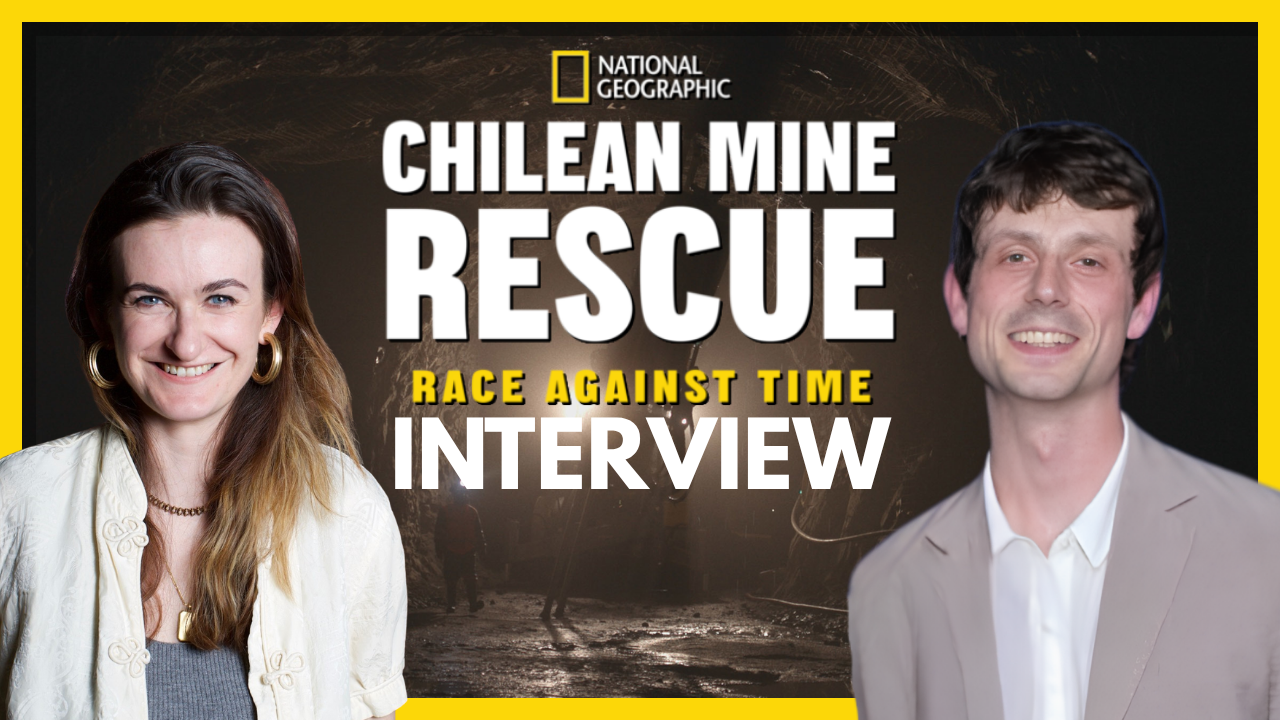
Chloe Campbell couldn't understand why it had taken 15 years for someone to tell this story properly. “It has people coming together. It has people fighting to survive, fighting to save other people's lives,” she said. “It's just an absolute gift of a story to tell.”
The pair spent months tracking down the miners, rescuers, and family members who lived through the 69-day ordeal, and Campbell said the most surprising interview wasn't about the rescue technology. It was a conversation with one of the miners who told her he was glad the collapse happened to him. “In spite of the depths of horror they faced, especially during those 17 days when they really didn't think they would ever be found”, she recalled him telling her, “This turned me into the person I am, and I'm genuinely grateful this happened to me.”
For Parris, the bigger surprise was technical: he hadn't realized the miners had access to cameras underground at all, let alone that footage from their darkest days, filmed when they believed they might never be found, had survived and was recoverable. “It's almost like they were living on the surface of the moon,” he said. “But also on an emotional level, because it gave you access to their inner turmoil, their perspective undergoing something almost unimaginable.”
That footage, shot on a 2010 cell phone, passed through laptops, phones, email, and WhatsApp before it ever reached the edit bay, needed restoration work to hold up on a modern screen. Parris said the team upscaled it, but deliberately stopped short of scrubbing it clean. “There's a character to that footage that was shot by the miners that speaks to the emotional state they were in,” he said. “It speaks to the fact that it wasn't like they were a film crew who knew what was going to happen. They were desperate to get any scraps of low-quality, dark footage, whatever it was, because there was no other option for them.”
Campbell described one image from that footage that stuck with her: the miners lighting a small fire underground to cook a shared pot of soup from their rationed tuna, a moment of ritual and unity in total darkness. “When you see the whispers of light that were coming from the fire ... out of the darkness is where you get those whispers of light and you get the feeling,” she said. The goal, she added, was to make the footage watchable “without erasing so much that you don't have that sense of joy and wonder” once viewers understand what they're looking at.
Beyond the recovered footage, Parris and Campbell drew from an unusually wide range of archival sources; news crews who arrived once the miners were found, and observational documentary teams who had gained access even earlier. Blending those different visual styles, Campbell said, became a stylistic and narrative challenge in its own right, especially in scenes built from just fragments of footage rather than full sit-down interviews.
The bigger challenge, according to Parris, was scale: figuring out how a small cast of interview subjects could represent the thousands of people involved in the rescue, from engineers to government officials to the miners' extended families. “Our challenge as filmmakers was to work out how to tell a story that fairly reflects a broad set of those perspectives in the most compelling way possible,” he said. “We knew going in that the miners were going to play an absolutely vital role in telling the story”, with the families and surface rescuers filling in the rest.
Asked what he hoped audiences take away from the series, Parris pointed to the miners' ability to hold onto their humanity in the 17 days before rescuers even knew they were alive, and to the families who refused to let the world forget them. “This group of 33 people were anonymous laborers who went into an incredibly dangerous environment and could have been forgotten very easily,” he said. “There's a version of history where the world has no idea what happened in Chile in 2010.”
Campbell's takeaway was simpler. “I can't quite believe that the rescuers just kept going in those 17 days,” she said. “It felt like a needle in a haystack, and they just kept going ... you can learn a lot from their determination and resilience.”
Chilean Mine Rescue: Race Against Time premieres tonight at 8/7c on National Geographic, with all episodes streaming tomorrow on Disney+ and Hulu.