
From Plainsville to Hexe: Disney’s “Hexed” Design Team Breaks Down Its Heroes, Villains, and Familiars


LightBox Expo attendees in Pasadena got an extended look at the inhabitants of Walt Disney Animation Studios' 65th animated feature as production designer Lorelay Bové and art director of characters Bill Schwab presented "The Magic of Character Design in Disney's Hexed," a look at the shape language, color theory, and costume work behind the secret world of witches.
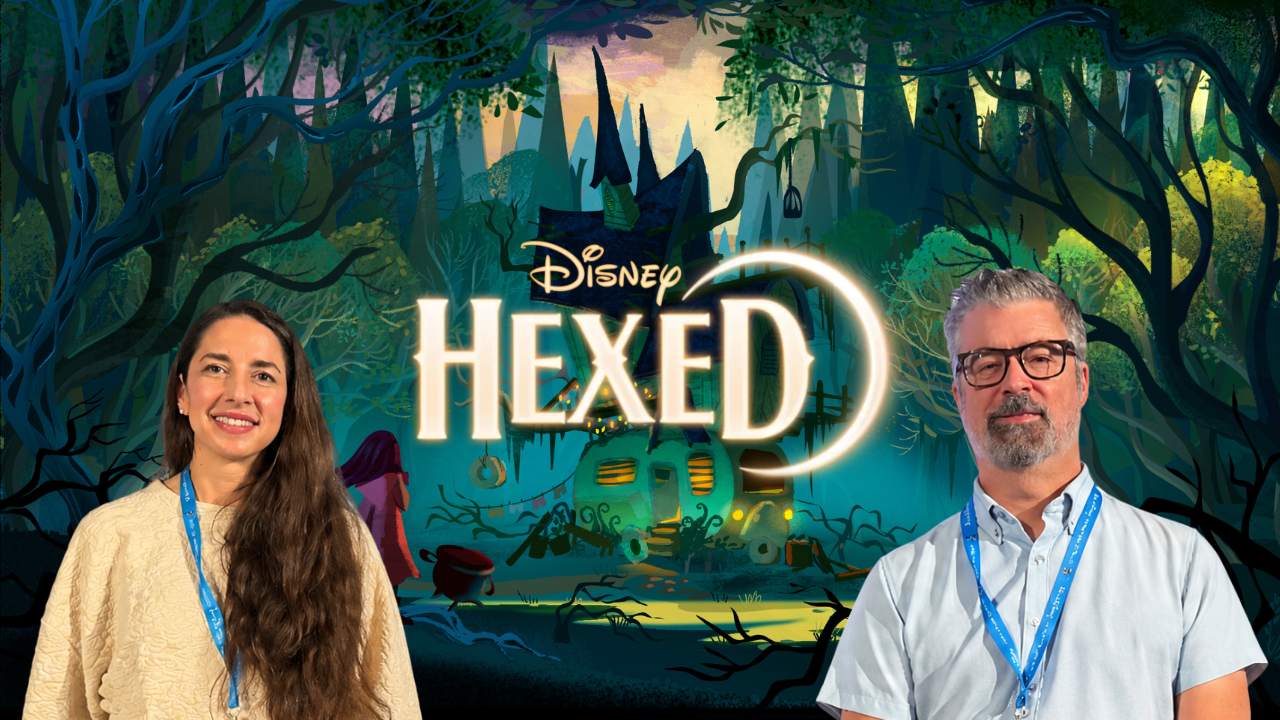
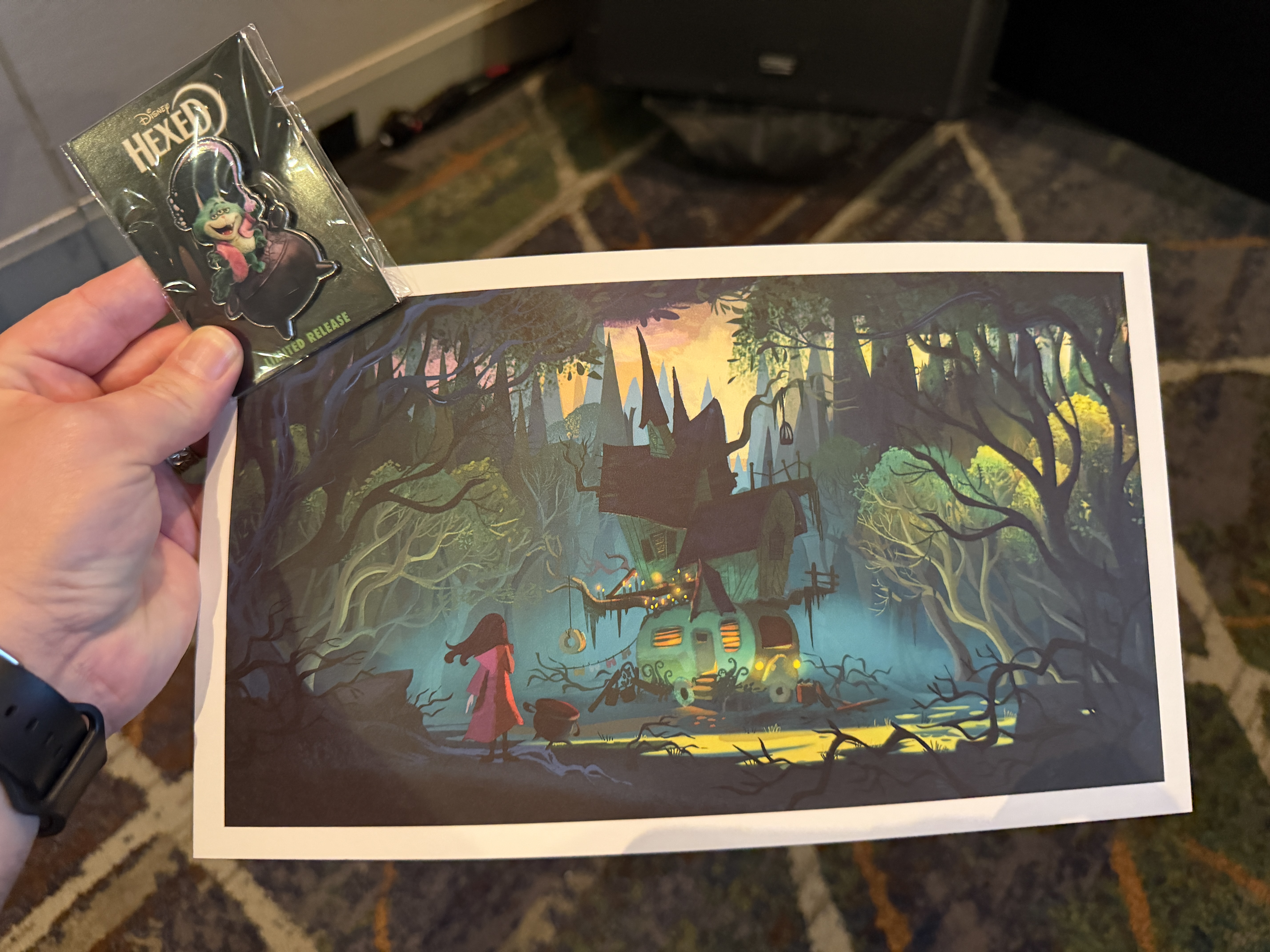
Before characters are designed, Bové explained, the first task is defining a shape language that supports the directors' story. Knowing audiences have seen countless witch worlds before, she landed on the triangle as the foundation for Hexe, an echo of the pointed witch's hat and a symbol of channeling power. She paired that with strong verticals to make the world feel vast and open, and balanced the sharp angles with organic, rhythmic curves drawn from nature, since the natural world is closely tied to witchcraft.
The film opens in Plainsville, which Bové described as the most boring town the team could imagine. Its flat, symmetrical compositions, limited palette, and conventional lighting are deliberate, mirroring how confined its residents feel. Hexe reverses every one of those choices with pointed shapes, a wide palette, theatrical lighting, and abundant texture.
To steep the team in classic Disney whimsy, Bové organized two trips to the studio's Animation Research Library, one for the environment team and one for the character team. Artists studied animation drawings and backgrounds from films including Sleeping Beauty, One Hundred and One Dalmatians, The Sword in the Stone, and The Rescuers. Schwab called it one of his favorite eras of Disney filmmaking and cited the caricatured work of Milt Kahl, Marc Davis, and Ken Anderson as touchstones for the stylized world the directors wanted to build.
The triangle carries from environments into the characters, who are sharper and more angular than those in most recent Disney Animation films, a challenge Schwab said was fun to embrace. Costumes throughout the film are also layered with celestial and witch iconography.
Color, meanwhile, reflects the story's themes. The directors identified two central tensions: limitation versus potential, and suppression versus nurturing. Scenes and costumes tied to limitation and suppression lean on cool, muted tones, including the school jacket that leaves Billie looking boxed in at the start of the film, while moments of potential and nurturing shift to a contrasting palette that the team tracks from beginning to end. Bové said audiences may not notice it, but they'll feel it.
Hailee Steinfeld voices Billie, the film's 16-year-old protagonist, an unconventional and impulsive rebel in clunky combat boots who doesn't always make the best choices. Schwab said it was a thrill to design a Disney heroine who begins the film completely unaware she is a witch and with no sense of her own potential, and who needed distinct looks for both Plainsville and Hexe.
The crescent moon emerges early as a defining motif in Billie's design, and Bové pointed out that even the layers of her hair are shaped like crescents. The directors also asked the team to explore Billie with her pointed hood both up and down, studying how her hair would interact with it, which produced poses that proved valuable to the rigging and animation teams.
Costume designer Letta Keresen is credited as a key artist on Billie's wardrobe, with early explorations leaning into reds and blacks. Billie starts in a constricting school uniform, gradually sheds that layer, and acquires a cloak from the witch world that evolves over her journey, with its thorny hem growing as the story progresses, a bit of costume storytelling Bové called quintessentially Disney.
Rashida Jones voices Alice, Billie's controlling and protective mother. Schwab described her design as a group effort spanning story, art, and animation. Alice is a woman desperately trying to keep everything together and not quite managing it, so early drawings show her with a jacket that doesn't sit quite right and a bag stuffed with far too much. Her look draws on the work of Milt Kahl and other midcentury artists.
Meg Park finalized the design and created a range of poses and expressions. Alice's bangs were inspired by Jones herself, and the overall silhouette was first designed to evoke a broom. Some side pieces of her hair were cut once the team moved into CG, Schwab explained, because they made her difficult to frame in shots, and Bové added that their constant movement proved distracting.
Alice's Plainsville look keeps her constricted in a maroon skirt suit. During a review with simulation artists and animators, Bové recalled that Alice's supervising animator asked how much the fitted skirt would stretch. When Bové answered that it wouldn't stretch much, the animator went out that same day, bought a similar skirt, and filmed herself moving in it to stay true to the material. That limitation became a defining element of Alice's walk cycle, with shorter, more restrained steps that make her feel more believable.
Ali Guthrie created the construction packet for Alice's cloak, complete with embroidery callouts, and the cloak picks up florals and reds as the film goes on. Bové noted that Alice's palette was intentionally kept close to Billie's to visually connect mother and daughter.
Jodie Foster voices Queen Celeste, the calculating, power-hungry ruler of Hexe. Schwab relished the opportunity to design a brand-new Disney villain who is both a witch and a queen, and pointed out how the triangle shapes her hairstyle, facial features, and early costume explorations.
Once the directors settled on a design, Ami Thompson explored Celeste's poses and expressions while Schwab worked with the modeling and animation teams to refine her facial expressions and rig. Designs shift in 3D, Bové explained, especially once characters share the screen. Placing Celeste's model next to Billie's, for example, led the team to adjust the scale of Celeste's head and tweak her eyes so the two feel like they belong in the same world; small changes, she said, make an outsized difference.
Brittany Lee designed Celeste's final costume, which is rich in nature-based florals. Her primary motif is belladonna, also known as deadly nightshade, a poisonous flower that Bové noted says a great deal about the character. Celeste's early designs leaned on the black-and-purple palette audiences might expect from a Disney villain, but the directors pushed the team lighter, landing on a final look of purple and white with touches of black that reflects the story they wanted to tell.
Walton Goggins voices Beef Roger, a three-eyed magical cat and one of Hexe's familiars. Schwab called the character a dream assignment, describing Beef Roger as a reclusive, lazy curmudgeon who lives in a van in the forest, reluctantly joins the adventure, and could really use a new robe. He can also stretch to great lengths and sprout extra limbs, which created exciting challenges once the drawings had to work in 3D.
Animator Tyler Pacana produced a 2D test that tried every trick imaginable with the character. From there, the directors narrowed things down, deciding, for instance, that Beef Roger probably wouldn't pop off his head but might pop out his third eye. That raised a cascade of practical questions, Bové said, such as whether he'd have a socket or fur underneath, and whether his robe would stretch with him.
Early explorations by Neysa Bové included an image of Beef Roger stretching, casting magic, and pouring tea all at once, which Schwab said became an iconic image for the production. As the story developed, the character evolved into more of a dirtbag and oddball, and Goggins came aboard. Schwab responded with matted fur, scraggly whiskers, and a chewed-up ear that hints at a backstory nobody ever fully explains. Draw-overs of CG poses later helped solve problems like his short limbs and enormous mouth, while rigging worked to keep his fur from losing mass in motion.
Queen Celeste's henchmen are the Morphlings, raven witches designed to feel dangerous and unmistakably witchy. The directors wanted them to transform into ravens, so Bové explained that their black-and-purple costumes are built from raven feathers and inspired by a military aesthetic. Keresen designed the final costumes and created detailed construction packets, adding feather detailing and talon-like nails that make the Morphlings feel less human.
Schwab called animating inanimate objects one of the most distinctive challenges of designing Hexe, a Disney tradition stretching from the brooms of "The Sorcerer's Apprentice" in Fantasia to the magic carpet in Aladdin. For Bucket, codesigned with Griselda Sastrawinata-Lemay, he researched medieval cauldrons. The directors envisioned the character as a high-energy, excitable puppy, so its handles flop around like ears. The team also stayed relatively true to the material of a cauldron, limiting squash and stretch in its animation.
Thompson designed Elias Quire, a book whose cover, pages, and other features combine to form a fully expressive face. In a fun aside, Bové shared that one of the film's heads of animation, Michael Franceschi, built a real version of the character and left it in the review room, complete with a mechanism under the pages that played his voice when pressed. Thompson also designed a teacup and tea set in the spirit of Lumière and Mrs. Potts from Beauty and the Beast, with filigree forming their faces.
As Billie, Bucket, and Beef Roger travel Hexe, they meet a potoo bird who joins the journey. Schwab encouraged the audience to look up the real animal, whose huge eyes, tiny beak, and wide, puppet-like mouth make it seem almost unreal. He noted that Disney Animation has rarely featured a bird as a main character in CG, making the character a welcome challenge. Hexe is also filled with familiars, the animal companions that assist witches with magic and spellcasting, and concept art on display included a bear, raccoon, wolf, cat, possum, spider, hawk, toad, and more, many of them in costume.
For crowds, Bové developed an overall look that Guthrie then carried through garment by garment. Concept art showed witches flying on all manner of objects, including a bicycle, a rake, and a long branch carrying a group of kids like a school bus, with crowd designs that evoke the background characters of Sleeping Beauty. The directors wanted townsfolk who felt modern yet timeless, so Bové avoided tying costumes to any specific period that might quickly date the film.
The character assets team told the designers they could build twelve garments, which Bové said turned the assignment into something like designing paper dolls. With a couple of pants, a few dresses, and a handful of hats, the team mixed and matched pieces to create unique silhouettes, then multiplied the variety further through a limited set of palettes and patterns.
As the story took shape, the team elevated certain "hero crowd" characters with custom costumes, hairstyles, and features, including the town's witch cops. Schwab also highlighted Hetta, a soothsayer Thompson designed with boldly pushed proportions, who became a favorite across the character and animation teams. A painting shown by Cami Andre brought it all together, placing the crowd palettes among Hexe's colorful, limited-palette houses.
The pair closed with a plug for Disney Animation's internship and apprenticeship programs. Schwab has served as a mentor in both the summer internship and the apprenticeship, while Bové has experienced the programs from every angle, as an intern, an apprentice, and a mentor.
Disney's Hexed opens in theaters on November 25th.