
"Sofia the First: Royal Magic" Team Takes a Single Sequence From Script to Screen at LightBox Expo


Disney Television Animation brought Sofia the First: Royal Magic to LightBox Expo in Pasadena for "From Script to Screen," a panel that followed one key sequence from the series' pilot through every stage of production. Creator and executive producer Craig Gerber, co-executive producer and story editor Krystal Banzon, and supervising director Kris Wimberly walked the audience from the first draft of the script to the finished, fully lit scene, and closed the session with a bit of news for longtime fans: some fan-favorite characters from the original series will return next year!
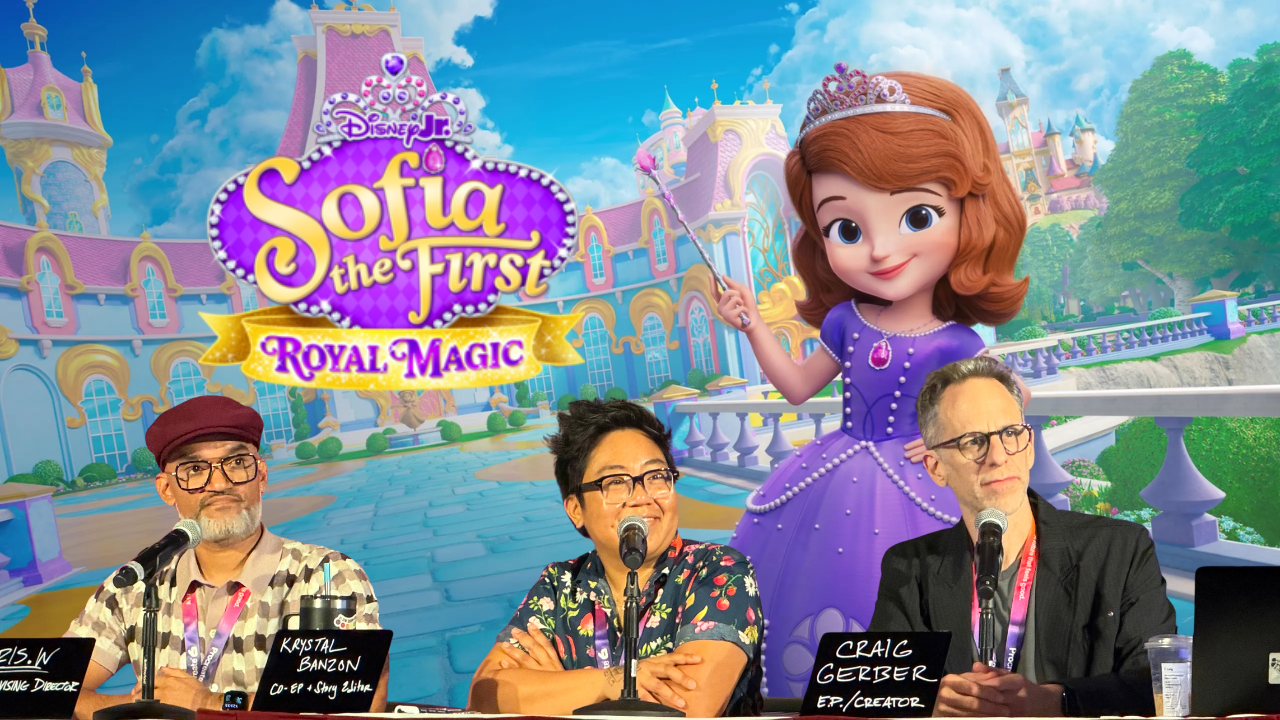
Gerber opened by explaining the premise for anyone unfamiliar with the new show. Sofia leaves Royal Prep for Charmswell, a school for royals who do magic, which means new friends, new adventures, and a whole new setting where most of the series takes place.
For the pilot, "Welcome to Charmswell," the writers wanted a story that introduced the school and its new characters while still carrying the kind of positive message both shows are built around. Their solution was a welcome race. The students are sorted into the school's three castles, and each team races across campus in something like a scavenger hunt, collecting the three pieces of its castle banner. The race also gave the team a reason to show off Charmswell's locations in an exciting way.
The emotional spine of the story belongs to Zane, one of Sofia's new friends alongside Layla and Camila. Zane doesn't feel like he belongs at Charmswell, a feeling stoked by his childhood rival, Prince Devin, the show's antagonist. Sofia sets out to prove to Zane that the team can win and that he's good enough to be there.
Because there was so much world-building to fit in, the pilot runs 22 minutes as a double episode, while most episodes are 11 minutes. The panel focused on the stretch at the end of Act 2 and the start of Act 3, when the team arrives at the school ballroom to find the last banner piece. To reach it, they have to cross a floor full of spinning enchanted thrones while the other teams pull ahead. Zane loses heart, so Sofia helps him through it. The moment turns into a song layered over an action sequence. Gerber noted that the sequence moves through action, comedy, drama, and music in a short span, which made it a good case study.
Banzon explained that Royal Magic is a script-driven series, so everything begins on the page. As head writer, she leads a room of four writers who develop ideas for each episode. Even at the script stage, the writers have to think about production. Each episode has limits on the number of new assets, characters, and locations, and the room has to stay within them. Banzon said the writers are lucky to sit in on storyboard pitches, where they can see whether a joke they love actually works visually. Sometimes a board artist's idea plays better than what the writers had in their heads, and sometimes a character simply can't move the way the script describes.
Gerber added that the script works as a blueprint. In editorial, the team often goes back to it while watching the animatic to check what a moment was meant to accomplish, since the script spells out the intended emotion and humor. The ballroom sequence covers about seven pages, taking the team from its lowest point to a real high.
Every episode features an original song, written after the script is locked but before design and voice recording begin. The writers draft dummy lyrics as placeholders when the script is first written.
This sequence originally had its own inspirational ballad, essentially Sofia telling Zane that she sees him and he can do this. When the team watched it, they agreed the energy needed to stay up, since the kids were still in the middle of a race. Instead of a new song, the moment became a reprise of "Time to Shine," the big number that opens the series.
The change came late, while boarding was already underway, so they wrote the reprise quickly and then boarded. What was planned as a song followed by an action sequence became both at once, with Zane's emotional turn tied to him figuring out how to get past the thrones.
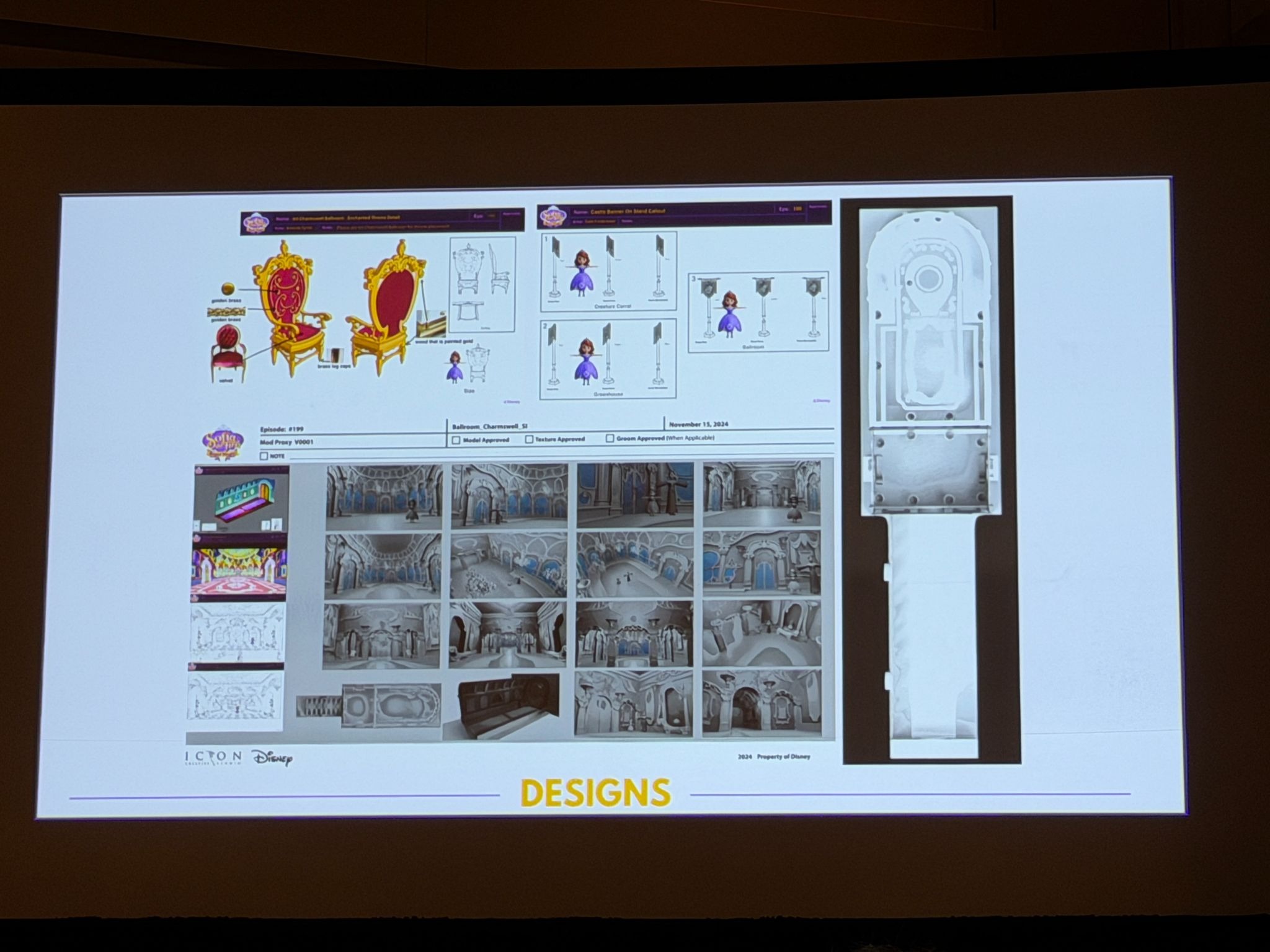
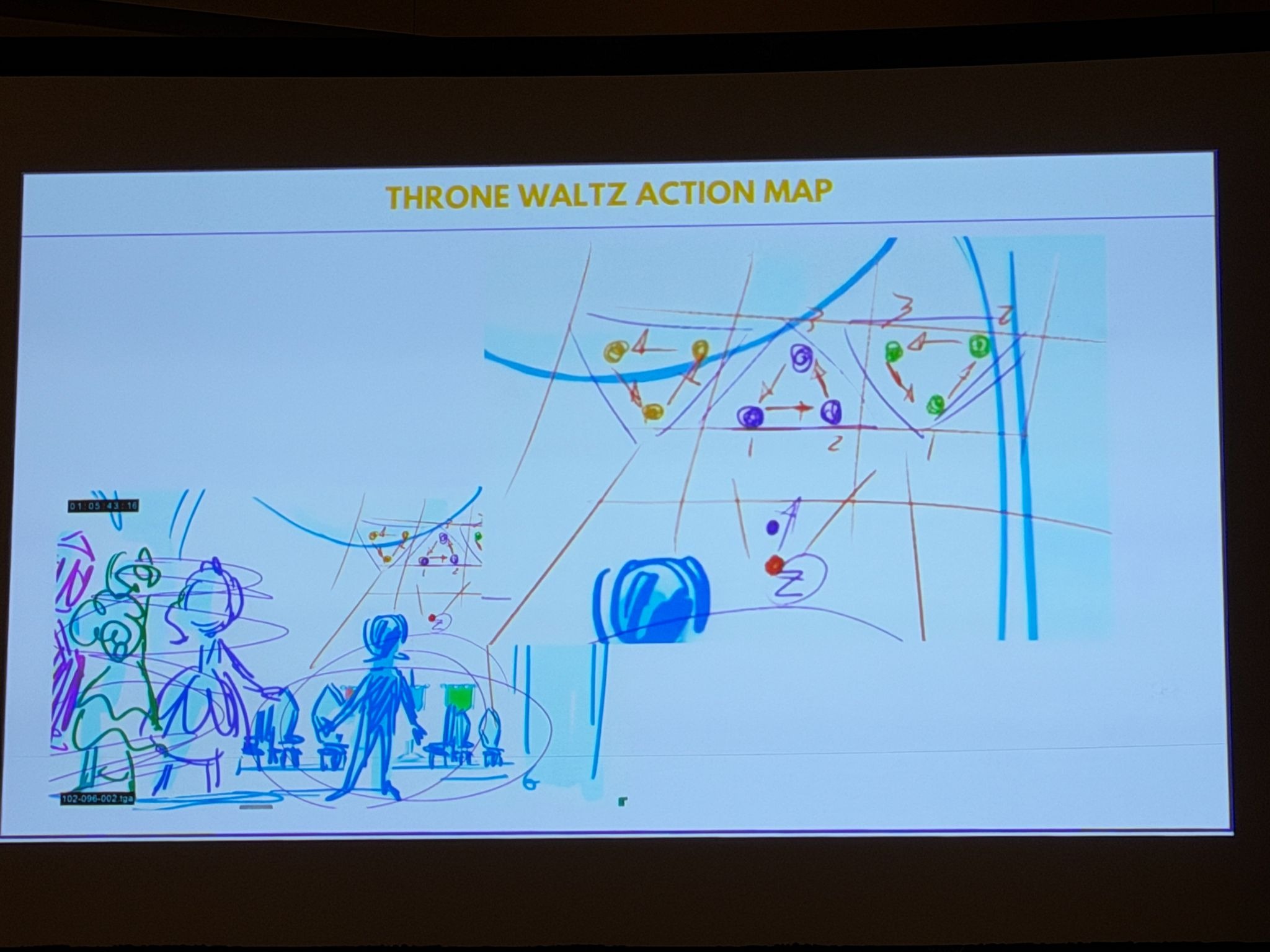
Wimberly described the supervising director's job as turning black words on a white page into what viewers see on screen. That starts with sitting down with art director Francis Giglio to list every asset a sequence needs. For Royal Magic, that included the entire Charmswell campus, which Wimberly said is the biggest environment the show's animation partner, Icon, has ever built. Icon initially said it couldn't be done, then broke it into pieces to make it work. The ballroom was designed with a top-down view so the board team could map out the action, while the modeling team began building at the same time. That overlap meant plenty of back-and-forth and redesigns when something turned out too tight or didn't work from a particular angle.
Wimberly also showed the grayscale model of the ballroom and a 2D drawing of one of the thrones. For anyone who wonders how much of the show is still hand-drawn, he said everything is drawn before it becomes pixels. The designs include Sofia for scale so the team can see how each item compares to the characters.
Gerber called scale one of the most vexing challenges in CG animation. The ballroom had to be big enough for 12 kids to run across while dodging thrones, but the production couldn't afford to keep all 12 on screen for the entire sequence. The characters are also roughly three feet tall, so a room built for adults wouldn't look right. Because a CG space is a real, dimensional environment where you can't cheat, the goal is somewhere between an airplane hangar and a shoebox, and the team often doesn't know for sure until the scene starts moving.
Wimberly sits with the directors to study what the writers intended and visualize how it will play out using assets that don't exist yet. He encouraged aspiring artists to think ahead about camera placement and how characters will actually move through a space, since a CG scene can't be cheated the way a 2D storyboard drawing can.
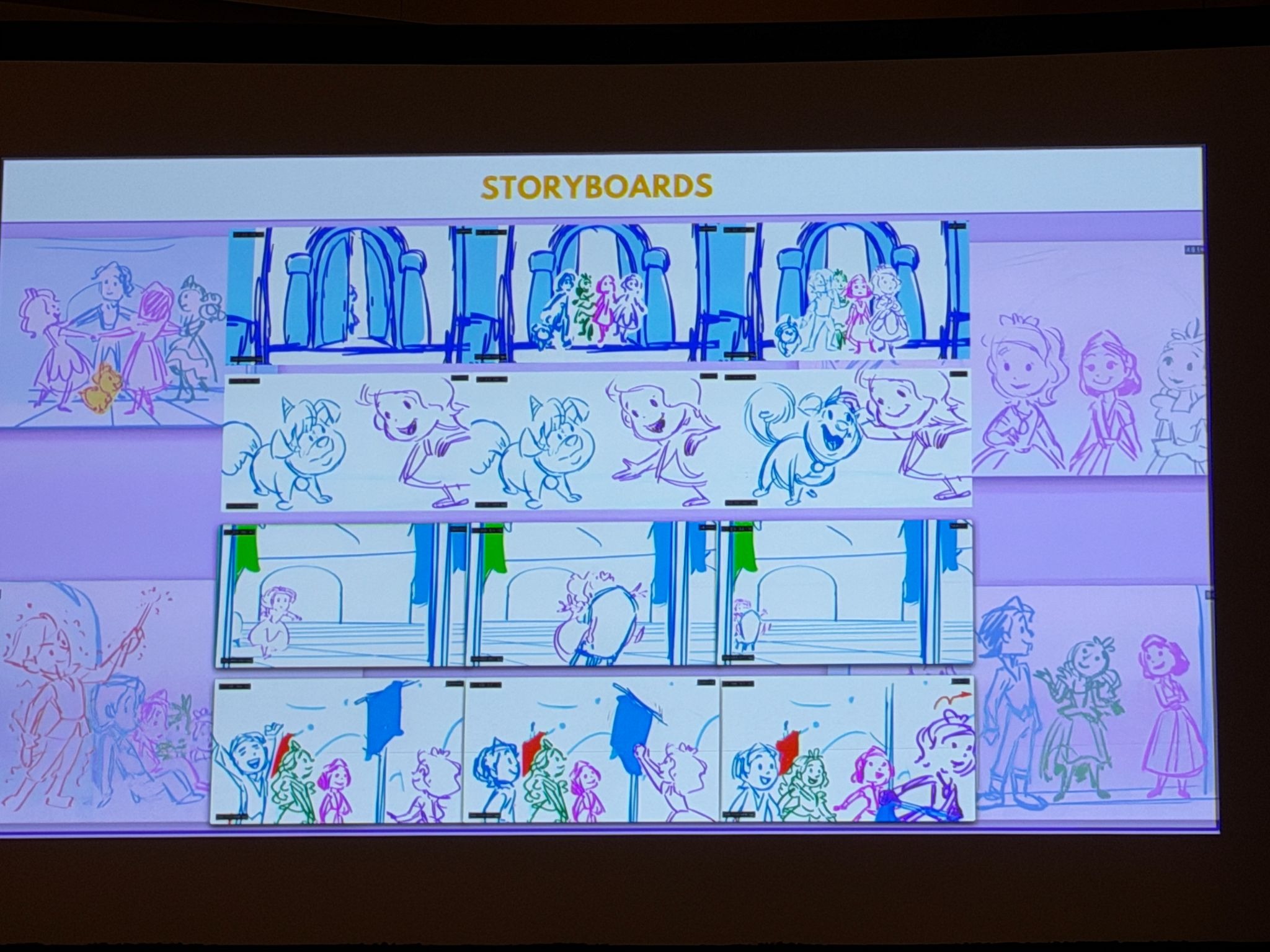
Storyboard highlights from the sequence included one of Wimberly's favorite gags, in which Sofia and a classmate get face-planted by a throne. He also pointed out a storytelling nuance: Sofia kneels down to talk to Pepper the Puppicorn instead of picking him up because the other characters aren't supposed to hear him. Talking to animals is one of the amulet's powers, so the staging has to respect how the show's magic works.
To work out the throne obstacle course, Wimberly drew an action map. The thrones aren't moving at random, and the team gets through by figuring out their pattern. On the map, the 12 thrones were color-coded and moved in teams of three, rotating like clockwork in a triangular pattern with the same rhythm in different directions.
From there, the boards were cut together with temporary sound and music into an animatic, shared with the network for notes, and revised. Wimberly said the animatic is where the team really dials in the emotional turns, the action, and the timing to fit the music.
Camera placement was another key decision. With 12 kids and 12 thrones scrambling at once in what is essentially a game of capture the flag, the team chose to shoot from the east wall toward the west and keep other characters off to the side so the audience stays focused on what matters. Wimberly said they also discovered that kids watching the students get knocked around by the thrones would be having too much fun to track where everyone else was. That fit the story point too: the thrones win, like a team going up against a much bigger football squad.
Once the animatic is locked, the production team packages the script, designs, boards, animatic, and song tracks and sends them to Icon in Canada. Icon returns layout, which covers the staging, blocking, key poses, and camera framing. This is where scale issues tend to surface, since the team can finally see the assets side by side in a real space. In the ballroom, the scale came out slightly different than intended but still worked. Wimberly said Icon's layouts are unusually fleshed out, sometimes just shy of animation, which gives the team a clearer picture early on.
The team then gives notes, and the post-production team transcribes them as drawovers for the animators. Next comes animation with smoothed-out acting, followed by Take 1, the lighting, color, and render pass, where textures and lighting are applied. Wimberly said he and Gerber comb through those takes for problems like a blown-out light or hair texture that disappears for a single frame.
In post, the team checks lighting and visual effects, including whether the right magic was used and whether it's timed correctly. Sound design defines what magic sounds like in this world, and ADR fixes lines that read unclearly or that Gerber decides to rewrite after seeing the scene play. Spotting sessions cover sound effects and score with composer Tony Morales.
Each episode takes about 18 months to move through the pipeline, but episodes start roughly one a week, so they stack on top of one another. At the busiest point in a season, the team said it can touch about 20 episodes at different stages in a single day, while also staying ahead on scripts. The panel then played the ballroom sequence as it rotated through each stage of production, and Wimberly credited the production team, including producer Craig Simpson, with keeping the show on time and on budget.
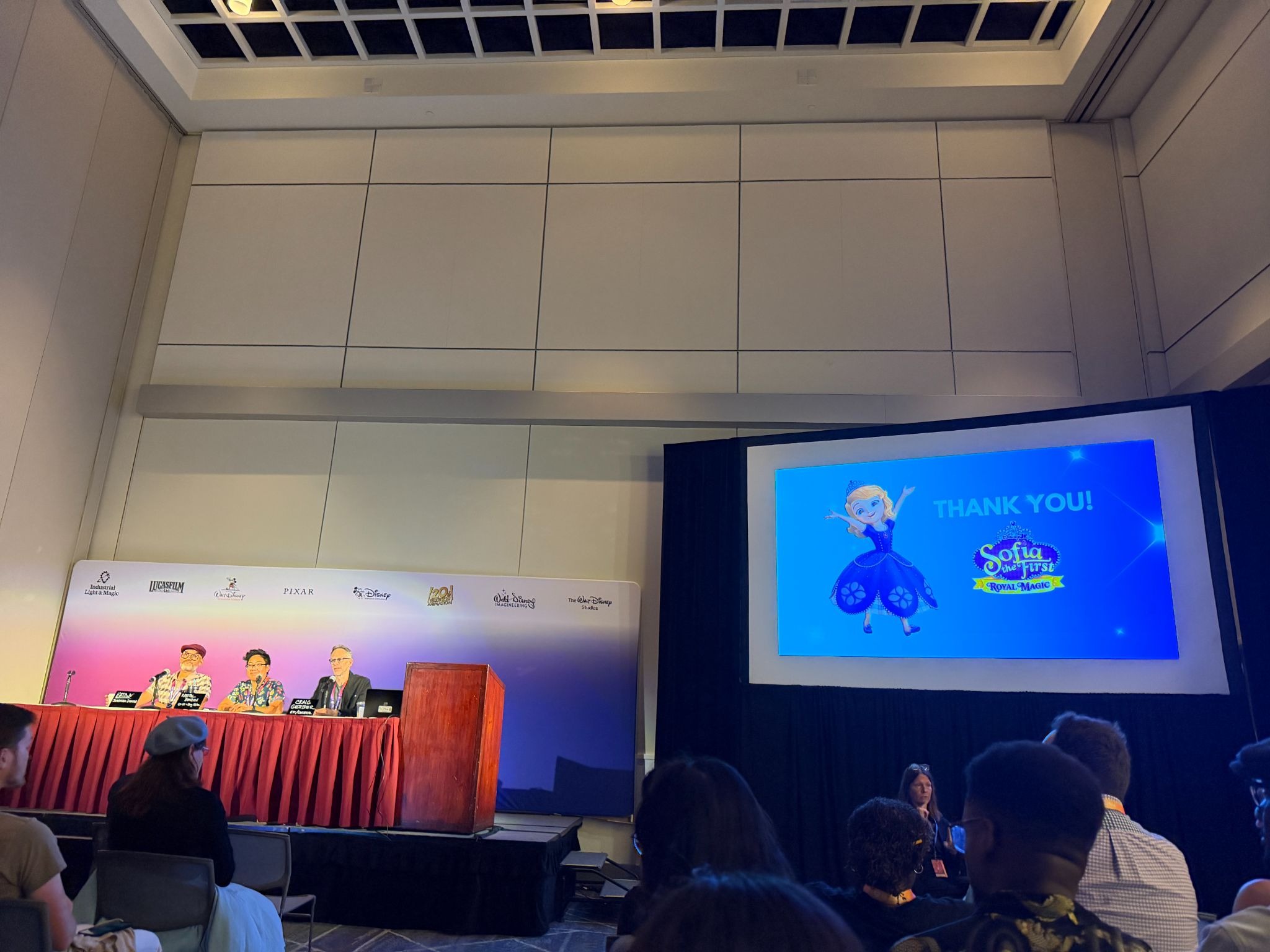
During an audience Q&A portion of the panel, the team was asked how involved the writers are with the songs. Banzon said the room writes sample lyrics that match the story beat and try to hit a realistic verse structure and meter. A songwriter then writes the music and adjusts the words to make it a better song. The guiding philosophy is that every song has to push the story forward, so pulling it out of the episode would break it.
On fitting stories into 11 minutes, the panel said a script of about 16 pages translates to roughly 11 minutes of screen time, broken into around 10 story beats across the acts. Gerber, who previously wrote live action, noted that animation scripts run faster on screen than live-action pages.
One fan asked why Royal Magic looks different from the original series. The biggest factor, the team said, is software, which now allows feature-quality lighting and rendering. They also wanted to make it clear this is a new show, not a continuation viewers need to catch up on. At the same time, the team wanted to keep the richness and saturation of a storybook, the kind of world a 4- or 5-year-old wants to climb into. Gerber added that the original's flatter, more desaturated look was partly a way to work around the limits of CG at the time, and it ended up working artistically.
The final question asked what it was like to return to Sofia's world. The answer was that it felt like meeting familiar characters again after years of writing them, with Ariel Winter's voice as Sofia still in their head. Alongside the new characters, older ones have returned to the series, and the team teased exciting updates rooted in the original, including the return of fan-favorite characters next year.
Sofia the First: Royal Magic airs on Disney Jr. and streams on Disney+.