
80 Percent Real, 20 Percent Magic: Lucasfilm Artists Break Down "The Mandalorian and Grogu" at LightBox Expo


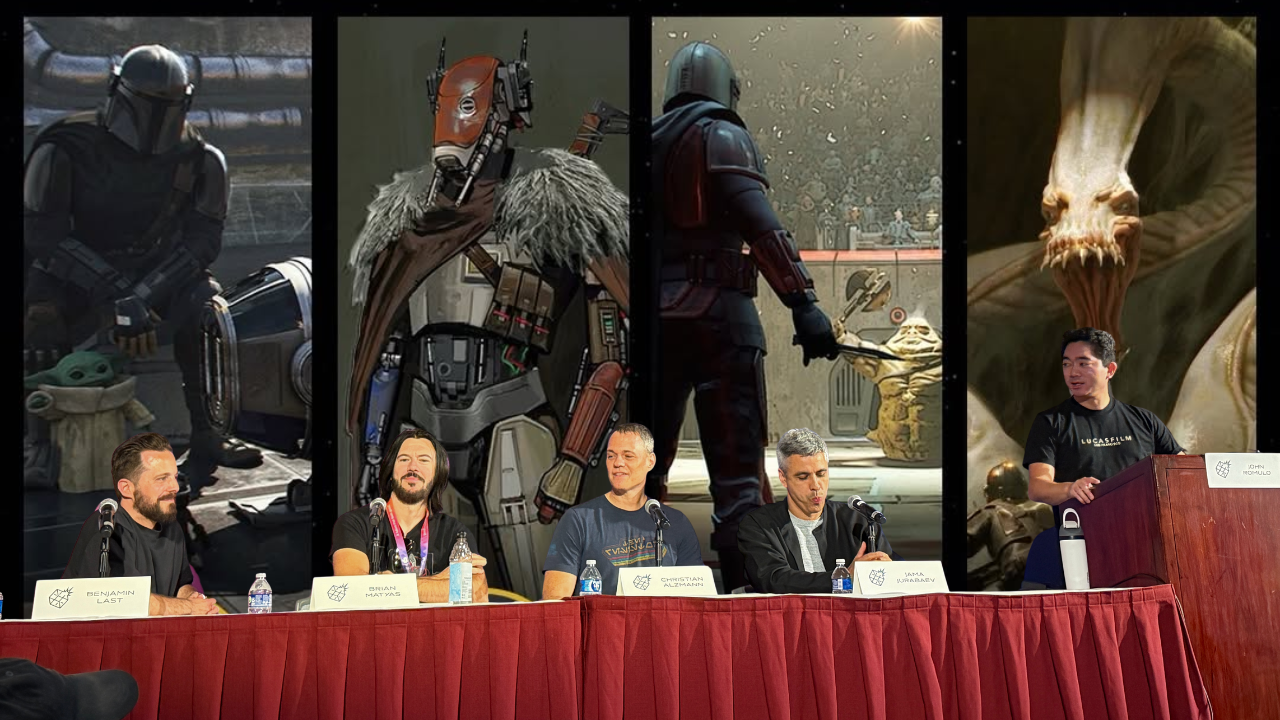
Lucasfilm returned to LightBox Expo in Pasadena with a panel devoted to Star Wars: The Mandalorian and Grogu. Moderated by digital asset coordinator John Romulo, who works alongside the art team every day, the session brought together concept artists Benjamin Last, Jama Jurabaev, Christian Alzmann, and Brian Matyas to walk through their designs and show how each one translated to the finished film.
Benjamin Last kicked things off with the Anzellan ship that Grogu squeezes himself into, a vessel that is almost too small even for him. Last knew from the first brief it would be an unusual assignment, since the ship's primary job is to provide comic relief during an otherwise serious moment.
Star Wars ships are usually grand and sleek, and some of the best ones layer simple, readable forms with dense high-tech detail. The challenge here was finding a level of detail that still read as Star Wars at Anzellan scale, while designing the exterior and interior at the same time. It was refreshing to work on something that didn't need to look cool so much as make audiences smile.
Romulo noted that the art department visited the film's set and saw the Anzellan ship in person. Last admitted he was surprised by how much of it was built practically, including fully realized interiors with working screens. Fans may have seen the ship themselves at the Lucasfilm booth at San Diego Comic-Con or D23. According to Last, much of the ship's final design was resolved around a single early image of Grogu in the cockpit, the shot that sold the concept.
Jama Jurabaev discussed Shikari, a location conceived as a sprawling city. He began working in Blender but realized partway through that the software simply couldn't handle the scale of buildings he needed, so he made the risky call to switch to Unreal Engine mid-project, despite not considering himself an expert.
One of his biggest hurdles was the sheer number of windows. Rather than design an interior behind every one, Jurabaev wanted frosted glass, which would also save money when the production built the set. Unreal didn't have a frosted glass material, so he wrote his own shader. He described that kind of problem-solving as part of the job, given how ambitious the film is. Once the environment was assembled, he could drop a camera into it and hunt for shots, handing pieces off to teammates when he hit the limits of his own skills.
Asked about sharing assets, Jurabaev joked that his models are deceptively pretty because he paints over them, so colleagues are sometimes disappointed to discover they're mostly simple cylinders underneath. Most of the team works in Blender, which makes passing files around easy, with one recurring headache. Because the artists are spread across Europe, Australia, and the Bay Area, forgetting to pack textures means a colleague opens the file to find everything rendered purple and loses a day waiting for a fix.
Staying in Shikari, Christian Alzmann explained that the location is steeped in a 1930s Chicago gangster aesthetic, and its crime boss Goin carries a little pet that nods to the classic villain stroking a white cat. Alzmann designs Star Wars creatures to have a personality you can read immediately, a tradition he traced back to early-'80s creature work like The Dark Crystal, the Muppets, and Return of the Jedi. With this one, he wanted the audience to recognize it as a little SOB at a glance. The final creature combined an on-set puppet with CG. Alzmann has a quote in The Art of Star Wars: The Mandalorian and Grogu, due out November 3rd, about how he knows a creature is working when it makes him smile or giggle. This one did, and he admitted it carries a bit of a Salacious Crumb vibe.
Brian Matyas tackled the city's background citizens, building on the environment work Jurabaev and Alzmann had already established. His designs were quick silhouette experiments meant to produce striking aliens who simply pass through the frame, while staying practical to fabricate. Costumes lean on real-world pieces like trench coats and business attire, then push the upper half of the silhouette just enough to feel alien. Lucasfilm design head Doug Chiang’s principle that Star Wars be 80 percent real and 20 percent fantastical was followed, and that small twist is where the magic lives. The same goes for weapons, noting the original trilogy took World War II and Vietnam-era firearms and added scopes and greebles.
Matyas also designed the Imperial Remnant Snowtroopers. Set roughly five years after the fall of the Empire, they should show wear and patina, since no Imperial officer is demanding spotless armor. He describes them as dingy, a little smelly, and personalized by their wearers.
A self-described cosplay fan, Matyas brings a fabrication mindset to his designs and keeps cost in mind. In this case, the changes largely come down to a paint job, costuming tweaks, accessories, and blaster modifications, giving the troopers a scrappier, Vietnam-era edge without a full redesign.
One page of the art book showcases the dejarik creatures, the holochess pieces first seen aboard the Millennium Falcon. The art department often adapts designs from animation into live action, which requires some light redesign and real-world engineering. With the dejarik monsters, the team had to take stop-motion puppets barely the size of a hand and give them functional anatomy as realistic creatures, some as tall as eight feet. The original Phil Tippett designs had iconic silhouettes, and the goal was to preserve their intent while making them feel real at scale.
Alzmann was also tasked with designing the arena where the creatures fight in Shikari. The brief imagined the Falcon's dejarik table as being based on a real sport, so he started from that board and looked at arenas like the Colosseum. To fit the 1930s Chicago theme, he also studied boxing matches of that era, with their smoky interiors, and fused the two worlds together.
Last discussed the speeder Goin uses to flee his mansion. The key constraint was that it had to fit inside the Razor Crest, which dictated its proportions. He kept instinctively pushing toward something sleek and wide before learning to let go, noting that some of Star Wars' background vehicles work precisely because they aren't the obvious design choice. His early passes drew on 1930s automotive styling before evolving into something darker and more mechanical.
Jurabaev also designed Nal Hutta, which he worked on alongside Shikari, and it turned out even bigger. He developed the landscape and its various mood stages. Working with director Jon Favreau often means being asked to go epic, then hearing it's too epic. Jurabaev explained that "too epic" means the scale is so vast that the background looks flat once the camera drops to the characters, so his lesson was to make sure every environment works at ground level, not just in the establishing shot. Building it in Unreal also let him hand the full set to the art department with accurate proportions.
Nal Hutta also had to be destroyed in the film's big battle sequence, which Jurabaev said turned him into an explosion master. He walked through the many types of explosions involved, from napalm-style blasts to detonations that punch through the bunkers where Hutt fighters emerge, all of which required careful study of reference.
One of Romulo's favorite sequences is Mando's fight in the dragon snake pit. Jurabaev said the pit started small and grew along with the dragon snake itself. He was nervous because he considered himself slower at that kind of work, but it paid off on set, where Favreau praised the lighting and the crew matched it to Jurabaev's artwork. He designed both the creature and the environment, and enjoyed exploring details like semi-translucent water and shots split above and below the waterline. His concept art also showed Mando using one of the dragon snake's teeth as a weapon, an idea that changed in the final film.
Back to creatures, Alzmann discussed the Amani, the species of Return of the Jedi's Amanaman. The original was built on a short schedule but still got an action figure, which Favreau remembered. He wanted to include the species from the beginning, with the brief that they be genuinely frightening. Alzmann gave them retroreflective eyes that shine back out of the dark and, once the team knew they'd be amphibious, shark-inspired teeth. He also gave them a culture, with trophies, tribal makeup, and ornate weapons, so they read as a community rather than animals.
Matyas closed the design discussion with the film's mercenary droids. When he got the brief from Doug Chiang, it reminded him of Chiang's book Robota. The droids are built on prequel-era battle droid bases but have developed their own culture, personalizing themselves with scavenged parts in mismatched colors and soft goods like capes and minimal clothing. Because the design ended up being worn by a performer, Matyas had to disguise human proportions, using the joints and neck as opportunities for negative space that could be removed with blue screen. He praised the costume department's work. The clothing touch, he noted, recalls the HK assassin droids he worked on for The Mandalorian.
To wrap up, each artist offered advice to students in the audience. Last encouraged artists to follow what they enjoy and to focus on core traditional skills, since designing on paper and in 3D still plays an essential role. Matyas said to remember why you love art, since professional work can start to feel like a job, and suggested following what excites you. For him, that's wanting a toy of whatever he's designing. Alzmann added that if you aren't inspired to make something, people won't be inspired to see it. He keeps his favorite movies playing on an iPad while he works to keep the kid in him alive. Jurabaev urged artists to stay open-minded and keep learning, noting that as someone born in the Soviet Union, he knew nothing about 1930s Chicago before this project. Understanding physics, history, and the real world, he said, matters all the more in a franchise that is 80 percent grounded in reality.
The Art of Star Wars: The Mandalorian and Grogu is due out November 3rd.
(Please note this article contains affiliate links. Your purchase will support LaughingPlace by providing us a small commission, but will not affect your pricing or user experience. Thank you.)